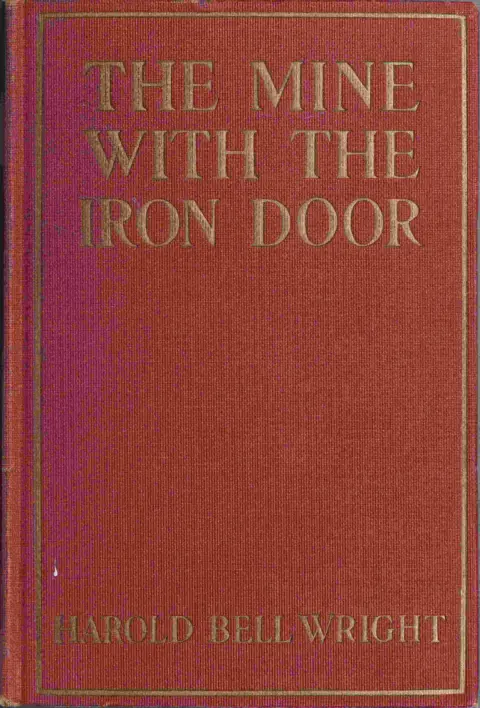
The Mine with the Iron Door
Harold Bell Wright
THE CLASSIC COLLECTION · 1921
"Helen of the Old House" by Harold Bell Wright is a novel written in the early 20th century. The story is set in the small manufacturing city of Millsburgh and revolves around the lives of its inhabitants, focusing on the contrast between the wealthy Mill owner Adam Ward and the struggling working-class families in the community. The characters, particularly Adam's daughter Helen and the children Bobby and Maggie Whaley, navigate themes of class struggle, happiness, and social responsibility against the backdrop of an industrialized society. The beginning of the novel introduces two children, Bobby and Maggie Whaley, who live in a poor community overshadowed by the Mill owned by Adam Ward. As they explore their environment, they come across a peculiar figure known as the Interpreter, who resides in a small hut on a cliff overlooking the Mill. The children, drawn by curiosity and the hope of adventure, climb to meet the Interpreter and are welcomed into his world filled with stories and kindness. Their initial joy is contrasted sharply with their subsequent encounter with Adam Ward, who harshly confronts them, revealing the depth of class divides and animosity that permeates their lives. The story sets the stage for deeper explorations of personal connections, societal roles, and the quest for happiness amidst adversity.
Introduction adapted from the source catalogue; source summaries may be automatically generated.
Free to read · English · 89,607 words · No account needed
MAKE TIME FOR A GOOD BOOK
On by default. Untick to stop anonymous reading totals. Each page counts after 10 seconds in view. How this works.
Anonymous counting is on unless you have switched it off.
The old basket maker, smiling down at her, answered, "Yes, dear, I have known your princess lady ever since she was a tiny baby--much smaller than you. And did you know, Maggie, that she was born in the old house down there, next door to Charlie and Mary Martin?"
"An'--an' did she live there when she was--when she was as big as me?"
Bobby interrupted with an important "Huh, I know her brother John is a boss in the Mill. He was in the war, too, with Captain Charlie. Did he live in the old house when he was a kid?"
"Yes."
"An'--an' when the princess lady was little like me, an' lived in the old house, did yer play with her?" asked Maggie.
The Interpreter laughed softly. "Yes, indeed, often. You see I worked in the Mill, too, in those days, Maggie, with her father and Peter Martin and--"
"That was when yer had yer real, sure-nuff legs, wasn't it?" the boy
interrupted.
"Yes, Bobby. And every Sunday, almost, I used to be at the old house where the little princess lady lived, or at the Martin home next door, and Helen and John and Charlie and Mary and I would always have such good times together."
Little Maggie's face shone with appreciative interest. "An' did yer tell them fairy stories sometimes?"
"Sometimes."
The little girl sighed and tried to get still closer to the man in the wheel chair. "I like fairies, don't yer?"
"Indeed, I do," he answered heartily.
"Skinny and Chuck, they said yer tol' them stories, too."
The Interpreter laughed quietly. "I expect perhaps I did."
"I don't suppose yer know any fairy stories right now, do yer?"
"Let me see," said the Interpreter, seeming to think very hard. "Why, yes, I believe I do know one. It starts out like this: Once upon a time there was a most beautiful princess, just like your princess lady, who lived in a most wonderful palace. Isn't that the way for a fairy story to begin?"
"Uh-huh, that's the way. An' then what happened?"
With a great show of indifference the boy drew near and stretched himself on the floor on the other side of the old basket maker's chair.
"Well, this beautiful princess in the story, perhaps because she was so beautiful herself, loved more than anything else in all the world to have lots and lots of jewels. You know what jewels are, don't you?"
"Uh-huh, the princess lady she has 'em--heaps of 'em. I seen her onct close, when she was a-gettin' into her autermobile, in front of one of them big stores."
Your reading position is saved on this browser. Take it to another device with a library code. Reading pages adapt to text, rather than matching a printed edition.
Harold Bell Wright
Harold Bell Wright
Harold Bell Wright
Harold Bell Wright
BEHIND THE BOOK
This eBook is for the use of anyone anywhere in the United States and most other parts of the world at no cost and with almost no restrictions whatsoever. You may copy it, give it away or re-use it under the terms of the Project Gutenberg License included with this eBook or online at www.gutenberg.org. If you are not located in the United States, you will have to check the laws of the country where you are located before using this eBook. Read the source licence.
The original source file, including credits and licence, is retained by this library. Request an original-format copy at no charge. Please include the book title and Project Gutenberg identifier #9410.
KEEP YOUR CURIOSITY GOING
Coulson Kernahan

Maurice Baring
Frances Wright
Cécile Tormay

Frederic Jesup Stimson

W. H. P. (William Henry Pope) Jarvis