
My study windows
James Russell Lowell

THE CLASSIC COLLECTION · 1888
"Heartsease and Rue" by James Russell Lowell is a collection of poems written in the late 19th century. The book explores a variety of themes including friendship, emotion, and the human experience, showcasing Lowell's lyrical style and keen observations. The poems likely reflect on relationships, personal sentiments, and philosophical musings, inviting readers to engage with the complexities of life and time. At the start of the collection, Lowell introduces the theme of friendship through a poignant elegy for the late scientist Louis Agassiz. The poem reflects on loss and mourning, conveying deep affection while capturing the essence of Agassiz's character and the impact he had on those around him. Lowell recalls vivid memories shared among friends, blending personal reflection with broader thoughts on life and death. The opening portion sets the tone for a series of heartfelt verses that navigate the intertwining paths of companionship and solitude.
Introduction adapted from the source catalogue; source summaries may be automatically generated.
Free to read · English · 31,127 words · No account needed
MAKE TIME FOR A GOOD BOOK
On by default. Untick to stop anonymous reading totals. Each page counts after 10 seconds in view. How this works.
Anonymous counting is on unless you have switched it off.
I don’t object, not I, to know
My sires were monkeys, if ’twas so;
I touch my ear’s collusive tip
And own the poor-relationship.
That apes of various shapes and sizes
Contained their germs that all the prizes
Of senate, pulpit, camp, and bar win
May give us hopes that sweeten Darwin.
Who knows but from our loins may spring
(Long hence) some winged sweet-throated thing
As much superior to us
As we to Cynocephalus?
This is consoling, but, alas,
It wipes no dimness from the glass
Where I am flattening my poor nose,
In hope to see beyond my toes.
Though I accept my pedigree,
Yet where, pray tell me, is the key
That should unlock a private door
To the Great Mystery, such no more?
Each offers his, but one nor all
Are much persuasive with the wall
That rises now, as long ago,
Between I wonder and I know,
Nor will vouchsafe a pin-hole peep
At the veiled Isis in its keep.
Where is no door, I but produce
My key to find it of no use.
Yet better keep it, after all,
Since Nature’s economical,
And who can tell but some fine day
(If it occur to her) she may,
In her good-will to you and me,
Make door and lock to match the key?
The world turns mild; democracy, they say,
Rounds the sharp knobs of character away,
And no great harm, unless at grave expense
Of what needs edge of proof, the moral sense;
For man or race is on the downward path
Whose fibre grows too soft for honest wrath,
And there’s a subtle influence that springs
From words to modify our sense of things.
A plain distinction grows obscure of late:
Man, if he will, may pardon; but the State
Forgets its function if not fixed as Fate.
So thought our sires: a hundred years ago,
If men were knaves, why, people called them so,
And crime could see the prison-portal bend
Its brow severe at no long vista’s end.
In those days for plain things plain words would serve;
Men had not learned, to admire the graceful swerve
Wherewith the Æsthetic Nature’s genial mood
Makes public duty slope to private good;
No muddled conscience raised the saving doubt;
A soldier proved unworthy was drummed out,
An officer cashiered, a civil servant
(No matter though his piety were fervent)
Disgracefully dismissed, and through the land
Each bore for life a stigma from the brand
Whose far-heard hiss made others more averse
To take the facile step from bad to worse.
The Ten Commandments had a meaning then,
Felt in their bones by least considerate men,
Because behind them Public Conscience stood,
And without wincing made their mandates good.
But now that “Statesmanship” is just a way
To dodge the primal curse and make it pay,
Since office means a kind of patent drill
To force an entrance to the Nation’s till,
And peculation something rather less
Risky than if you spelt it with an s;
Now that to steal by law is grown an art,
Whom rogues the sires, their milder sons call smart,
And “slightly irregular” dilutes the shame
Of what had once a somewhat blunter name,
With generous curve we draw the moral line:
Our swindlers are permitted to resign;
Their guilt is wrapped in deferential names,
And twenty sympathize for one that blames.
Add national disgrace to private crime,
Confront mankind with brazen front sublime,
Steal but enough, the world is unsevere,--
Tweed is a statesman, Fisk a financier;
Invent a mine, and be--the Lord knows what;
Secure, at any rate, with what you’ve got.
The public servant who has stolen or lied,
If called on, may resign with honest pride:
As unjust favor put him in, why doubt
Disfavor as unjust has turned him out?
Even if indicted, what is that but fudge
To him who counted-in the elective judge?
Whitewashed, he quits the politician’s strife
At ease in mind, with pockets filled for life:
His “lady” glares with gems whose vulgar blaze
The poor man through his heightened taxes pays,
Himself content if one huge Kohinoor
Bulge from a shirt-front ampler than before,
But not too candid, lest it haply tend
To rouse suspicion of the People’s Friend.
A public meeting, treated at his cost,
Resolves him back more virtue than he lost;
With character regilt he counts his gains;
What’s gone was air, the solid good remains;
For what is good, except what friend and foe
Seem quite unanimous in thinking so,
The stocks and bonds which, in our age of loans,
Replace the stupid pagan’s stocks and stones?
With choker white, wherein no cynic eye
Dares see idealized a hempen tie,
At parish-meetings he conducts in prayer,
And pays for missions to be sent elsewhere;
On ’Change respected, to his friends endeared,
Add but a Sunday-school-class, he’s revered,
And his too early tomb will not be dumb
To point a moral for our youth to come.
1872.
Your reading position is saved on this browser. Take it to another device with a library code. Reading pages adapt to text, rather than matching a printed edition.
James Russell Lowell
James Russell Lowell
James Russell Lowell
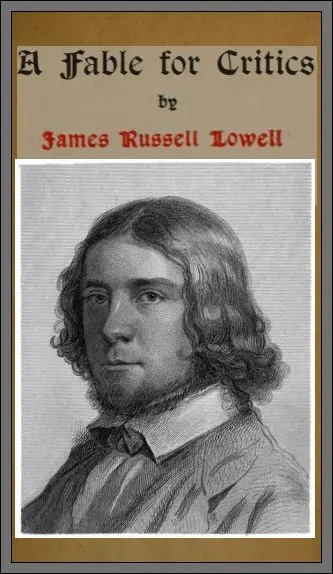
James Russell Lowell
BEHIND THE BOOK
This eBook is for the use of anyone anywhere in the United States and most other parts of the world at no cost and with almost no restrictions whatsoever. You may copy it, give it away or re-use it under the terms of the Project Gutenberg License included with this eBook or online at www.gutenberg.org. If you are not located in the United States, you will have to check the laws of the country where you are located before using this eBook. Read the source licence.
The original source file, including credits and licence, is retained by this library. Request an original-format copy at no charge. Please include the book title and Project Gutenberg identifier #68260.
KEEP YOUR CURIOSITY GOING

Eric Mackay
Edmund Gosse
Sophia Margaretta Hensley
Gilbert Parker
George MacDonald

Elizabeth Bibesco