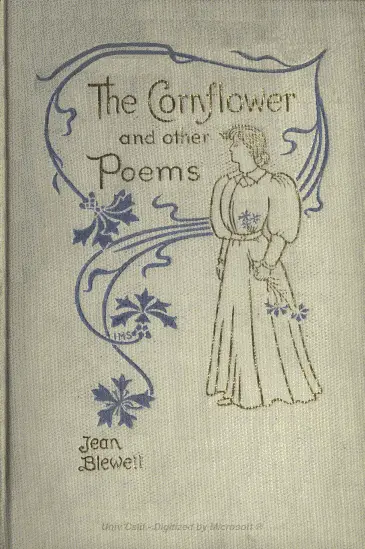
The Cornflower, and Other Poems
Jean Blewett
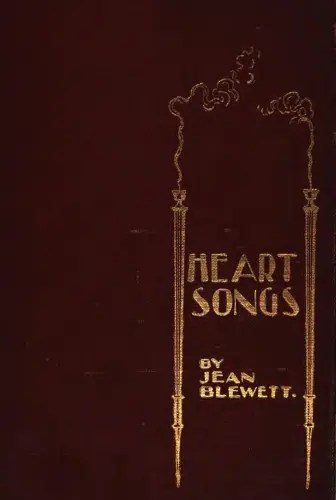
THE CLASSIC COLLECTION · 1897
"Heart Songs" by Jean Blewett is a collection of poems written in the late 19th century. The work explores themes of love, nature, and human experiences, often reflecting on the tender emotions associated with relationships and the passage of time. The poems are crafted with vivid imagery and a melodic quality that invites readers to immerse themselves in the sentiments expressed. The beginning of the collection sets the tone with lines that echo romantic longing and reflections on love. The poem “Wooing His Valentine” introduces a speaker who wishes to eloquently express affection but struggles with vulnerability, while “Jealous, Sweetheart?” captures the pangs of insecurity in romance. As the opening progresses, a narrative unfolds in “The Day Neil Rode to Mill,” depicting a young man's quest for a bride that intertwines family expectations with personal desires. The initial verses paint a rich tapestry of emotion and character, revealing both societal norms and individual passions as the speaker navigates the complexities of love.
Introduction adapted from the source catalogue; source summaries may be automatically generated.
Free to read · English · 37,725 words · No account needed
MAKE TIME FOR A GOOD BOOK
On by default. Untick to stop anonymous reading totals. Each page counts after 10 seconds in view. How this works.
Anonymous counting is on unless you have switched it off.
I’ve lost all this by my mistake,
I walked, you see, not circumspectly,
I pressed a claim for love’s sweet sake,
And friendship took to flight directly.
And I am left to think with pain
How folly caused my loss and sorrow,
Had I my friendship back again
I’d do the very same to-morrow.
The Grave
O the grave is a quiet place, my dear,
So still and so quiet by night and by day,
Reached by no sound either joyous or drear,
But keeping its silence alway, alway.
O the grave is a restful place, my dear,
Unvext by the weightiest loss or gain,
All the undone work of the speeding year
May beat at its portals in vain, in vain.
O the grave is a tender place, my dear,
The Love immortal, the faith, the trust,
The grace and the beauty, lie buried there,
So pure and so white in a robe of dust.
O the grave is a home-like place, my dear, Where we all do gather when day is done, Where the earth mother folds us close and near, And the latch-string waits for the laggard one.
Settled by Arbitration
The three sat at meat in a country inn,
And Patrick’s face wore an elegant grin,
For the Scotchman lean, and the Englishman stout
Were having a nice little quarrel out.
Now, it all begun when five times had gone
The glass and bottle to everyone,
The Englishman, he had a stubborn jaw
And could quote whole pages of English law,
While the Scotchman, was as stern and as gray
As the rocks of his country far away.
The bottle it made him but look more stern,
But the other one took a boasting turn,
He talked of their big brave ships on the sea,
Of their soldiers as brave as brave could be,
Of the English beef that no land could beat,
Of their puddings and pastries good to eat;
And the Scotchman listened to every word
And seemed agreeing with all that he heard,
Till the squared-jawed fellow by-and-by claimed
His country the wittiest ever named;
“The Henglish wit, sir, hit shines like the sun”
“Aye! the sun in a fog,” the other one,
Then the arguments flew so thick and fast--
They’d have come to blows ere the thing was past
Had not Patrick, good hearted, blithe and gay,
Chanced to travel with them that summer day,
“Now sure,” said he, “you know ’tis the fashion
To settle disputes by arbitration,
Faith, a rale ould shindy’s the thing for me,
But the rale ould shindy has ceased to be,
Let’s be the powers, and raison a bit,
Whist now! and ould Erin will settle it.”
Then these two disputants, they both agreed
To take his finding in word and deed.
“The English wit, sir--let’s take off our hats--
Can’t be seen by folks that are blind as bats,
’Tis none of your common everyday stuff,
Nor like that of Ireland, vulgar and bluff,
Sure, ’tis something I would only compare
To what is well known as precious and rare,
Say to the famous philosopher’s stone--
Or elixir of life to ould sages known;
No Irishman from the hill or the bog
Would say it was like the sun in a fog,
That statement, sirs, on the face is untrue
For sometimes the fog will let the sun through.”
One pacified man went off with good grace,
And Patrick laughed at the other’s stern face,
“You think me a blarney--hark, what I say,
I tould the truth in an iligant way,
Sure you know, and I know, and everyone,
The fable of the philosopher’s stone,
For stone, elixir, and Englishman’s wit
Men have searched long, and found nivir a bit,”
Then low to himself, “faith, that joke’s so clear
That even a Scotchman may see it--next year!”
Your reading position is saved on this browser. Take it to another device with a library code. Reading pages adapt to text, rather than matching a printed edition.
Jean Blewett
BEHIND THE BOOK
This eBook is for the use of anyone anywhere in the United States and most other parts of the world at no cost and with almost no restrictions whatsoever. You may copy it, give it away or re-use it under the terms of the Project Gutenberg License included with this eBook or online at www.gutenberg.org. If you are not located in the United States, you will have to check the laws of the country where you are located before using this eBook. Read the source licence.
The original source file, including credits and licence, is retained by this library. Request an original-format copy at no charge. Please include the book title and Project Gutenberg identifier #53824.
KEEP YOUR CURIOSITY GOING

Eric Mackay
Edmund Gosse
Sophia Margaretta Hensley
Gilbert Parker
George MacDonald

Elizabeth Bibesco