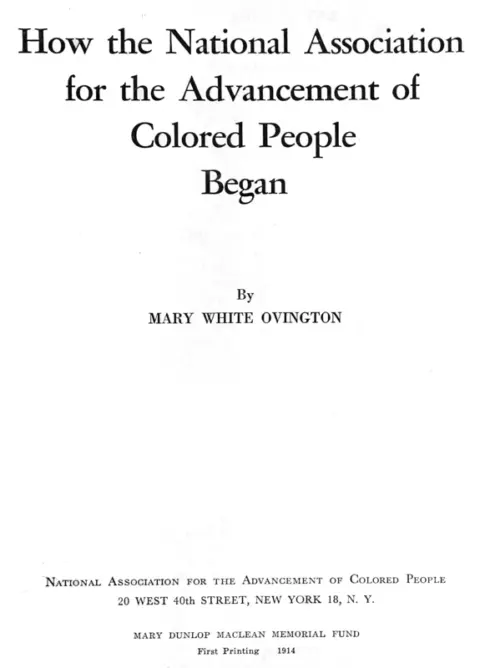
How the National Association for the Advancement of Colored People Began
Mary White Ovington
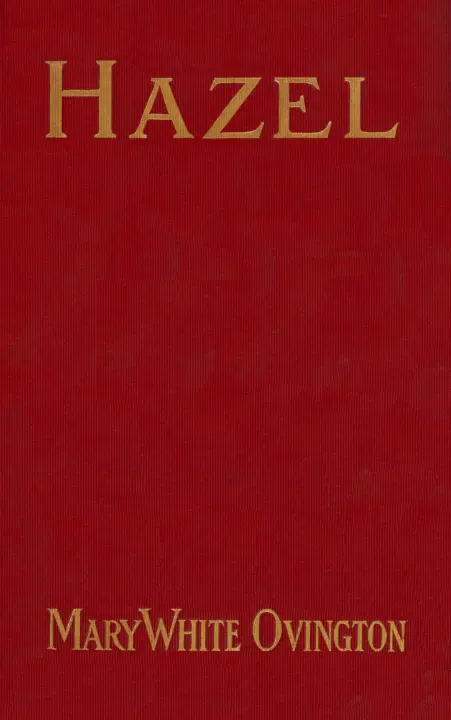
THE CLASSIC COLLECTION · 1913
"Hazel" by Mary White Ovington is a novel written in the early 20th century. The story revolves around Hazel Tyler, a young girl of color, who navigates her life in a racially divided society after moving from Boston to Alabama to live with her grandmother. The narrative explores themes of childhood innocence, race, and familial love as Hazel adjusts to her new environment while grappling with her identity. The opening portion of "Hazel" introduces us to the main character, a young girl named Hazel Tyler, who is stuck inside on a rainy day and longs for a more exciting life. As she interacts with her mother and peers, her thoughts reveal her preoccupations with clothes and the struggles of her family's financial situation following her father's death. We witness her imaginative play with a friend as they act out a Bible story, showcasing Hazel's creativity and her desire to escape reality. The contrasting dynamics of her home life, alongside her aspirations for a brighter future, set the stage for the broader journey Hazel will undertake as she moves to Alabama, leading to critical reflections on her place in a racially stratified society.
Introduction adapted from the source catalogue; source summaries may be automatically generated.
Free to read · English · 26,288 words · No account needed
MAKE TIME FOR A GOOD BOOK
On by default. Untick to stop anonymous reading totals. Each page counts after 10 seconds in view. How this works.
Anonymous counting is on unless you have switched it off.
He led her among the trees to a little enclosure. Small pines, not more than six feet high, made a natural hedge, and shut them out from the road below.
“How pretty,” cried Hazel. “It’s like a little house. Here, take the books, Scip, and I’ll decide what to do.”
He obediently held the books for her.
As she looked about among the pines a new idea came to her.
“We won’t call it school,” she declared. “We’ll play house. You and I will be brother and sister. We’ll play that I’ve had advantages, I’ve been North to school, and now I’ve come home. This will be our house and this,” tapping with her foot, “will be the parlor. We’ll sit down here and I’ll teach you.”
She took the books and papers from his hands and placed them on the ground. “I can sit down and lean against this tree and pretend I’m in a chair. Here is the paper and pencil. I haven’t a primer so I’ll start and print the letters. Sit down, Scip.”
He seated himself beside her.
“Do you know your alphabet?” she asked.
“I don’t rightly know whether I remember it all, ma’am.”
“You mustn’t say ma’am to me, I’m your sister.”
“No, ma’am.”
Hazel laughed. “You’re so funny, Scip. Now do you know what that letter is?” pointing to the first on his paper.
“Yes, Sister. That’s A.”
The little girl almost jumped at her new name. She did not know how common the appellation was in the South.
“And the next one, Scip?”
And so on. I and J proved stumbling blocks, but once passed the end was reached without further mistake.
“Now words,” said Hazel, turning from the alphabet, “are letters put together. Can you spell any words?”
“I can print my name.”
“Please do, then.”
Scipio took the pencil and laboriously printed S C I P I O L E E.
“The C isn’t pronounced,” Hazel said thoughtfully. “I guessed it was spelt SIPIO. You can never guess at spelling, though, it’s so queer.”
“It’s a fool name,” said Scip, moodily. “My pa and ma done give us all fool names but Tom.”
“I think Scipio was a Roman, and the Romans were very brave. You aren’t afraid of anything are you?”
“I’s afraid of my father.”
Hazel was silent. She felt very sorry for her new playmate.
“Shall we go on?” she said at length.
“Yes, ma’am.”
She let the “ma’am” pass, and began to teach again.
Your reading position is saved on this browser. Take it to another device with a library code. Reading pages adapt to text, rather than matching a printed edition.
Mary White Ovington
Mary White Ovington
Mary White Ovington
BEHIND THE BOOK
This eBook is for the use of anyone anywhere in the United States and most other parts of the world at no cost and with almost no restrictions whatsoever. You may copy it, give it away or re-use it under the terms of the Project Gutenberg License included with this eBook or online at www.gutenberg.org. If you are not located in the United States, you will have to check the laws of the country where you are located before using this eBook. Read the source licence.
The original source file, including credits and licence, is retained by this library. Request an original-format copy at no charge. Please include the book title and Project Gutenberg identifier #68017.
KEEP YOUR CURIOSITY GOING
Coulson Kernahan

Maurice Baring
Frances Wright
Cécile Tormay

Frederic Jesup Stimson

W. H. P. (William Henry Pope) Jarvis