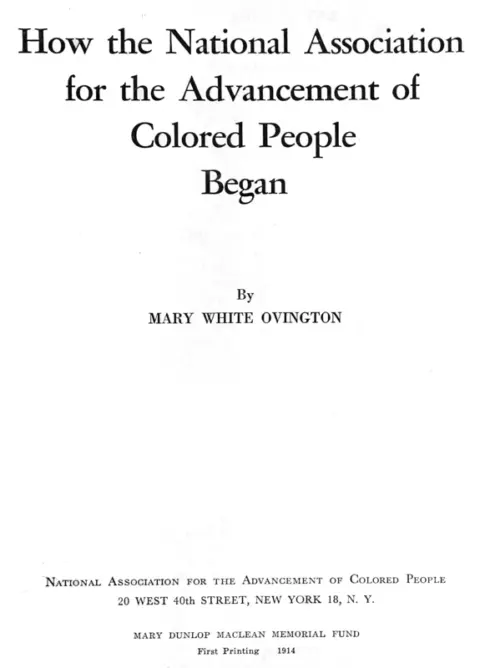
How the National Association for the Advancement of Colored People Began
Mary White Ovington
THE CLASSIC COLLECTION · 1913
"Hazel" by Mary White Ovington is a novel written in the early 20th century. The story revolves around Hazel Tyler, a young girl of color, who navigates her life in a racially divided society after moving from Boston to Alabama to live with her grandmother. The narrative explores themes of childhood innocence, race, and familial love as Hazel adjusts to her new environment while grappling with her identity. The opening portion of "Hazel" introduces us to the main character, a young girl named Hazel Tyler, who is stuck inside on a rainy day and longs for a more exciting life. As she interacts with her mother and peers, her thoughts reveal her preoccupations with clothes and the struggles of her family's financial situation following her father's death. We witness her imaginative play with a friend as they act out a Bible story, showcasing Hazel's creativity and her desire to escape reality. The contrasting dynamics of her home life, alongside her aspirations for a brighter future, set the stage for the broader journey Hazel will undertake as she moves to Alabama, leading to critical reflections on her place in a racially stratified society.
Introduction adapted from the source catalogue; source summaries may be automatically generated.
Free to read · English · 26,288 words · No account needed
MAKE TIME FOR A GOOD BOOK
On by default. Untick to stop anonymous reading totals. Each page counts after 10 seconds in view. How this works.
Anonymous counting is on unless you have switched it off.
“I’ll go into the parlor and make my picture-puzzle,” she said.
“That’s right, dear,” Mrs. Tyler answered.
The little girl worked for a time at the elaborate puzzle spread out on the parlor table; but its green trees were perplexing, and she soon returned to the kitchen to find the pink dress finished and on the top of a pile of speckless linen in the laundry basket. Her mother stood with hat and coat on.
“I’m going to run out to make sure that John comes to-night to get the clothes,” Mrs. Tyler said. “Now, don’t look so woe-begone, dear. I’ll cook waffles for supper, and we’ll have the maple syrup that Mrs. Brown brought us from the country.”
Hazel’s face brightened. “May we eat off the pretty china?” she asked.
“Yes, you may set the table with it when I get back.” And Mrs. Tyler went out into the narrow hall, down the dark stairs and into the narrow street.
She could hardly have reached the corner when Hazel heard a knock at the door, and opened it to a little black girl who at once stepped gaily into the room.
“Where you been all day, Hazel?” she asked.
She was a jolly little girl of ten, a year younger than Hazel, with plump arms and legs and a sturdy body. Her crinkly hair was tied with a bright red ribbon, and she wore a gay bandanna about her neck. Her black eyes shone with good will.
“How do you do, Charity?” Hazel said, a little hesitatingly.
She liked this new neighbor and had played with her the rare afternoons that she had been allowed on the street; but she knew her mother scarcely approved of Charity. But then her mother did not approve of any of the girls and boys on Hammond Street and one must play with some one.
“Your mother’s out,” said Charity. “I know, for I saw her go. Where you been all day, Hazel?”
“Here at home,” Hazel answered. “I’ve got a sore throat, and I’m not allowed to go out, and there’s nothing to do in this poky place.”
“Let’s play,” said Charity, “you shut your eyes and I’ll hide.”
“Pooh,” Hazel replied contemptuously, “you know, Charity, there isn’t a single place here big enough for a cat to hide in.”
“Well, let’s, let’s,” Charity looked about for inspiration, and her glance fell on the doll in the adjoining room, “let’s play house.”
“No, you would just beat the baby. Let’s play a new game, something brand new that we never played before.”
Your reading position is saved on this browser. Take it to another device with a library code. Reading pages adapt to text, rather than matching a printed edition.
Mary White Ovington
Mary White Ovington
Mary White Ovington
BEHIND THE BOOK
This eBook is for the use of anyone anywhere in the United States and most other parts of the world at no cost and with almost no restrictions whatsoever. You may copy it, give it away or re-use it under the terms of the Project Gutenberg License included with this eBook or online at www.gutenberg.org. If you are not located in the United States, you will have to check the laws of the country where you are located before using this eBook. Read the source licence.
The original source file, including credits and licence, is retained by this library. Request an original-format copy at no charge. Please include the book title and Project Gutenberg identifier #68017.
KEEP YOUR CURIOSITY GOING
Coulson Kernahan

Maurice Baring
Frances Wright
Cécile Tormay

Frederic Jesup Stimson

W. H. P. (William Henry Pope) Jarvis