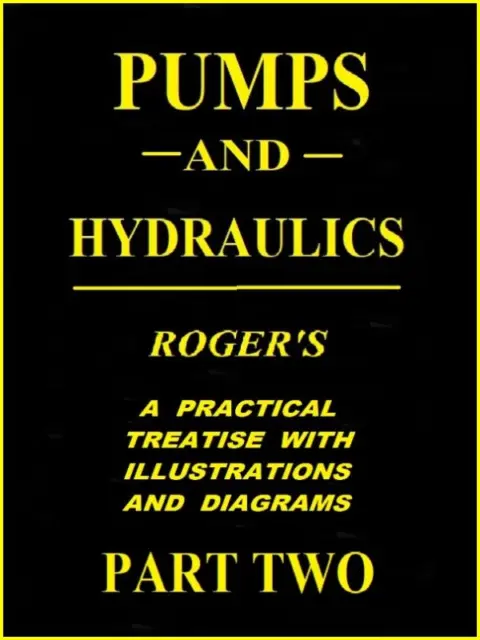
Pumps and Hydraulics, Part 2 (of 2)
N. (Nehemiah) Hawkins
THE CLASSIC COLLECTION · 1915
"Hawkins Electrical Guide v. 07 (of 10)" by N. Hawkins is a technical engineering book first published in 1914. This volume is part of a groundbreaking series designed to demystify electricity's complex principles for everyday readers. Notable for its extensive detailed illustrations, the guide made cutting-edge electrical technology accessible to common people. Published by Theodore Audel & Company—actually Hawkins himself under a pseudonym—the work's visual content influenced technical publications for decades to come.
Introduction adapted from the source catalogue; source summaries may be automatically generated.
Free to read · English · 69,705 words · No account needed
MAKE TIME FOR A GOOD BOOK
On by default. Untick to stop anonymous reading totals. Each page counts after 10 seconds in view. How this works.
Anonymous counting is on unless you have switched it off.
If the medium resistance cannot discharge the lightning, the gap GM spark, and the discharge is limited only by the low resistance.
The low resistance should take care of most cases but with extraordinarily heavy strokes and high frequencies, the discharge can ~break back~ far enough to cut out all resistance.
In the last steps, the resistance is relatively low in proportion to the number of shunt gaps, GL, and is designed to cut out the line current immediately from the gap, GL. This "breaking back" effect is valuable in discharging lightning of low frequency.
After the spark passes, the arcs are extinguished in the reversed order. The low resistance, L, is proportioned so as to draw the arcs immediately from the gaps, GL. The line current continues in the next group of gaps, GM, until the end of the half cycle of the generator wave.
At this instant the medium resistance, M, aids the rectifying quality of the gaps, GM, by shunting out the low frequency current of the alternator.
On account of this shunting effect the current dies out sooner in the gaps, GM, than it otherwise would.
In the same manner, but to a less degree, the high resistance, H, draws the line current from the gaps, GH.
This current now being limited by the high resistance, the arc is easily extinguished at the end of the first one-half cycle of the alternator wave.
~Ques. What is the difference between arrester for grounded Y and
non-grounded neutral systems?~
Ans. The connections are shown in figs. 2,365 and 2,366. The difference in design lies in the use of a fourth arrester leg between the multiplex connection and ground or ungrounded system.
~Ques. Why is the fourth leg introduced?~
Ans. The arrester is designed to have two legs between line and line. If one line become accidentally grounded, the full line voltage would be thrown across one leg if the fourth or ground leg were not present.
On a ~Y~ system with a grounded neutral, the accidentally grounded phase causes a short circuit of the phase and the arrester is relieved of the strain by the tripping of the circuit breaker. Briefly stated, the fourth or ground leg of the arrester is used when, for any reason, the system could be operated, even for a short time with one phase grounded.
~Ques. Describe the multiplex connection.~
Ans. It consists of a common connection between the phase legs of the arrester above the earth connection and provides an arrester better adapted to relieve high pressure surges between lines than would otherwise be possible.
Its use also economizes in space and material for delta and partially grounded or non-grounded ~Y~ systems.
Your reading position is saved on this browser. Take it to another device with a library code. Reading pages adapt to text, rather than matching a printed edition.
N. (Nehemiah) Hawkins
N. (Nehemiah) Hawkins
N. (Nehemiah) Hawkins
N. (Nehemiah) Hawkins
BEHIND THE BOOK
This eBook is for the use of anyone anywhere in the United States and most other parts of the world at no cost and with almost no restrictions whatsoever. You may copy it, give it away or re-use it under the terms of the Project Gutenberg License included with this eBook or online at www.gutenberg.org. If you are not located in the United States, you will have to check the laws of the country where you are located before using this eBook. Read the source licence.
The original source file, including credits and licence, is retained by this library. Request an original-format copy at no charge. Please include the book title and Project Gutenberg identifier #49253.
KEEP YOUR CURIOSITY GOING

Charles G. (Charles Griffith) Ross
Hannah Webster Foster

Emily Lawless
Edwin Hamlin Carr

Charles De Lano Hine
Andrew Ure