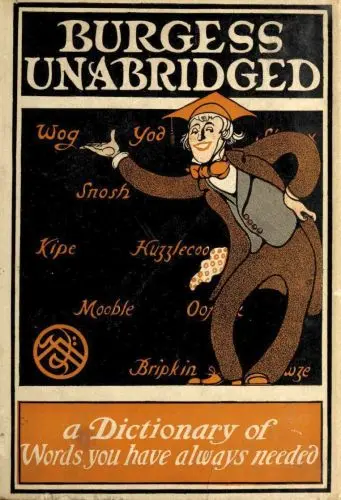
Burgess Unabridged: A new dictionary of words you have always needed
Gelett Burgess
THE CLASSIC COLLECTION · 1923
"Have you an educated heart?" by Gelett Burgess is a philosophical treatise exploring the nuances of kindness and emotional intelligence, written in the early 20th century. Through a mixture of narrative and reflection, the book seeks to define and illustrate the concept of the "Educated Heart," a metaphor for those who possess a refined sensibility in their interactions with others. The text examines the importance of thoughtfulness, consideration, and genuine kindness in human relationships. In the book, the protagonist shares poignant anecdotes involving friends and acquaintances who exemplify or lack the qualities of the Educated Heart. Through dialogues, personal observations, and humorous critiques, Burgess elucidates how true kindness involves not merely the act of giving or acknowledging gifts but also understanding the recipient's feelings and needs. The narrative emphasizes the significance of style in kindness—how the manner and intention behind our actions can mark the difference between simple politeness and the deeper connection fostered by an Educated Heart. Ultimately, it prompts readers to reflect on their own emotional capabilities while advocating for a more compassionate and perceptive approach to interpersonal relationships.
Introduction adapted from the source catalogue; source summaries may be automatically generated.
Free to read · English · 7,254 words · No account needed
MAKE TIME FOR A GOOD BOOK
On by default. Untick to stop anonymous reading totals. Each page counts after 10 seconds in view. How this works.
Anonymous counting is on unless you have switched it off.
ASK any invalid. Ask poor Luraine. “I’m afraid I’ll have to wear glasses,” wept poor Luraine, after that accident when her eye was injured. “Well, my dear,” said her would-be comforter, “I do hope you’ll get some of those smart tortoiseshell goggles--they’re so becoming!” And that, ladies and gentlemen, is what often passes for sympathy.
Ask any partially deaf person who is the cruellest of her would-be friends. Isn’t it that kind and thoughtless one who says, so sweetly: “Why, I think you get along awfully well, you know. Really no one would ever know you can’t hear!” No one but the Educated Heart ever knows or cares for the tearful nights of wild revolt, the days and years of stoic suffering that remain, just the same. Yes, just the same.
BUT let’s pass, now, to the last cage in our menagerie. Here’s a dangerous galravaging beast--one of those terrible creatures who “mean well,” even while they rend you. One historic remark of this emotional reptile there is, that in the annals of mental torture, surpasses in heartlessness all other expressions of good intent. Oh, I have said it--you have, too, I suppose. May God forgive us both, for there are those who never, never will!
Galna it was who has dramatized it for me best. A dreadful suicide it was, no horror lacking. Galna, alone in the house--alone, save for her maid and that shocking wreck of one she had loved. And in her anguish, her despair, her bewilderment, the telephone bell rang. Lo, Mrs. Spick, kind, effusive Mrs. Spick, had rung her up to coo conventional condolence.
“And now, if there is anything I can do, Galna,” she concluded, “be sure and let me know!”
Ah, my friend, sometime you, too, must have suffered--suffered and known not where to turn; and, as sure as most hearts, alas, are ignorant, sometime you, too, must have heard that frightful phrase-- that mockery of friendship. The very epitaph it is upon the grave of affection: “If there is anything I can do, be sure and let me know!”
But as Galna, dazed, lonely, aching, staggered back to her room, behold, upon her bed she saw an unfamiliar thing. Tear-blinded, she groped for it. A hundred-dollar bill!
“Why, where did this come from?” she asked, wondering.
“Oh, Miss Felice left it there,” said her maid, “she thought perhaps you might happen to be short of money.”
“Felice?”
“Yes, she’s downstairs now, helping wash the dishes and putting the parlor to rights, and sending telegrams.”
Your reading position is saved on this browser. Take it to another device with a library code. Reading pages adapt to text, rather than matching a printed edition.
Gelett Burgess

Gelett Burgess & Will Irwin
Gelett Burgess
Gelett Burgess
BEHIND THE BOOK
This eBook is for the use of anyone anywhere in the United States and most other parts of the world at no cost and with almost no restrictions whatsoever. You may copy it, give it away or re-use it under the terms of the Project Gutenberg License included with this eBook or online at www.gutenberg.org. If you are not located in the United States, you will have to check the laws of the country where you are located before using this eBook. Read the source licence.
The original source file, including credits and licence, is retained by this library. Request an original-format copy at no charge. Please include the book title and Project Gutenberg identifier #69614.
KEEP YOUR CURIOSITY GOING

David Patterson (Spirit) Hatch
Coulson Kernahan

Ralph Waldo Emerson
Frances Wright

Edwin Abbott Abbott

Joseph Droz