THE CLASSIC COLLECTION✦An outlaw’s diary: the CommuneCLASSIC FREE BOOKS
An outlaw’s diary: the Commune
Cécile Tormay
THE CLASSIC COLLECTION · 1915
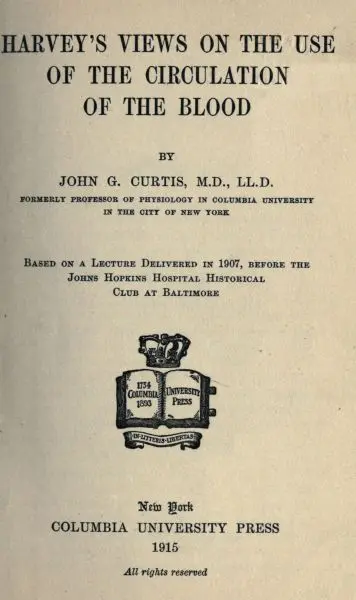
"Harvey's Views on the Use of the Circulation of the Blood" by John G. Curtis is a scientific publication written in the early 20th century. The work delves into the contributions of William Harvey, a pioneering figure in physiology known for his discovery of the circulation of blood. Curtis explores Harvey's ideas, contextualizing them within the framework of ancient Greek philosophy and the medical knowledge of his time. The opening of the book sets the stage for a detailed examination of Harvey's formative years and the impact of his education at the University of Padua. Curtis vividly describes the Anatomical Theater where Harvey studied, emphasizing the contrast between the prevailing Galenic doctrines and Harvey's revolutionary approach to physiology. The narrative introduces Harvey's legacy as more than just a discoverer of blood circulation; it presents him as a thinker who wrestled with the philosophical underpinnings of his findings, drawing connections between ancient thought and his own groundbreaking observations.
Introduction adapted from the source catalogue; source summaries may be automatically generated.
Free to read · English · 59,929 words · No account needed
MAKE TIME FOR A GOOD BOOK
On by default. Untick to stop anonymous reading totals. Each page counts after 10 seconds in view. How this works.
Anonymous counting is on unless you have switched it off.
Spirits, 20, 23, 127, 147, 148;
and air, Harvey, on, 29;
animal, 22, 25, 127;
Aristotle's view of, 21;
and blood, 117, 120, 127, 133;
Columbus on, 27, 30;
Erasistratus's view of, 21;
Galen's view of, 22, 27;
Harvey's view of, 28, 31, 33, 127;
Hippocrates's view of, 20;
and innate heat, 126, 129;
natural, 25, 27;
and nervous system, 31;
psychical, 23;
in semen, 119, 128, 140, 148;
vital, 22, 24, 27.
Spiritus, 20, 147.
Spontaneous generation, 143, 145, 152.
Sun and fire, 150.
Sun and generation, 145, 151.
Taenia, 42.
Thales, 111.
Tissues, feeding of, and circulation, 7.
Torricelli, Evangelista, 96.
Tricuspid valve, 55.
Universe of Aristotle, 121.
Uranus, 149.
Valves of heart, 15, 16, 55, 58, 62.
Veins, arising in liver, 56, 60;
flow in, 9, 95, 100.
Vena cava, as distributer of blood, 55;
Galen's view of, 56.
Venous artery, 30, 57.
Vesalius, 118;
on pores of septum, 27.
Vital spirits, 22, 24, 27.
Wind-egg, 135, 145, 151.
Columbia University in the City of New York
The Press was incorporated June 8, 1893, to promote the publication of the results of original research. It is a private corporation, related directly to Columbia University by the provisions that its Trustees shall be officers of the University and that the President of Columbia University shall be President of the Press.
The publications of the Columbia University Press include works on Biography, History, Economics, Education, Philosophy, Linguistics, and Literature, and the following series:
Columbia University Contributions to Anthropology. Columbia University Biological Series. Columbia University Studies in Cancer and Allied Subjects. Columbia University Studies in Classical Philology. Columbia University Studies in Comparative Literature. Columbia University Studies in English. Columbia University Geological Series. Columbia University Germanic Studies. Columbia University Indo-Iranian Series. Columbia University Contributions to Oriental History and Philology. Columbia University Oriental Studies. Columbia University Studies in Romance Philology and Literature. Records of Civilization: Sources and Studies.
Adams Lectures.
Julius Beer Lectures.
Blumenthal Lectures.
Carpentier Lectures.
Hewitt Lectures.
Jesup Lectures.
Catalogues will be sent free on application.
Columbia University in the City of New York
GRAPHICAL METHODS. By CARL RUNGE, Ph.D., Professor of Applied Mathematics in the University of Göttingen; Kaiser Wilhelm Professor of German History and Institutions for the year 1909-1910. 8vo, cloth, pp. ix + 148. Price, $1.50 net.
SOCIAL EVOLUTION AND POLITICAL THEORY. By LEONARD T. HOBHOUSE, Professor of Sociology in the University of London. 12mo, cloth, pp. ix + 218. Price, $1.50 net.
POLITICAL PROBLEMS OF AMERICAN DEVELOPMENT. By ALBERT SHAW, LL.D., Editor of the Review of Reviews. 12mo, cloth, pp. vii + 268. Price, $1.50 net.
CONSTITUTIONAL GOVERNMENT IN THE UNITED STATES. By WOODROW WILSON, LL.D., sometime President of Princeton University. 12mo, cloth, pp. vii + 236. Price, $1.50 net.
THE PRINCIPLES OF POLITICS FROM THE VIEWPOINT OF THE AMERICAN CITIZEN. By JEREMIAH W. JENKS, LL.D., Professor of Government and Public Administration in New York University. 12mo, cloth, pp. xviii + 187. Price, $1.50 net.
THE COST OF OUR NATIONAL GOVERNMENT. By HENRY JONES FORD, Professor of Politics in Princeton University. 12mo, cloth, pp. xv + 147. Price, $1.50 net.
Your reading position is saved on this browser. Take it to another device with a library code. Reading pages adapt to text, rather than matching a printed edition.
BEHIND THE BOOK
This eBook is for the use of anyone anywhere in the United States and most other parts of the world at no cost and with almost no restrictions whatsoever. You may copy it, give it away or re-use it under the terms of the Project Gutenberg License included with this eBook or online at www.gutenberg.org. If you are not located in the United States, you will have to check the laws of the country where you are located before using this eBook. Read the source licence.
The original source file, including credits and licence, is retained by this library. Request an original-format copy at no charge. Please include the book title and Project Gutenberg identifier #47448.
KEEP YOUR CURIOSITY GOING
Cécile Tormay

Moritz Busch
John L. Ransom
Frances Wright
Cécile Tormay

Mabel Potter Daggett