THE CLASSIC COLLECTION✦An outlaw’s diary: the CommuneCLASSIC FREE BOOKS
An outlaw’s diary: the Commune
Cécile Tormay
THE CLASSIC COLLECTION · 1915
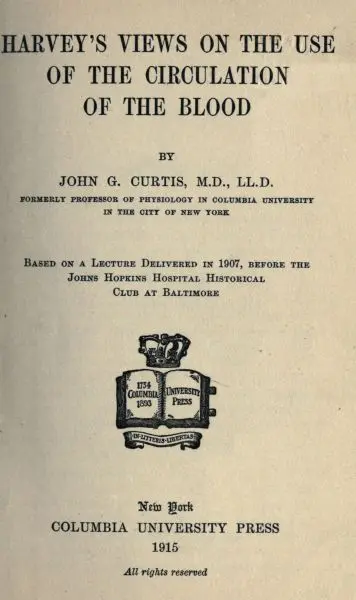
"Harvey's Views on the Use of the Circulation of the Blood" by John G. Curtis is a scientific publication written in the early 20th century. The work delves into the contributions of William Harvey, a pioneering figure in physiology known for his discovery of the circulation of blood. Curtis explores Harvey's ideas, contextualizing them within the framework of ancient Greek philosophy and the medical knowledge of his time. The opening of the book sets the stage for a detailed examination of Harvey's formative years and the impact of his education at the University of Padua. Curtis vividly describes the Anatomical Theater where Harvey studied, emphasizing the contrast between the prevailing Galenic doctrines and Harvey's revolutionary approach to physiology. The narrative introduces Harvey's legacy as more than just a discoverer of blood circulation; it presents him as a thinker who wrestled with the philosophical underpinnings of his findings, drawing connections between ancient thought and his own groundbreaking observations.
Introduction adapted from the source catalogue; source summaries may be automatically generated.
Free to read · English · 59,929 words · No account needed
MAKE TIME FOR A GOOD BOOK
On by default. Untick to stop anonymous reading totals. Each page counts after 10 seconds in view. How this works.
Anonymous counting is on unless you have switched it off.
[324] Aristotle: On the Generation of Animals, 736b, 33 to 737a, 7. In translating into English the foregoing Aristotelian passages the present writer has sought rather to indicate than to smooth away the ruggedness of the original Greek. Harvey quotes these passages verbatim from a Latin translation which may be found in Volume III of the Berlin Academy's quarto edition of Aristotle's works. This translation was made in the fifteenth century by Theodore Gaza, a learned Greek of Thessalonica, who had fled from the conquering Turks to Italy, where he learned Latin not long before his thirtieth year. Gaza was neither physician nor biologist. In view of these facts we need not wonder that his Latin version of Aristotle On the Generation of Animals is occasionally unsatisfactory, as we have seen. In the edition of the Greek text of Aristotle's History of Animals, published by Teubner in 1907 (Aristotelis De Animalibus Historia, textum recognovit Leonardus Dittmeyer, 1907, Leipsic, p. XXII, l. 1-5), the editor says in his Latin preface, regarding Gaza's Latin Translation of the History of Animals: "There is need of caution, if we wish to unearth the Greek text from his interpretation."
[325] Respondens, not proportione respondens.
[326] Harvey: On Generation, LXXI, Syd. 505, l. 18 to 506, l. 16; Op. Omn. 526, l. 20 to 527, l. 20.
[327] Harvey: On Generation, LXXI, Syd. 508, l. 22-38; Op. Omn. 529,
l. 24 to 530, l. 5.
[328] The sources, contained in Aristotle's own works, of the foregoing brief sketch of his conception of the universe, are as follows: On Heaven, the whole of the treatise; On Generation and Corruption, the whole of the treatise; Physics, Book IV, chapter 14, 223b, 15 to 224a, 2; Meteorology, Book I, chapters 1, 2, 3, and 9; Metaphysics, Book XI, chapter 7, 1072b, 28-30, and chapter 8; Nicomachean Ethics, Book VI, chapter 7, 1141a, 33 to b, 2; On the Parts of Animals, Book I, chapters 4 and 5, 644b, 20-25; Book II, chapter 10, 656a, 3-8; On the Generation of Animals, Book IV, chapter 10. The treatise entitled "On the Universe: To Alexander," is not a genuine work of Aristotle. See V. Rose: De Aristotelis Librorum Ordine et Auctoritate, 90-100. Besides the foregoing Aristotelian texts, see Prantl's note, number 37, on pages 303-307 of his edition of Aristotle's treatise On Heaven and On Generation and Corruption, and the references to other writers contained in the said note.
[329] Aristotle: On Heaven, 269a, 5-7.
[330] Aristotle: Meteorology, 339b, 25-26.
[331] Aristotle: On Heaven, 269a, 30-32.
[332] Aristotle: On Heaven, 269b, 15-17.
[333] Aristotle: On Heaven, 270b, 1-5 and 20-24. Aristotle accepts the derivation of αἱθέρα from ἀεὶ θεῖν. Modern philology rejects this.
[334] Aristotle: Meteorology, 339b, 17-19.
[335] Aristotle: On Heaven, 289a, 13-16.
[336] Milton: Paradise Lost, III, l. 716-721.
[337] See pp. 119-121.
[338] Aristotle: Physics, 194b, 13.
Your reading position is saved on this browser. Take it to another device with a library code. Reading pages adapt to text, rather than matching a printed edition.
BEHIND THE BOOK
This eBook is for the use of anyone anywhere in the United States and most other parts of the world at no cost and with almost no restrictions whatsoever. You may copy it, give it away or re-use it under the terms of the Project Gutenberg License included with this eBook or online at www.gutenberg.org. If you are not located in the United States, you will have to check the laws of the country where you are located before using this eBook. Read the source licence.
The original source file, including credits and licence, is retained by this library. Request an original-format copy at no charge. Please include the book title and Project Gutenberg identifier #47448.
KEEP YOUR CURIOSITY GOING
Cécile Tormay

Moritz Busch
John L. Ransom
Frances Wright
Cécile Tormay

Mabel Potter Daggett