THE CLASSIC COLLECTION✦An outlaw’s diary: the CommuneCLASSIC FREE BOOKS
An outlaw’s diary: the Commune
Cécile Tormay
THE CLASSIC COLLECTION · 1915
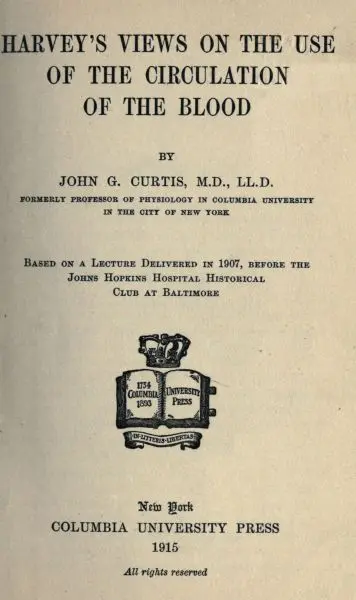
"Harvey's Views on the Use of the Circulation of the Blood" by John G. Curtis is a scientific publication written in the early 20th century. The work delves into the contributions of William Harvey, a pioneering figure in physiology known for his discovery of the circulation of blood. Curtis explores Harvey's ideas, contextualizing them within the framework of ancient Greek philosophy and the medical knowledge of his time. The opening of the book sets the stage for a detailed examination of Harvey's formative years and the impact of his education at the University of Padua. Curtis vividly describes the Anatomical Theater where Harvey studied, emphasizing the contrast between the prevailing Galenic doctrines and Harvey's revolutionary approach to physiology. The narrative introduces Harvey's legacy as more than just a discoverer of blood circulation; it presents him as a thinker who wrestled with the philosophical underpinnings of his findings, drawing connections between ancient thought and his own groundbreaking observations.
Introduction adapted from the source catalogue; source summaries may be automatically generated.
Free to read · English · 59,929 words · No account needed
MAKE TIME FOR A GOOD BOOK
On by default. Untick to stop anonymous reading totals. Each page counts after 10 seconds in view. How this works.
Anonymous counting is on unless you have switched it off.
[264] Declinante sponte sanguine et, venarum motu, compresso ad centrum. Harvey: On the Motion, etc., IV, Syd. 27, l. 33-35; Op. Omn. 29, l. 19-21.
[265] Malpighi: Letter II Regarding the Lungs, Bologna, 1661. Marcelli Malpighii Opera Omnia, Leyden, 1687, Vol. II, 328.
[266] Harvey: Exercise to Riolanus, I, Syd. 96, l. 37 to 97, l. 13; Op. Omn. 99, l. 2-15. The term "circulatory vessels" is one repeated by Harvey from Riolanus, whose views he is here refuting. Riolanus speaks of the region outside the liver, to which the branches of the portal vein are distributed, as the "first region." The "second and third regions" appear to comprise all the rest of the body. See Harvey: Exercise to Riolanus, I, Syd. 90, l. 30 to 91, l. 23; Op. Omn. 92, l. 21 to 93, l. 18. See also Joannes Riolanus, Filius: Encheiridium Anatomicum et Pathologicum, 154, l. 1-13; 155, l. 17 to 156, l. 17; 297, l. 7-17.
[267] Quibus absorptus et exhaustus traducitur. Harvey: Exercise
to Riolanus, II, Syd. 133, l. 30-39; Op. Omn. 133, l. 25 to 134, l.
1.
[268] In sinistri ventriculi locum. Harvey: On the Motion, etc., VII, Syd. 45, l. 5-9; Op. Omn. 47, l. 7-10.
[269] Harvey: Exercise to Riolanus, II, Syd. 133, l. 3-6; Op. Omn.
132, l. 30 to 133, l. 2.
[270] Harvey: Prelectiones, 86 left, l. 30-32.
[271] Harvey: Prelectiones, 33 left, l. 31.
[272] Shakspere: Hamlet, Act I, Scene IV, l. 70-73.
[273] ἀύτη γὰρ ὀυσία ὀφθαλμοῦ ἡ κατὰ τὸν λόγον.
[274] κίνησις. Cf. p. 52.
[275] δύναμις.
[276] ὅτι ἐστὶν ἡ ψυχὴ τῶν ἐιρημένων τούτων ἀρχὴ καὶ τούτοις ὥρισται.
[277] θρεπτικῷ, ἀισθωτικῷ, διανοητικῷ, κινήσει.
[278] The foregoing passages from Aristotle's treatise On Soul occur respectively as follows: 412a, 14-15; 414a, 12-14; 412b, 18-22; 413a, 26; 413a, 31; 413a, 20-26; 413a, 31 to b, 16.
[279] ὀυθὲν γὰρ ἀυτοῦ τῇ ἐνεργείᾳ κοινωνεῖ [σωματικὴ ἐνέργια.]
[280] Aristotle: On the Generation of Animals, 736a, 24 to 737b,
7. The quoted passage is 736b, 28-29. Compare On Soul, 413b,
24-29.
It was not Greek philosophy alone in which in ancient times the word corresponding to "soul" was used in a wider sense than that of the quotation from "Hamlet." In the English Authorized Version of the Old Testament, first published in 1611, we read in Genesis II, 7: "Man became a living soul." The reading is the same in the Revised Version of 1885. In Genesis I, 30, we read in both versions: "And to every beast of the earth, and to every fowl of the air, and to every thing that creepeth upon the earth, wherein there is life, I have given every green herb for meat." In both versions it is noted in the margin that the expression translated by the single English word "life" is, in the Hebrew, "a living soul." Accordingly we find this Hebrew expression of Genesis I, 30, rendered "a soul of life"--ψυχὴν ζωῆς,--in the ancient translation of the Old Testament into Greek, known as the "Septuagint," which was probably completed less than two hundred years after the death of Aristotle and more than one hundred and fifty years before the Christian era. In the early Latin translation of the Scriptures which was finished in A.D. 405, and is largely embodied in the "Vulgate" of to-day, we read in the same verse--Genesis I, 30, "anima viviens"--"a living soul." In Genesis II, 7, where the reference is to man himself and the English Bible reads "a living soul," the Vulgate reads "animam viventem," using the same Latin words as for the lower creatures of I, 30. In like manner the Septuagint reads in Genesis II, 7, ψυχὴν ζῶσαν, as it reads in I, 30, ψυχὴν ζωῆς. Other instances from the Book of Genesis could be cited of the wide significance given therein to the expression which corresponds to "soul."
Your reading position is saved on this browser. Take it to another device with a library code. Reading pages adapt to text, rather than matching a printed edition.
BEHIND THE BOOK
This eBook is for the use of anyone anywhere in the United States and most other parts of the world at no cost and with almost no restrictions whatsoever. You may copy it, give it away or re-use it under the terms of the Project Gutenberg License included with this eBook or online at www.gutenberg.org. If you are not located in the United States, you will have to check the laws of the country where you are located before using this eBook. Read the source licence.
The original source file, including credits and licence, is retained by this library. Request an original-format copy at no charge. Please include the book title and Project Gutenberg identifier #47448.
KEEP YOUR CURIOSITY GOING
Cécile Tormay

Moritz Busch
John L. Ransom
Frances Wright
Cécile Tormay

Mabel Potter Daggett