THE CLASSIC COLLECTION✦An outlaw’s diary: the CommuneCLASSIC FREE BOOKS
An outlaw’s diary: the Commune
Cécile Tormay
THE CLASSIC COLLECTION · 1915
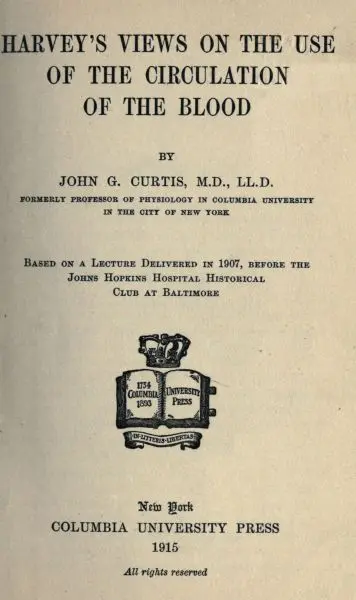
"Harvey's Views on the Use of the Circulation of the Blood" by John G. Curtis is a scientific publication written in the early 20th century. The work delves into the contributions of William Harvey, a pioneering figure in physiology known for his discovery of the circulation of blood. Curtis explores Harvey's ideas, contextualizing them within the framework of ancient Greek philosophy and the medical knowledge of his time. The opening of the book sets the stage for a detailed examination of Harvey's formative years and the impact of his education at the University of Padua. Curtis vividly describes the Anatomical Theater where Harvey studied, emphasizing the contrast between the prevailing Galenic doctrines and Harvey's revolutionary approach to physiology. The narrative introduces Harvey's legacy as more than just a discoverer of blood circulation; it presents him as a thinker who wrestled with the philosophical underpinnings of his findings, drawing connections between ancient thought and his own groundbreaking observations.
Introduction adapted from the source catalogue; source summaries may be automatically generated.
Free to read · English · 59,929 words · No account needed
MAKE TIME FOR A GOOD BOOK
On by default. Untick to stop anonymous reading totals. Each page counts after 10 seconds in view. How this works.
Anonymous counting is on unless you have switched it off.
[123] Hippocrates: On the Nature of the Child, Lit. Vol. VII, 530,
l. 3-19.
[124] Aristotle: History of Animals, 561a, 4 to 562b, 2.
[125] Harvey: On the Motion, etc., XVII, Syd. 76, l. 3-10; Op. Omn. 77, l. 14-20. On Generation, XVII, Syd. 235, l. 21-26; Op. Omn. 249, l. 9-13.
[126] Harvey: On the Motion, etc., IV, Syd. 30, l. 14-18 and 30, l. 31 to 31, l. 4; Op. Omn. 32, l. 8-10 and 32, l. 22-30.
[127] Aristotle: On the Parts of Animals, 666a, 8-13.
[128] Principium.
[129] Harvey: On the Motion, etc., XVI, Syd. 74, l. 4-15; Op. Omn.
75, l. 9-19.
[130] It would be natural to conjecture that this Aristotelian slighting of spirits derived from the air, taken in connection with Aristotle's exaltation of the vital innate heat, may have had much weight with Harvey, who, although he used the word "spirits" freely, insisted that the blood and the spirits are one. But in this matter the Aristotelian precedent cannot have had the same force for Harvey that it would have for us, because he believed Aristotle to be the author of two treatises in which the spirits are expressly treated, not only as entities, but as entities of great physiological importance, though their relations with the outer air are neglected in one of the treatises and quite obscurely dealt with in the other. (See Harvey: On the Motion, etc., IV, Syd. 29, l. 16-25; Op. Omn. 31, l. 8-16. Do., VI, Syd. 38, l. 7-12; Op. Omn. 40, l. 2-5.) Indeed, Harvey in one of his references to Aristotle directly affirmed that the philosopher had believed in "motor spirits" within the animal body. (See Harvey: On the Motion, etc., XVII, Syd. 81, l. 8-12; Op. Omn. 82, l. 31 to 83, l. 3. Compare [Pseudo-] Aristotle: On Spirits, 485a, 5-8; and the Latin translation of the same "by an unknown interpreter," 249b, 13-18.) The two treatises in question are entitled, respectively, "On the Motion of Animals" and "On Spirits," and have been attributed to Aristotle and habitually printed among his works, both before and since the time of Harvey. Modern criticism, however, has made it clear that neither treatise is a genuine work of Aristotle. It is especially plain that the treatise "On Spirits" is by another hand and of another school; among other reasons, because the author declares the skin to be supplied with blood by the veins, and with spirits by accompanying vessels which he calls "arteries." In this treatise the maintenance of the spirits by respiration is discussed, but left uncertain (483b, 15-19). It is but fair to the criticism of Harvey's time to note that, glaringly at variance as the undoubted works of Aristotle are with the treatise "On Spirits," the latter was pronounced genuine, in 1839, by so eminent a scholar as É. Littré, in his "Œuvres d'Hippocrate," etc., Vol. I, 203. Reasons why the treatises in question are not by Aristotle, are given at length in the essay in Latin by V. Rose, entitled "De Aristotelis Librorum Ordine et Auctoritate Commentatio," Berlin, 1854, 162-171, and at the end of 174.
Your reading position is saved on this browser. Take it to another device with a library code. Reading pages adapt to text, rather than matching a printed edition.
BEHIND THE BOOK
This eBook is for the use of anyone anywhere in the United States and most other parts of the world at no cost and with almost no restrictions whatsoever. You may copy it, give it away or re-use it under the terms of the Project Gutenberg License included with this eBook or online at www.gutenberg.org. If you are not located in the United States, you will have to check the laws of the country where you are located before using this eBook. Read the source licence.
The original source file, including credits and licence, is retained by this library. Request an original-format copy at no charge. Please include the book title and Project Gutenberg identifier #47448.
KEEP YOUR CURIOSITY GOING
Cécile Tormay

Moritz Busch
John L. Ransom
Frances Wright
Cécile Tormay

Mabel Potter Daggett