THE CLASSIC COLLECTION✦An outlaw’s diary: the CommuneCLASSIC FREE BOOKS
An outlaw’s diary: the Commune
Cécile Tormay
THE CLASSIC COLLECTION · 1915
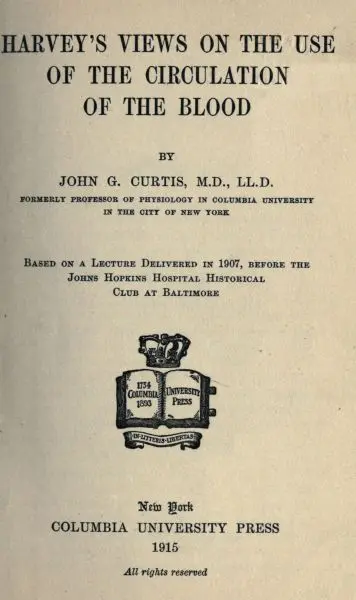
"Harvey's Views on the Use of the Circulation of the Blood" by John G. Curtis is a scientific publication written in the early 20th century. The work delves into the contributions of William Harvey, a pioneering figure in physiology known for his discovery of the circulation of blood. Curtis explores Harvey's ideas, contextualizing them within the framework of ancient Greek philosophy and the medical knowledge of his time. The opening of the book sets the stage for a detailed examination of Harvey's formative years and the impact of his education at the University of Padua. Curtis vividly describes the Anatomical Theater where Harvey studied, emphasizing the contrast between the prevailing Galenic doctrines and Harvey's revolutionary approach to physiology. The narrative introduces Harvey's legacy as more than just a discoverer of blood circulation; it presents him as a thinker who wrestled with the philosophical underpinnings of his findings, drawing connections between ancient thought and his own groundbreaking observations.
Introduction adapted from the source catalogue; source summaries may be automatically generated.
Free to read · English · 59,929 words · No account needed
MAKE TIME FOR A GOOD BOOK
On by default. Untick to stop anonymous reading totals. Each page counts after 10 seconds in view. How this works.
Anonymous counting is on unless you have switched it off.
[12] Aristotle: On Sleep and Waking, 456a, 30 to b, 5.
Galen: On the Use of the Parts, etc., Kn. Vol. III, 269-270; Dar.
Vol. I, 280-282.
[13] Galen: On the Natural Faculties, Kn. Vol. II, 186-189; Dar.
Vol. II, 306-307.
[14] Harvey: On the Motion, etc., Syd. 72, l. 24 to 73, l. 12; Op.
Omn. 73, l. 26 to 74, l. 15.
[15] Harvey: On the Motion, etc., Syd. 75, l. 9-22; Op. Omn. 76, l.
15-25.
[16] Joannes Riolanus, Filius: Encheiridium Anatomicum et Pathologicum, etc., Paris, 1648, 298, l. 1-4. Harvey's quotation does complete justice to the sense, but is by no means accurate verbally.
[17] Harvey: Exercise to Riolanus, I, Syd. 95, l. 4-21; Op. Omn. 97,
l. 6-23.
[18] Aselli: De Lactibus, sive Lacteis Venis, etc. Milan, 1627.
[19] John Aubrey: Brief Lives, etc., 1898, Vol. I, 302.
[20] Harvey's venous artery and arterial vein correspond
respectively to the pulmonary vein and the pulmonary artery of our
nomenclature.
[21] Harvey: On the Motion, etc., VI, Syd. 39, l. 29 to 40, l. 15; Op. Omn. 41, l. 20 to 42, l. 10.
[22] Compare Aristotle: History of Animals, 511b, 10-24.
[23] Harvey: On the Motion, etc., XVII, Syd. 85, l. 17-25; Op. Omn.
87, l. 5-12.
[24] Aristotle: On Youth and Old Age, On Life and Death, 469b,
6-20.
[25] Aristotle: On Respiration, 473a, 8-10.
[26] Aristotle: On the Generation of Animals, 732a, 18-20.
[27] Aristotle: On Youth and Old Age, On Life and Death, 469a, 28 to 470a, 18. On Respiration, 474a, 25 to b, 24; 478a, 26 to b, 21; 480a, 18 to b, 20.
[28] Aristotle: On Respiration, 478a, 21-30.
[29] διὰ τὴν σύναψιν.
[30] Aristotle: History of Animals, 496a, 27-32.
[31] Hippocrates: On the Heart, Lit. Vol. IX, 86 and 90-92.
[32] Hippocrates: On the Heart, Lit. Vol. IX, 86-88.
[33] Galen: On the Use of Respiration, Kn. Vol. IV, 487-493.
[34] ποιότητος.
[35] Galen: Is Blood Naturally Contained in the Arteries? Kn. Vol.
IV, 724-725.
[36] Galen: On the Use of Respiration, Kn. Vol. IV, 510.
[37] Galen: On the Use of the Parts, etc., Kn. Vol. III, 412; Dar.
Vol. I, 381.
[38] Galen: On the Use of the Pulse, Kn. Vol. V, 149-180.
[39] Harvey: On the Motion, etc., Preface, Syd. 9-14; Op. Omn. 9-14.
[40] Galen: On the Use of the Parts, etc., Kn. Vol. III, 636-656;
Dar. Vol. I, 541-552.
[41] Harvey: Prelectiones, 86 right.
[42] Compare Hippocrates: On Flatus, Lit. Vol. VI, 96.
[43] Harvey: Prelectiones, 86 right.
[44] Galen: On the Use of Respiration, Kn. Vol. IV, 470-471.
[45] Harvey: Prelectiones, 86 right.
[46] Aristotle: On Respiration, 473a, 15 to 474a, 24. Hippocrates: On the Sacred Disease, Lit. Vol. VI, 368 and 372.
[47] Hippocrates: On the Sacred Disease, Lit. Vol. VI, 368.
[48] Passages which justify the statements here made are among those
cited in note 140.
[49] Galen: Is Blood Naturally Contained in the Arteries? Kn. Vol.
IV, 703-736.
[50] Galen: On the Use of the Parts, etc., Kn. Vol. III, 541-542;
Dar. Vol. I, 476.
[51] Plato: Timæus, 69c-d. Archer-Hind's Edition, 254, l. 13 to
256, l. 6.
[52] Aristotle: On Soul, 412a, 1 to 415a, 13.
[53] Galen: On the Doctrines of Hippocrates and Plato, Kn. Vol. V,
608.
Your reading position is saved on this browser. Take it to another device with a library code. Reading pages adapt to text, rather than matching a printed edition.
BEHIND THE BOOK
This eBook is for the use of anyone anywhere in the United States and most other parts of the world at no cost and with almost no restrictions whatsoever. You may copy it, give it away or re-use it under the terms of the Project Gutenberg License included with this eBook or online at www.gutenberg.org. If you are not located in the United States, you will have to check the laws of the country where you are located before using this eBook. Read the source licence.
The original source file, including credits and licence, is retained by this library. Request an original-format copy at no charge. Please include the book title and Project Gutenberg identifier #47448.
KEEP YOUR CURIOSITY GOING
Cécile Tormay

Moritz Busch
John L. Ransom
Frances Wright
Cécile Tormay

Mabel Potter Daggett