
The lost dirigible
Ralph Henry Barbour
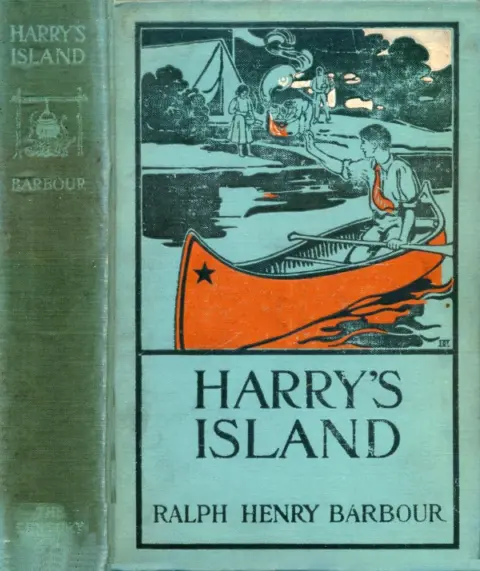
THE CLASSIC COLLECTION · 1907
"Harry's Island" by Ralph Henry Barbour is a novel written in the early 20th century. This charming story revolves around a group of boys, specifically focusing on three main characters: Chub, Roy, and Dick, who are on the brink of graduation from Ferry Hill School. As summer approaches, the friends fantasize about camping on Fox Island, planning exploits full of youthful exuberance, adventures, and budding friendships. At the start of the novel, the three boys lounge on Hood's Hill, admiring the scenery and discussing their coming separation after graduation, highlighting a sense of nostalgia mixed with excitement. The narrative introduces Harry, an adventurous girl who is as spirited and determined as the boys, further enriching the dynamics between them. As the boys plan their potential camping trip, they express a mix of hopefulness and uncertainty about the future, setting the stage for the adventures that lie ahead. The opening portion vividly captures the carefree essence of boyhood and the anticipation of new experiences, making it an engaging read for audiences who appreciate tales of friendship and youthful adventures.
Introduction adapted from the source catalogue; source summaries may be automatically generated.
Free to read · English · 63,750 words · No account needed
MAKE TIME FOR A GOOD BOOK
On by default. Untick to stop anonymous reading totals. Each page counts after 10 seconds in view. How this works.
Anonymous counting is on unless you have switched it off.
“Let’s see it,” said Dick. He took the paper and looked it over carefully. It appeared to be the half of a page from a pocket note-book. It was traversed by pale blue lines and the lower corners were curled as though from much handling. The writing was small and the letters well formed.
“Do you reckon it’s a joke?” asked Chub.
“Who could have done it?” inquired Roy. “We don’t know any one around here, now that school is closed.”
“Wait a bit,” exclaimed Dick. “Here’s something on the other side; it’s been rubbed out, but I can see the words ‘set’ and ‘Billings,’ and there are some figures, I think.”
“‘Seth Billings,’” pondered Roy. “It isn’t ‘Seth Billings,’ is it?”
“No, I don’t think so; I can’t see any h. Here, you see what you can
make of it.”
Roy took the paper and scrutinized it closely, but was unable to
decipher any more than Dick.
“Well, ‘Seth Billings’ wants to keep away from this camp in future,” said Chub, “or he will get his head punched.”
“I don’t think his name can be Seth Billings,” said Harry, “because he signed that verse ‘N. W.’”
“‘W. N.,’” Chub corrected. “Not that it matters, though. He was probably going by in a boat and saw the camp and just naturally snooped around and helped himself to--say, do you suppose he’s taken anything else?”
There was a concerted movement toward the tent and a rapid inventory of their property. Nothing was missing, however; or so, at least, it seemed until Dick raised the cover of the tin bread-box. Then:
“Bread, too,” he said dryly; “and here’s another sonnet in the bottom of the box. Listen to this:
“What’s the good o’ butter
When it can’t be spread?
Hence I am your debtor
For half a loaf of bread.
Chub burst into a laugh and the others joined him.
“He’s a joker, he is!” he gasped. “As far as I’m concerned he’s welcome. But I wouldn’t want him to visit us every day; we’d be bankrupt in a week!”
“But who is he?” puzzled Roy. “Any one know a ‘W. N.’?”
They all thought hard but without solving the riddle.
“Oh, he’s probably a tramp or--or something like that,” said Roy.
“Tramps don’t usually pay for what they take with verses,” Chub objected; “and his rhymes aren’t bad, you know, all except ‘butter,’ and ‘debtor’; that’s poetic license with a vengeance.”
Your reading position is saved on this browser. Take it to another device with a library code. Reading pages adapt to text, rather than matching a printed edition.
Ralph Henry Barbour
Ralph Henry Barbour

Ralph Henry Barbour

Ralph Henry Barbour
BEHIND THE BOOK
This eBook is for the use of anyone anywhere in the United States and most other parts of the world at no cost and with almost no restrictions whatsoever. You may copy it, give it away or re-use it under the terms of the Project Gutenberg License included with this eBook or online at www.gutenberg.org. If you are not located in the United States, you will have to check the laws of the country where you are located before using this eBook. Read the source licence.
The original source file, including credits and licence, is retained by this library. Request an original-format copy at no charge. Please include the book title and Project Gutenberg identifier #54909.
KEEP YOUR CURIOSITY GOING
Coulson Kernahan

Maurice Baring
Frances Wright
Cécile Tormay

Frederic Jesup Stimson

W. H. P. (William Henry Pope) Jarvis