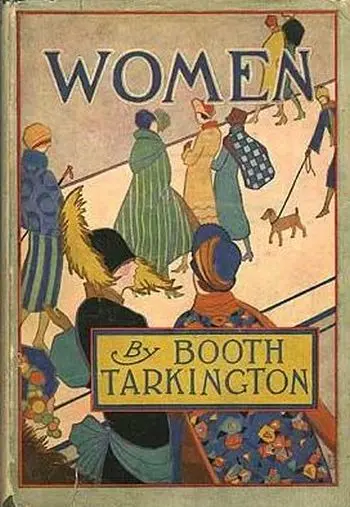
Women
Booth Tarkington
THE CLASSIC COLLECTION · 1921
"Harlequin and Columbine" by Booth Tarkington is a novel set in the late 19th century, exploring the world of theater and the complexities of artistic expression. The story centers around Talbot Potter, a charismatic and successful stage actor, who navigates the challenges of rehearsing a new play while dealing with the personalities and dynamics of the theater world, including a promising young playwright and an intriguing understudy named Wanda Malone. The opening of the novel introduces us to Talbot Potter as he makes his way through the bustling streets of New York City, showcasing his serene yet self-aware demeanor amidst the distractions of the Fifth Avenue crowd. As the rehearsal unfolds, we meet Stewart Canby, the anxious playwright experiencing his first rehearsal, and we witness the tension that arises when Potter begins improvising lines and altering the script to fit his artistic vision. Canby grapples with the challenges of maintaining the integrity of his work as Potter's larger-than-life personality dominates the scene. The interplay of ambition, creativity, and human relationships sets the stage for a rich exploration of the theatrical world, hinting at conflicts and connections that will develop throughout the narrative.
Introduction adapted from the source catalogue; source summaries may be automatically generated.
Free to read · English · 22,730 words · No account needed
MAKE TIME FOR A GOOD BOOK
On by default. Untick to stop anonymous reading totals. Each page counts after 10 seconds in view. How this works.
Anonymous counting is on unless you have switched it off.
“Oh, no,” said Tinker easily. “Not all. Not by any means. No.”
“Show me one that isn't sawdust!” the tragedian cried fiercely. “Show me
just one!”
“We-ll,” said Tinker with extraordinary deliberation, “to start near home: Wanda Malone.”
Potter burst into terrible laughter. “All sawdust! That's why I discharged her this afternoon.”
“You what?” Canby shouted incredulously.
“I dismissed her from my company,” said Potter with a startling change to icy calmness. “I dismissed her from my company this afternoon.”
Old Tinker leaned forward. “You didn't!”
Potter's iciness increased. “Shall I repeat it? I was obliged to dismiss Miss Wanda Malone from my company, this afternoon, after rehearsal.”
“Why?” Canby gasped.
“Because,” said Potter, with the same calmness, “she has an utterly
commonplace mind.”
Canby rose in agitation, quite unable, for that moment, to speak; but Tinker, still leaning forward, gazing intently at the face of the actor, made a low, long-drawn sound of wonder and affirmation, the slow exclamation of a man comprehending what amazes him. “So that's it!”
“Besides being intensely ordinary,” said Potter, with superiority, “I discovered that she is deceitful. That had nothing whatever to do with my decision to leave the stage.” He whirled upon Tinker suddenly, and shouted: “No matter what you think!”
“No,” said Tinker. “No matter.”
Potter laughed. “Talbot Potter leaves the stage because a little 'ingenue' understudy tries to break the rules of his company! Likely, isn't it?”
“Looks so,” said old Tinker.
“Does it?” retorted Potter with rising fury. “Then I'll tell you, since you seem not to know it, that I'm not going to leave the stage! Can't a man give vent to his feelings once in his life without being caught up and held to it by every old school-teacher that's stumbled into the 'show-business' by mistake! We're going right on with this play, I tell you; we rehearse it to-morrow morning just the same as if this hadn't happened. Only there will be a new 'ingenue' in Miss Malone's place. People can't break iron rules in my company. Maybe they could in Mounet-Sully's, but they can't in mine!”
“What rule did she break?” Canby's voice was unsteady. “What rule?”
“Yes,” Tinker urged. “Tell us what it was.”
“After rehearsal,” the star began with dignity, “I was--I--” He paused. “I was disappointed in her.”
“Ye-es?” drawled Tinker encouragingly.
Your reading position is saved on this browser. Take it to another device with a library code. Reading pages adapt to text, rather than matching a printed edition.
Booth Tarkington
Booth Tarkington
Booth Tarkington
Booth Tarkington
BEHIND THE BOOK
This eBook is for the use of anyone anywhere in the United States and most other parts of the world at no cost and with almost no restrictions whatsoever. You may copy it, give it away or re-use it under the terms of the Project Gutenberg License included with this eBook or online at www.gutenberg.org. If you are not located in the United States, you will have to check the laws of the country where you are located before using this eBook. Read the source licence.
The original source file, including credits and licence, is retained by this library. Request an original-format copy at no charge. Please include the book title and Project Gutenberg identifier #6401.
KEEP YOUR CURIOSITY GOING
Coulson Kernahan

Maurice Baring
Frances Wright
Cécile Tormay

Frederic Jesup Stimson

W. H. P. (William Henry Pope) Jarvis