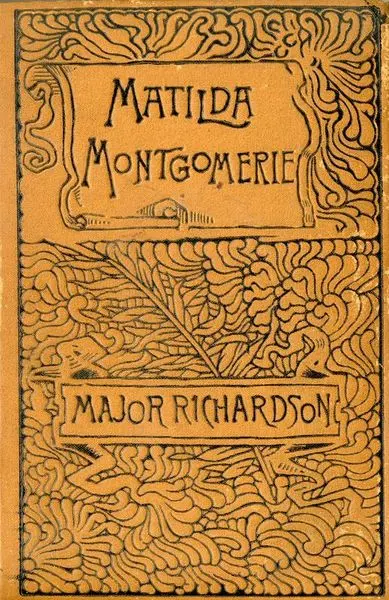
Matilda Montgomerie; Or, The Prophecy Fulfilled
Major (John) Richardson
THE CLASSIC COLLECTION · 1856
"Hardscrabble; or, The Fall of Chicago: A Tale of Indian Warfare" by John Richardson is a historical novel written in the early 19th century. The story unfolds during the tensions surrounding the War of 1812, specifically focusing on the precarious life on the frontier where settlers interact with Native American tribes. The narrative introduces several characters, including Mr. Heywood, a landowner; Ephraim Giles, his servant; and the boy Wilton, hinting at the challenges they face from the encroaching threats of war and conflict. At the start of the novel, readers are placed in a rustic farmhouse near Chicago, where the characters engage in daily life. The narrative highlights their interactions, revealing dynamics of social class amidst the backdrop of impending danger. Mr. Heywood's unease grows as he learns about a group of Native Americans spotted nearby, leading to escalating tensions in the area. Meanwhile, the characters' concerns about their safety intensify as they recognize that their lives may depend on how they navigate this precarious relationship with the Native tribes. The opening sets a rich tone of suspense and establishes the profound themes of survival and the complexities of frontier life during a time of turmoil.
Introduction adapted from the source catalogue; source summaries may be automatically generated.
Free to read · English · 57,561 words · No account needed
MAKE TIME FOR A GOOD BOOK
On by default. Untick to stop anonymous reading totals. Each page counts after 10 seconds in view. How this works.
Anonymous counting is on unless you have switched it off.
“I certainly saw him last night, Captain Headley, but not at a very late hour. We took a glass or two of punch, and smoked a couple of pipes together, but we both went to bed early, and for my part, I know that I slept so soundly as to have heard nothing--seen nothing, until I got up this morning.”
The doctor spoke truly as to the time of their retirement to rest, for the ensign had left him early in the night, while he had found his way to his own bed, early in the morning.
“The boat is nearing the landing-place, sir,” reported the sergeant of the guard, who now came up, and more immediately addressed Lieutenant Elmsley.
This information, for the moment, banished the subject under discussion. “Let the men pile their arms,” ordered Captain Headley; “and when this is done, Mr. Elmsley, follow me to the landing-place.”
In a few minutes both officers were there. The boat was within fifty yards, when the subaltern joined his captain; and the oarsmen, evidently desirous of doing their best in the presence of the commanding officer, were polling silently and with a vigor that soon brought it to its accustomed berth.
“What body is that, Corporal Nixon?” inquired the latter, “and how is it that you are only here this morning?”
“Sir,” answered the corporal, removing one of his hands from the steer-oar, and respectfully touching his cap, “it's poor Le Noir, the Frenchman, killed by the Injins yesterday, and as for our absence, it couldn't be helped, sir; but it's a long report I have to make, and perhaps, captain, you would like to hear it more at leisure than I can tell it here.”
By this time the men had landed from the boat, leaving the Canadian to be disposed of afterwards as the commanding officer might direct. The quick eye of the latter immediately detected the slight limping of Green, whose wound had become stiff from neglect, cold, and the cramped position in which he had been sitting in the boat.
“What is the matter with this man?” he inquired of the corporal. “What makes him walk so stiffly?”
“Nothing much the matter, captain,” was the indifferent reply. “It's only a ball he got in his leg in the scrimmage last night.”
“Ha! the first gun-shot wound that has come under my treatment during the three long years I have been stationed here. Quick, my fine fellow, take yourself to the hospital, and tell the orderly to prepare my instruments for probing.”
“Scrimmage last night; what do you mean, Corporal Nixon--whom had you
the scrimmage with?”
Your reading position is saved on this browser. Take it to another device with a library code. Reading pages adapt to text, rather than matching a printed edition.
Major (John) Richardson
Major (John) Richardson
Major (John) Richardson
Major (John) Richardson
BEHIND THE BOOK
This eBook is for the use of anyone anywhere in the United States and most other parts of the world at no cost and with almost no restrictions whatsoever. You may copy it, give it away or re-use it under the terms of the Project Gutenberg License included with this eBook or online at www.gutenberg.org. If you are not located in the United States, you will have to check the laws of the country where you are located before using this eBook. Read the source licence.
The original source file, including credits and licence, is retained by this library. Request an original-format copy at no charge. Please include the book title and Project Gutenberg identifier #5169.
KEEP YOUR CURIOSITY GOING
Cécile Tormay

Moritz Busch
Coulson Kernahan
John L. Ransom

Maurice Baring
Frances Wright