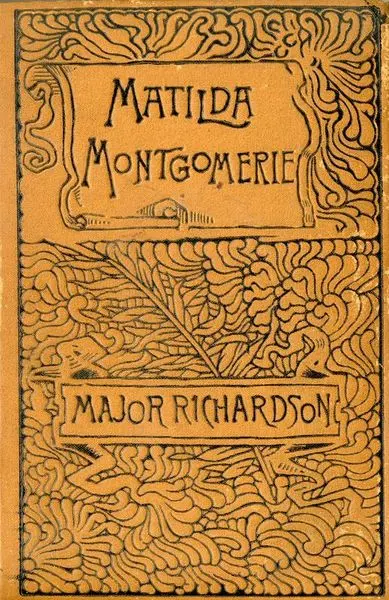
Matilda Montgomerie; Or, The Prophecy Fulfilled
Major (John) Richardson
THE CLASSIC COLLECTION · 1856
"Hardscrabble; or, The Fall of Chicago: A Tale of Indian Warfare" by John Richardson is a historical novel written in the early 19th century. The story unfolds during the tensions surrounding the War of 1812, specifically focusing on the precarious life on the frontier where settlers interact with Native American tribes. The narrative introduces several characters, including Mr. Heywood, a landowner; Ephraim Giles, his servant; and the boy Wilton, hinting at the challenges they face from the encroaching threats of war and conflict. At the start of the novel, readers are placed in a rustic farmhouse near Chicago, where the characters engage in daily life. The narrative highlights their interactions, revealing dynamics of social class amidst the backdrop of impending danger. Mr. Heywood's unease grows as he learns about a group of Native Americans spotted nearby, leading to escalating tensions in the area. Meanwhile, the characters' concerns about their safety intensify as they recognize that their lives may depend on how they navigate this precarious relationship with the Native tribes. The opening sets a rich tone of suspense and establishes the profound themes of survival and the complexities of frontier life during a time of turmoil.
Introduction adapted from the source catalogue; source summaries may be automatically generated.
Free to read · English · 57,561 words · No account needed
MAKE TIME FOR A GOOD BOOK
On by default. Untick to stop anonymous reading totals. Each page counts after 10 seconds in view. How this works.
Anonymous counting is on unless you have switched it off.
“What a tale, this, to carry back,” gravely remarked Weston. “I wouldn't take the corporal's stripes to-morrow, and be the first man to tell Miss Heywood of it.”
“Supposing we get back at all,” said Cass. “Though we're safe enough for the present, I've no notion these devils will let us off go soon.”
“There's no great danger now,” interrupted the corporal. “I defy them, if they're not stronger than we saw them this morning, to get into the house, with six good firelocks to defend it.”
“But they may set fire to it, and burn us out,” persevered the apprehensive man with the hooked nose and the peaked chin; “I've heard of those things before.”
“Burn your granny out, Nutcrackers; look at them logs well, and say if it would'nt take hell-fire itself to burn 'em through in a month, but corporal, had'nt we better divide the ammunition. We don't know, as Cass says, what the imps are about, and what trouble they may give us yet.”
“Right, Green, there's nothing like being on the sure side, and so, my lads look to the pouches. Weston, there's a candle in that stone bottle on the shelf--light it, and put it on the table as soon as you have got that on its legs again.”
The examination was soon made. Each small cartouch box, expressly made for light excursions, contained, with the exception of the single cartridge which Collins had fired, the usual allowance of fifteen rounds. Two of these however--those of Green and Philips--had been so saturated by long immersion in the water, that they were wholly unserviceable. They were therefore emptied and dried, and the deficiency supplied from the pouches of their comrades, thus leaving about a dozen charges to each man.
“A small stock of ammunition, this, I guess, to stand a long siege on an empty belly,” drawled forth Cass.
“Just like you--always croakin',” sneered Green, “and always thinking of your belly. Why man, you've more ammunition there, I take it, than ever you'll fire away in your life.”
“And if we haven't enough,” said the corporal, going to, and taking down and shaking a powder horn, which hung suspended from the wall, that had evidently been overlooked by the Indians, “here are a dozen more charges at least, and the balls of the cartridges have not, I take it, lost their power to drill a hole into a fellow because they've been considerably well ducked. But hark! what noise is that--listen!”
Your reading position is saved on this browser. Take it to another device with a library code. Reading pages adapt to text, rather than matching a printed edition.
Major (John) Richardson
Major (John) Richardson
Major (John) Richardson
Major (John) Richardson
BEHIND THE BOOK
This eBook is for the use of anyone anywhere in the United States and most other parts of the world at no cost and with almost no restrictions whatsoever. You may copy it, give it away or re-use it under the terms of the Project Gutenberg License included with this eBook or online at www.gutenberg.org. If you are not located in the United States, you will have to check the laws of the country where you are located before using this eBook. Read the source licence.
The original source file, including credits and licence, is retained by this library. Request an original-format copy at no charge. Please include the book title and Project Gutenberg identifier #5169.
KEEP YOUR CURIOSITY GOING
Cécile Tormay

Moritz Busch
Coulson Kernahan
John L. Ransom

Maurice Baring
Frances Wright