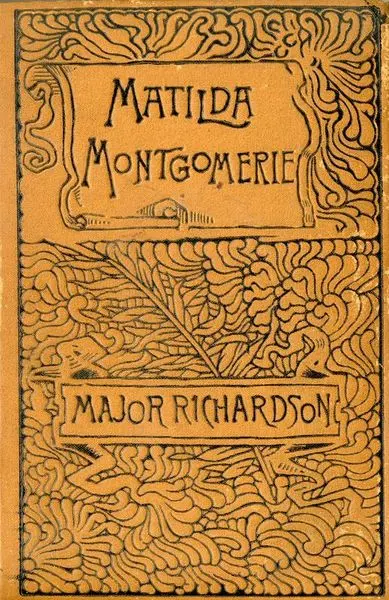
Matilda Montgomerie; Or, The Prophecy Fulfilled
Major (John) Richardson
THE CLASSIC COLLECTION · 1856
"Hardscrabble; or, The Fall of Chicago: A Tale of Indian Warfare" by John Richardson is a historical novel written in the early 19th century. The story unfolds during the tensions surrounding the War of 1812, specifically focusing on the precarious life on the frontier where settlers interact with Native American tribes. The narrative introduces several characters, including Mr. Heywood, a landowner; Ephraim Giles, his servant; and the boy Wilton, hinting at the challenges they face from the encroaching threats of war and conflict. At the start of the novel, readers are placed in a rustic farmhouse near Chicago, where the characters engage in daily life. The narrative highlights their interactions, revealing dynamics of social class amidst the backdrop of impending danger. Mr. Heywood's unease grows as he learns about a group of Native Americans spotted nearby, leading to escalating tensions in the area. Meanwhile, the characters' concerns about their safety intensify as they recognize that their lives may depend on how they navigate this precarious relationship with the Native tribes. The opening sets a rich tone of suspense and establishes the profound themes of survival and the complexities of frontier life during a time of turmoil.
Introduction adapted from the source catalogue; source summaries may be automatically generated.
Free to read · English · 57,561 words · No account needed
MAKE TIME FOR A GOOD BOOK
On by default. Untick to stop anonymous reading totals. Each page counts after 10 seconds in view. How this works.
Anonymous counting is on unless you have switched it off.
“Well then, here's at it,” resumed Jackson, rising and commencing to strip. “It's only by groping and feeling that we can find the arms, and when once we've tumbled on 'em, it will be easy enough to get 'em up with one hand, while we swim with the other. We must plunge here from the stern,” he added, as the men whom he had named jumped on board and commenced stripping themselves.
“How came the Injin to knock the muskets overboard, Corporal?” inquired one of the party who had not yet spoken--a fat, portly man, with a long hooked nose, and a peaked chin.
“I'm dashed,” replied Nixon, “if I can tell myself, though I was looking at him as he jumped from one end of the boat to the other. All I know is, the firelocks were propped against the stern of the boat as we placed them, with the backs of the cartouch boxes slung under the ramrods, and I suppose, for I don't know how else it could be done, that instead of alighting on the seat, he must have passed it, and putting his foot on the muzzles, tipped them with the weight of his body, head over heels into the water.”
“Corporal,” Ventured Collins, as he removed his last garment, “you asked that painted chap if he saw anything green in your eye. Now, that's as it may be, but hang me, if it wasn't a little green to take him for a Pottawattamie?”
“And how do you know he was'nt a Pottawattamie? Who made you a judge of Indian flesh?” retorted the corporal, with an air of dissatisfaction.
“Didn't he say he was, and didn't he wear a chiefs medal?”
“Say? Yes, I'll be bound he'd say and wear anything to gull us, but I'm sure he's no Pottawattamie. I never seen a Pottawattamie of that build. They are tall, thin, skinny, bony fellows--while this chap was square, stoat, broad-shouldered, and full of muscle.”
Corporal Nixon pondered a little, because half-convinced, but would not acknowledge that he could have been mistaken. “Are you all ready?” he at length inquired, anxious, like most men, when driven into a corner on one topic, to introduce another.
“All ready,” answered Jackson, taking the first plunge in the direction in which he knew the muskets must have fallen.
Before following his example, the others waited for his report. This was soon made. He had got hold of one of the muskets, and partly lifted it from its bed, but the net-work of strong weeds above it, opposing too much resistance, he had been compelled to quit his hold, and came to the surface of the water for air.
Your reading position is saved on this browser. Take it to another device with a library code. Reading pages adapt to text, rather than matching a printed edition.
Major (John) Richardson
Major (John) Richardson
Major (John) Richardson
Major (John) Richardson
BEHIND THE BOOK
This eBook is for the use of anyone anywhere in the United States and most other parts of the world at no cost and with almost no restrictions whatsoever. You may copy it, give it away or re-use it under the terms of the Project Gutenberg License included with this eBook or online at www.gutenberg.org. If you are not located in the United States, you will have to check the laws of the country where you are located before using this eBook. Read the source licence.
The original source file, including credits and licence, is retained by this library. Request an original-format copy at no charge. Please include the book title and Project Gutenberg identifier #5169.
KEEP YOUR CURIOSITY GOING
Cécile Tormay

Moritz Busch
Coulson Kernahan
John L. Ransom

Maurice Baring
Frances Wright