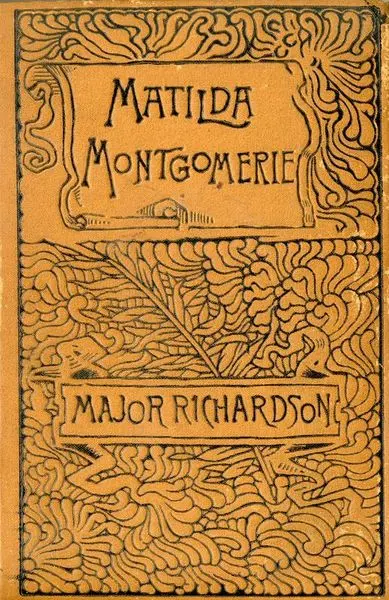
Matilda Montgomerie; Or, The Prophecy Fulfilled
Major (John) Richardson
THE CLASSIC COLLECTION · 1856
"Hardscrabble; or, The Fall of Chicago: A Tale of Indian Warfare" by John Richardson is a historical novel written in the early 19th century. The story unfolds during the tensions surrounding the War of 1812, specifically focusing on the precarious life on the frontier where settlers interact with Native American tribes. The narrative introduces several characters, including Mr. Heywood, a landowner; Ephraim Giles, his servant; and the boy Wilton, hinting at the challenges they face from the encroaching threats of war and conflict. At the start of the novel, readers are placed in a rustic farmhouse near Chicago, where the characters engage in daily life. The narrative highlights their interactions, revealing dynamics of social class amidst the backdrop of impending danger. Mr. Heywood's unease grows as he learns about a group of Native Americans spotted nearby, leading to escalating tensions in the area. Meanwhile, the characters' concerns about their safety intensify as they recognize that their lives may depend on how they navigate this precarious relationship with the Native tribes. The opening sets a rich tone of suspense and establishes the profound themes of survival and the complexities of frontier life during a time of turmoil.
Introduction adapted from the source catalogue; source summaries may be automatically generated.
Free to read · English · 57,561 words · No account needed
MAKE TIME FOR A GOOD BOOK
On by default. Untick to stop anonymous reading totals. Each page counts after 10 seconds in view. How this works.
Anonymous counting is on unless you have switched it off.
“What you want with boat?” asked the corporal, almost involuntarily, and without the slightest expectation that his question would be understood.
“Me want 'em cross,” replied the Indian, pointing to the opposite woods.
“But why you come in bear skin?” and, in his turn, the corporal pointed with his finger in the direction in which the supposed bear had been seen.
“Ugh!” grunted the savage doggedly, finding that he had been detected in
his disguise.
“What nation you?--Pottawattamie?”
“Wah! Pottawattamie!”
“Curious enough,” pursued the corporal, addressing himself to his comrades. “I don't half like the look of the fellow, but I suppose it's all right. We musn't offend him. You chief?”, he continued, pointing to a large silver medal suspended over the breast of the athletic and well-proportioned Indian.
“Yes, me chief. Pottawattamie chief,” and he made a sign in the direction of the Fort, near which the encampment of that tribe lay.
“You friend, then?” remarked the corporal, extending his hand.
“Yes, me friend,” he answered promptly, brightening up and taking the proffered hand; “you give 'em boat?”
“Do you see any thing green in my eye?” asked the Virginian, incapable, even under the circumstances, of repressing the indulgence of his humor.
But the party questioned, although speaking a little English, was not sufficiently initiated in its elegancies to comprehend this; so, he merely answered with a “ugh!” while the greater portion of the men laughed boisterously, both at the wit of the corporal, and at the seeming astonishment it excited.
This mirth by no means suited the humor of the Indian. He felt that it was directed towards himself, and again he stood fierce, and with a dilating frame before them.
Corporal Nixon at once became sensible of his error. To affront one of the friendly chiefs would, he knew, not only compromise the interests of the garrison, but incur the severe displeasure of the commanding officer, who had always enjoined the most scrupulous abstinence from any thing offensive to them.
“I only meant to say,” he added, as he again extended his hand. “I can't give 'em boat, White chief,” and he pointed in the direction of the Fort, “no let me.”
“Ugh!” exclaimed the Indian, his stern features again brightening up with a last hope. “'Spose come with Injin?”
Your reading position is saved on this browser. Take it to another device with a library code. Reading pages adapt to text, rather than matching a printed edition.
Major (John) Richardson
Major (John) Richardson
Major (John) Richardson
Major (John) Richardson
BEHIND THE BOOK
This eBook is for the use of anyone anywhere in the United States and most other parts of the world at no cost and with almost no restrictions whatsoever. You may copy it, give it away or re-use it under the terms of the Project Gutenberg License included with this eBook or online at www.gutenberg.org. If you are not located in the United States, you will have to check the laws of the country where you are located before using this eBook. Read the source licence.
The original source file, including credits and licence, is retained by this library. Request an original-format copy at no charge. Please include the book title and Project Gutenberg identifier #5169.
KEEP YOUR CURIOSITY GOING
Cécile Tormay

Moritz Busch
Coulson Kernahan
John L. Ransom

Maurice Baring
Frances Wright