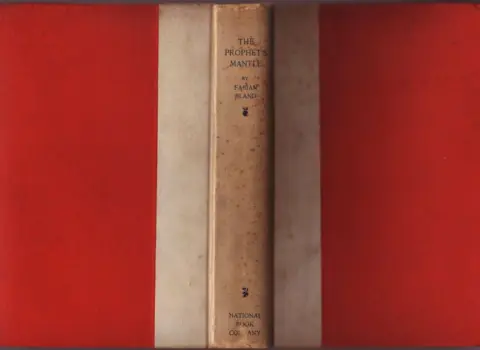
The Prophet’s Mantle
E. (Edith) Nesbit & Hubert Bland
THE CLASSIC COLLECTION · 1910
"Harding's Luck" by E. Nesbit is a novel written in the early 20th century. The story introduces readers to Dickie Harding, a young boy living in a grim environment with an unkind aunt, who struggles with lameness and dreams of adventure. The central theme revolves around Dickie's desperate longing for love and belonging, all while he navigates a world filled with misfortune and small joys, particularly his attachment to a cherished toy named Tinkler and his encounters with various characters, including a kind neighbor and a dubious man named Mr. Beale. The opening of "Harding's Luck" paints a vivid picture of Dickie's life and his sad background, beginning with the loss of his rabbit hutch, which leads to a burst of emotions that highlights his isolation. His lament over losing the hutch and how his aunt treats him sets the stage for Dickie's character—a boy yearning for kindness and adventure amid hardship. As he interacts with a stimulating neighbor and contemplates his secret dreams, Dickie's determination becomes apparent when he decides to sell moonflowers to regain his beloved toy from the pawnbroker. The chapter captures both the struggles and small triumphs of childhood, setting in motion Dickie's journey of self-discovery and adventure in a world that often seems unkind.
Introduction adapted from the source catalogue; source summaries may be automatically generated.
Free to read · English · 68,950 words · No account needed
MAKE TIME FOR A GOOD BOOK
On by default. Untick to stop anonymous reading totals. Each page counts after 10 seconds in view. How this works.
Anonymous counting is on unless you have switched it off.
But he had not got to "strive with pride" before the dear lady caught him in her arms, exclaiming, "Bless my dear son! how he has grown!" and the fine gentleman thumped him on the back, and bade him "bear himself like a gentleman's son, and not like a queasy square-toes." And they both laughed, and he cried a little, and the tutor seemed to be blotted out, and there they were, all three as jolly as if they had known each other all their lives. And a stout young nurse brought the baby, and Dickie loved it and felt certain it loved him, though it only said, "Goo ga goo," exactly as your baby-brother does now, and got hold of Dickie's hair and pulled it and would not let go.
There was a glorious dinner, and Dickie waited on this new father of his, changed his plate, and poured wine out of a silver jug into the silver cup that my lord drank from. And after dinner the dear lady-mother must go all over the house to see everything, because she had been so long away, and Dickie walked in the garden among the ripe apples and grapes with his father's hand on his shoulder, the happiest, proudest boy in all Deptford--or in all Kent either.
His father asked what he had learned, and Dickie told, dwelling, perhaps, more on the riding, and the fencing, and the bowls, and the music than on the sour-faced tutor's side of the business.
"But I've learned a lot of Greek and Latin, too," he added in a hurry, "and poetry and things like that."
"I fear," said the father, "thou dost not love thy book."
"I do, sir; yet I love my sports better," said Dickie, and looked up to meet the fond, proud look of eyes as blue as his own.
"Thou'rt a good, modest lad," said his father when they began their third round of the garden, "not once to ask for what I promised thee."
Dickie could not stand this. "I might have asked," he said presently, "but I have forgot what the promise was--the fever----"
"Ay, ay, poor lad! And of a high truth, too! Owned he had forgot! Come, jog that poor peaked remembrance."
Dickie could hardly believe the beautiful hope that whispered in his
ear.
"I almost think I remember," he said. "Father--did you promise----?"
"I promised, if thou wast a good lad and biddable and constant at thy book and thy manly exercises, to give thee, so soon as thou should'st have learned to ride him----"
Your reading position is saved on this browser. Take it to another device with a library code. Reading pages adapt to text, rather than matching a printed edition.
E. (Edith) Nesbit & Hubert Bland
E. (Edith) Nesbit
E. (Edith) Nesbit
E. (Edith) Nesbit
BEHIND THE BOOK
This eBook is for the use of anyone anywhere in the United States and most other parts of the world at no cost and with almost no restrictions whatsoever. You may copy it, give it away or re-use it under the terms of the Project Gutenberg License included with this eBook or online at www.gutenberg.org. If you are not located in the United States, you will have to check the laws of the country where you are located before using this eBook. Read the source licence.
The original source file, including credits and licence, is retained by this library. Request an original-format copy at no charge. Please include the book title and Project Gutenberg identifier #28725.
KEEP YOUR CURIOSITY GOING
Coulson Kernahan

Maurice Baring
Frances Wright
Cécile Tormay
Francis Greenleaf Allinson & Anne C. E. (Anne Crosby Emery) Allinson

Frederic Jesup Stimson