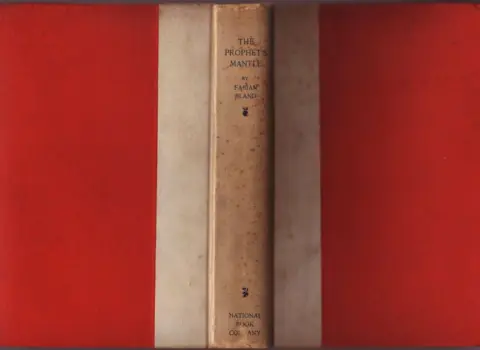
The Prophet’s Mantle
E. (Edith) Nesbit & Hubert Bland
THE CLASSIC COLLECTION · 1910
"Harding's Luck" by E. Nesbit is a novel written in the early 20th century. The story introduces readers to Dickie Harding, a young boy living in a grim environment with an unkind aunt, who struggles with lameness and dreams of adventure. The central theme revolves around Dickie's desperate longing for love and belonging, all while he navigates a world filled with misfortune and small joys, particularly his attachment to a cherished toy named Tinkler and his encounters with various characters, including a kind neighbor and a dubious man named Mr. Beale. The opening of "Harding's Luck" paints a vivid picture of Dickie's life and his sad background, beginning with the loss of his rabbit hutch, which leads to a burst of emotions that highlights his isolation. His lament over losing the hutch and how his aunt treats him sets the stage for Dickie's character—a boy yearning for kindness and adventure amid hardship. As he interacts with a stimulating neighbor and contemplates his secret dreams, Dickie's determination becomes apparent when he decides to sell moonflowers to regain his beloved toy from the pawnbroker. The chapter captures both the struggles and small triumphs of childhood, setting in motion Dickie's journey of self-discovery and adventure in a world that often seems unkind.
Introduction adapted from the source catalogue; source summaries may be automatically generated.
Free to read · English · 68,950 words · No account needed
MAKE TIME FOR A GOOD BOOK
On by default. Untick to stop anonymous reading totals. Each page counts after 10 seconds in view. How this works.
Anonymous counting is on unless you have switched it off.
He got the old worn-down knife out of the bowl on the back kitchen sink, where it nestled among potato peelings like a flower among foliage, and carefully cut half a dozen of the smaller flowers. Then he limped up to New Cross Station, and stood outside, leaning on his crutch, and holding out the flowers to the people who came crowding out of the station after the arrival of each train--thick, black crowds of tired people, in too great a hurry to get home to their teas to care much about him or his flowers. Everybody glanced at them, for they were wonderful flowers, as white as water-lilies, only flat--the real sunflower shape--and their centres were of the purest yellow gold color.
"Pretty, ain't they?" one black-coated person would say to another. And
the other would reply--
"No. Yes. I dunno! Hurry up, can't you?"
It was no good. Dickie was tired, and the flowers were beginning to droop. He turned to go home, when a sudden thought brought the blood to his face. He turned again quickly and went straight to the pawnbroker's. You may be quite sure he had learned the address on the card by heart.
He went boldly into the shop, which had three handsome gold balls hanging out above its door, and in its window all sorts of pretty things--rings, and chains, and brooches, and watches, and china, and silk handkerchiefs, and concertinas.
"Well, young man," said the stout gentleman behind the counter, "what
can we do for you?"
"I want to pawn my moonflowers," said Dickie.
The stout gentleman roared with laughter, and slapped a stout leg with a
stout hand.
"Well, that's a good 'un!" he said, "as good a one as ever I heard. Why, you little duffer, they'd be dead long before you came back to redeem them, that's certain."
"You'd have them while they were alive, you know," said Dickie gently.
"What are they? Don't seem up to much. Though I don't know that I ever saw a flower just like them, come to think of it," said the pawnbroker, who lived in a neat villa at Brockley and went in for gardening in a gentlemanly, you-needn't-suppose-I-can't-afford-a-real-gardener-if-I-like sort of way.
"They're moonflowers," said Dickie, "and I want to pawn them and then get something else out with the money."
"Got the ticket?" said the gentleman, cleverly seeing that he meant "get
out of pawn."
"Yes," said Dickie; "and it's my own Tinkler that my daddy gave me before he died, and my aunt Missa propagated it when I was in hospital."
The man looked carefully at the card.
Your reading position is saved on this browser. Take it to another device with a library code. Reading pages adapt to text, rather than matching a printed edition.
E. (Edith) Nesbit & Hubert Bland
E. (Edith) Nesbit
E. (Edith) Nesbit
E. (Edith) Nesbit
BEHIND THE BOOK
This eBook is for the use of anyone anywhere in the United States and most other parts of the world at no cost and with almost no restrictions whatsoever. You may copy it, give it away or re-use it under the terms of the Project Gutenberg License included with this eBook or online at www.gutenberg.org. If you are not located in the United States, you will have to check the laws of the country where you are located before using this eBook. Read the source licence.
The original source file, including credits and licence, is retained by this library. Request an original-format copy at no charge. Please include the book title and Project Gutenberg identifier #28725.
KEEP YOUR CURIOSITY GOING
Coulson Kernahan

Maurice Baring
Frances Wright
Cécile Tormay
Francis Greenleaf Allinson & Anne C. E. (Anne Crosby Emery) Allinson

Frederic Jesup Stimson