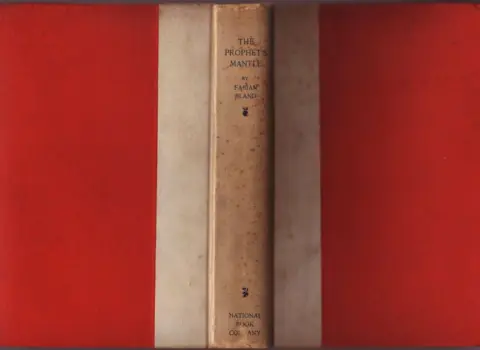
The Prophet’s Mantle
E. (Edith) Nesbit & Hubert Bland
THE CLASSIC COLLECTION · 1910
"Harding's Luck" by E. Nesbit is a novel written in the early 20th century. The story introduces readers to Dickie Harding, a young boy living in a grim environment with an unkind aunt, who struggles with lameness and dreams of adventure. The central theme revolves around Dickie's desperate longing for love and belonging, all while he navigates a world filled with misfortune and small joys, particularly his attachment to a cherished toy named Tinkler and his encounters with various characters, including a kind neighbor and a dubious man named Mr. Beale. The opening of "Harding's Luck" paints a vivid picture of Dickie's life and his sad background, beginning with the loss of his rabbit hutch, which leads to a burst of emotions that highlights his isolation. His lament over losing the hutch and how his aunt treats him sets the stage for Dickie's character—a boy yearning for kindness and adventure amid hardship. As he interacts with a stimulating neighbor and contemplates his secret dreams, Dickie's determination becomes apparent when he decides to sell moonflowers to regain his beloved toy from the pawnbroker. The chapter captures both the struggles and small triumphs of childhood, setting in motion Dickie's journey of self-discovery and adventure in a world that often seems unkind.
Introduction adapted from the source catalogue; source summaries may be automatically generated.
Free to read · English · 68,950 words · No account needed
MAKE TIME FOR A GOOD BOOK
On by default. Untick to stop anonymous reading totals. Each page counts after 10 seconds in view. How this works.
Anonymous counting is on unless you have switched it off.
"I draws water with my arms, not my legs," said Dickie cheerfully.
"There's a blue mug in the wash-house window-ledge," said the old man. "Fetch me a drop when you've had your drink, my lad."
Of course, Dickie's manners were too good for him to drink first. He drew up the dripping oaken bucket from the cool darkness of the well, fetched the mug, and offered it brimming to the old man. Then he drank, and looked at the garden ablaze with flowers--blush-roses and damask roses, and sweet-williams and candytuft, white lilies and yellow lilies, pansies, larkspur, poppies, bergamot, and sage.
It was just like a play at the Greenwich Theatre, Dickie thought. He had seen a scene just like that, where the old man sat in the sun and the Prodigal returned.
Dickie would not have been surprised to see Beale run up the brick path and throw himself on his knees, exclaiming, "Father, it is I--your erring but repentant son! Can you forgive me? If a lifetime of repentance can atone ..." and so on.
If Dickie had been Beale he would certainly have made the speech, beginning, "Father, it is I." But as he was only Dickie, he said--
"Your name's Beale, ain't it?"
"It might be," old Beale allowed.
"I seen your son in London. 'E told me about yer garden."
"I should a thought 'e'd a-forgot the garden same as 'e's forgot me,"
said the old man.
"'E ain't forgot you, not 'e," said Dickie; "'e's come to see you, an 'e's waiting outside now to know if you'd like to see 'im."
"Then 'e oughter know better," said the old man, and shouted in a thin, high voice, "Jim, Jim, come along in this minute!"
Even then Beale didn't act a bit like the prodigal in the play. He just unlatched the gate without looking at it--his hand had not forgotten the way of it, for all it was so long since he had passed through that gate. And he walked slowly and heavily up the path and said, "Hullo, dad!--how goes it?"
And the old man looked at him with his eyes half shut and said, "Why, it is James--so it is," as if he had expected it to be some one quite different.
And they shook hands, and then Beale said, "The garden's looking well."
And the old man owned that the garden 'ud do all right if it wasn't for
the snails.
Your reading position is saved on this browser. Take it to another device with a library code. Reading pages adapt to text, rather than matching a printed edition.
E. (Edith) Nesbit & Hubert Bland
E. (Edith) Nesbit
E. (Edith) Nesbit
E. (Edith) Nesbit
BEHIND THE BOOK
This eBook is for the use of anyone anywhere in the United States and most other parts of the world at no cost and with almost no restrictions whatsoever. You may copy it, give it away or re-use it under the terms of the Project Gutenberg License included with this eBook or online at www.gutenberg.org. If you are not located in the United States, you will have to check the laws of the country where you are located before using this eBook. Read the source licence.
The original source file, including credits and licence, is retained by this library. Request an original-format copy at no charge. Please include the book title and Project Gutenberg identifier #28725.
KEEP YOUR CURIOSITY GOING
Coulson Kernahan

Maurice Baring
Frances Wright
Cécile Tormay
Francis Greenleaf Allinson & Anne C. E. (Anne Crosby Emery) Allinson

Frederic Jesup Stimson