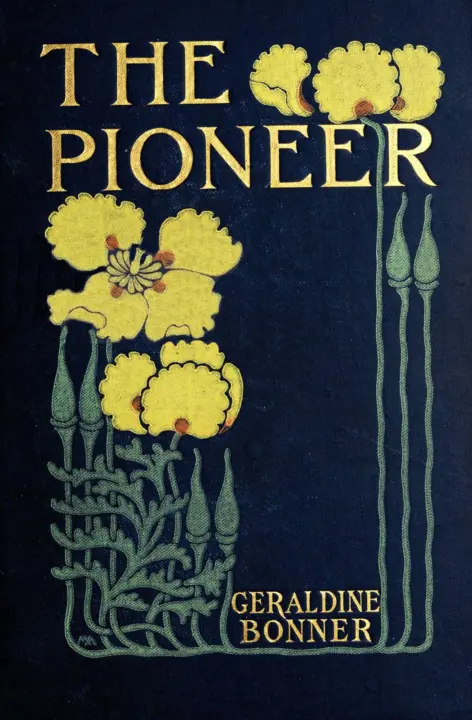
The pioneer
Geraldine Bonner

THE CLASSIC COLLECTION · 1900
"Hard-Pan: A Story of Bonanza Fortunes" by Geraldine Bonner is a novel written in the late 19th century. The story unfolds in a declining San Francisco, teeming with remnants of past fortunes, focusing on the lives of characters tied to the city’s dramatic fluctuations in wealth. Central to the narrative are John Gault, a man caught between his intriguing encounters with Viola Reed, the daughter of a fallen bonanza king, and Letitia Mason, who harbors feelings for him. The opening of the novel sets the stage with a dinner party where characters discuss Colonel Ramsay Reed and his daughter, revealing the complexities and expectations of high society. As the conversations unfold, John Gault's growing interest in Viola becomes evident, contrasting with Letitia's contrasting feelings towards John. After dinner, John visits Viola at her home, a stark juxtaposition to the earlier lavish gathering, where the authenticity of their interactions begins to spark deeper emotions. This initial segment establishes the central themes of social status, unrequited love, and the haunting specter of past opulence that pervades their lives, propelling the reader into the intricacies of each character's motivations and societal roles.
Introduction adapted from the source catalogue; source summaries may be automatically generated.
Free to read · English · 61,352 words · No account needed
MAKE TIME FOR A GOOD BOOK
On by default. Untick to stop anonymous reading totals. Each page counts after 10 seconds in view. How this works.
Anonymous counting is on unless you have switched it off.
"Yes, or quarterly--according to the way the stock is drawn."
"But isn't there some that is non-assessable? I've surely heard that
expression."
"In other States, but in California--well, possibly there might be."
"I'm sure there must be. This of my father's must have been." She came quite close to him in her earnestness, and looked at him with an expression of uneasiness on her face.
"It must have been that kind," she insisted; "probably you never heard
of this mine."
"Probably I never did," he answered grimly.
They walked on for a few moments in silence. There was a visible drop in her spirits. Stealing a side glance at her, he could see that she was looking down, evidently in troubled thought. Suddenly she raised her head and said:
"Well, I don't really know anything about it. Only I do hope one thing, and that is that it will go on paying."
"Don't bother about that," he said; "it will."
"What makes you think it will?"
He turned on her roughly and said:
"Don't you think it will?"
"I'd like to think so," she answered, abashed by his unusual manner; "but I've learned that it's foolish to hope. I try not to."
He gave a short, disagreeable laugh and said:
"Oh, not in this case. Hope as much as you like."
"You're very cheering," she answered; "but I don't see how you can be
so sure."
"It seems to me you're very pessimistic--especially for a young woman who has just found a drawerful of paying stock."
His manner in making this remark was so impregnated with angry bitterness that Viola, chilled and repelled, made no response. In silence they walked onward till a turn in the street brought them in sight of the house.
At the gate she said rather timidly:
"Would you like to come in?"
He had been carrying the basket, and now found the depositing of it in a place of safety an excuse to enter; for even in his present state of morose ill humor he could not forego the pleasure of a few more moments of her society.
In the cold, half-furnished house their footsteps echoed with a strangely solitary effect. She preceded him into the parlor, and moved about with the confident tread of the chatelaine, pulling up the blinds, putting the basket out of sight, and laying aside her hat and gloves. There were some thin flowered muslin curtains hanging over the bay-window, and she arranged the folds of these with deft, proprietary touches, and then stepped back and studied the effect.
After watching her for a moment the visitor said in a tone of restored
amiability:
"Aren't those something new?"
Your reading position is saved on this browser. Take it to another device with a library code. Reading pages adapt to text, rather than matching a printed edition.
Geraldine Bonner
Geraldine Bonner
Geraldine Bonner

Geraldine Bonner
BEHIND THE BOOK
This eBook is for the use of anyone anywhere in the United States and most other parts of the world at no cost and with almost no restrictions whatsoever. You may copy it, give it away or re-use it under the terms of the Project Gutenberg License included with this eBook or online at www.gutenberg.org. If you are not located in the United States, you will have to check the laws of the country where you are located before using this eBook. Read the source licence.
The original source file, including credits and licence, is retained by this library. Request an original-format copy at no charge. Please include the book title and Project Gutenberg identifier #63911.
KEEP YOUR CURIOSITY GOING
Coulson Kernahan

Maurice Baring
Frances Wright
Cécile Tormay

Frederic Jesup Stimson

W. H. P. (William Henry Pope) Jarvis