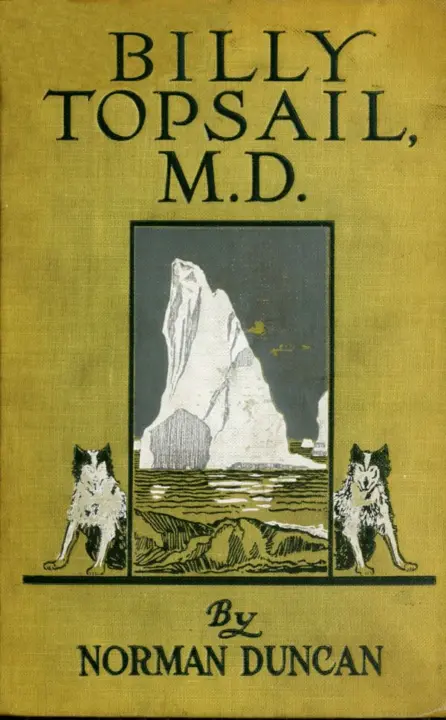
Billy Topsail, M.D.: A Tale of Adventure With Doctor Luke of the Labrador
Norman Duncan
THE CLASSIC COLLECTION · 1918
"Harbor Tales Down North" by Norman Duncan is a collection of short stories written in the early 20th century. The narratives explore life in coastal Newfoundland, focusing on the lives, struggles, and the rich, vibrant characters of the local community. The collection features themes of adventure, love, and the challenges faced by those living in a harsh yet beautiful maritime environment. The opening of the tale revolves around two young men, Tommy Lark and Sandy Rowl, who are confronted with a telegram meant for Elizabeth Luke's mother. The telegram hints at urgent news regarding Elizabeth, leading the two friends to discuss the potential significance of its contents. With a backdrop of a stormy sea and perilous ice conditions, Tommy is determined to deliver the telegram, believing Elizabeth may be in distress. As they assess the treacherous conditions of Scalawag Run, the tension escalates, revealing their fears, hopes, and complex emotions regarding their romantic feelings for Elizabeth, setting the stage for a gripping adventure.
Introduction adapted from the source catalogue; source summaries may be automatically generated.
Free to read · English · 59,649 words · No account needed
MAKE TIME FOR A GOOD BOOK
On by default. Untick to stop anonymous reading totals. Each page counts after 10 seconds in view. How this works.
Anonymous counting is on unless you have switched it off.
"He lifted his hand. 'Hark!' says he.
"Whatever she was, she was yellin' for help like a bull in a bog.
"'Whoo-o-o-oo! Whoo, whoo! Whoo-o-oo-ugh!'
"Cap'n Sammy grinned. 'I make a tramp cotched fast in the ice,' says
he.
"'Whoo-o-oo-ugh! Whoo, whoo, whoo, whoo-o-oop!'
"'I make a tramp,' says he, rubbin' his hands, 'with her propeller
ripped off.'
"I reached a hand for the rope.
"'Hol' on!' says he; 'you keep your hook off that there whistle.'
"'I was thinkin',' says I, 't' speed a message o' comfort.'
"'Let her beller a bit, ye dunderhead!' says he.
"'What for?' says I.
"'T' make sure in her own mind,' says he, 'that she needs a kindly
hand t' help her.'
"'Twould be easy enough for the steam-swiler Royal Bloodhound t' jerk that yelpin' tramp, had she lost her propeller--as well she might, poor helpless lady o' fashion! in that slob-ice--'twould be easy enough t' rip her through a league o' the floe t' open water, with a charge or two o' good black powder t' help.
"'Tumm,' says Cap'n Sammy, by an' by, 'how's the glass?'
"'She've the look an' conduct o' the devil, sir.'
"'Good!' says he. 'I hopes she kicks the bottom out. You might go so far as t' give that bellerin' ironclad a toot.'
"I tooted.
"'You come along o' me, Tumm,' says he, 'an' learn how t' squeeze a
lemon.'
"Cap'n Sammy kep' explodin' in little chuckles, like a bunch o' Queen's-birthday firecrackers, as we trudged the ice toward the howlin' ship in the mist. 'Twas a hundred fathoms o' rough goin', I promise you, that northern slob, in which the tramp an' the Royal Bloodhound lay neighbors; an' 'twas mixed with hummocks an' bergs, an' 'twas all raftered an' jammed by the westerly gales o' that season. After dawn then; an' 'twas a slow, greasy dawn, I mind. But the yellow light growed fast in the fog; an' the mist thinned in a whiff o' wind from the nor'west. 'Twould lift, by an' by: a clean, gray day. 'Every man for hisself,' says Cap'n Sammy, as we drawed near, 'an' the devil take the hindmost. She's a likely-lookin' craft. Pinched fast, too. An' the weather-glass kickin' at its foundations! Eh, Tumm? Every man for hisself.' It turned out Cap'n Sammy was right. She was a tramp, the Claymore, two thousand tons, outbound from Liverpool t' Canadian ports, loaded deep, an' now tight in the grip o' the ice. In a big blow o' wind her iron sides would yield like paper t' the crush o' the pack. An' if the signs read true that blow was brewin' in the nor'west. 'Twas breezin' up, down there, with the sky in a saucy temper. From the deck o' the Claymore I looked t' the west, where the little puffs o' wind was jumpin' from, an' t' the sour sky, an' roundabout upon the ice; an' I was glad I wasn't shipped aboard that thin-skinned British tramp, but was mate of a swilin'-steamer, Newf'un'land built, with sixteen-inch oak sides, an' thrice braced with oak in the bows. She was spick an' span, that big black tramp, fore an' aft, aloft an' below; but in a drive o' ice--with the wind whippin' it up, an' the night dark, an' the pack a livin', roarin' whirlpool o' pans an' bergs--white decks an' polished brass don't count for much. 'Tis a stout oak bottom, then, that makes for peace o' mind.
Your reading position is saved on this browser. Take it to another device with a library code. Reading pages adapt to text, rather than matching a printed edition.
Norman Duncan
Norman Duncan
Norman Duncan
Norman Duncan
BEHIND THE BOOK
This eBook is for the use of anyone anywhere in the United States and most other parts of the world at no cost and with almost no restrictions whatsoever. You may copy it, give it away or re-use it under the terms of the Project Gutenberg License included with this eBook or online at www.gutenberg.org. If you are not located in the United States, you will have to check the laws of the country where you are located before using this eBook. Read the source licence.
The original source file, including credits and licence, is retained by this library. Request an original-format copy at no charge. Please include the book title and Project Gutenberg identifier #24520.
KEEP YOUR CURIOSITY GOING
Coulson Kernahan

Maurice Baring
Frances Wright
Cécile Tormay

Frederic Jesup Stimson

W. H. P. (William Henry Pope) Jarvis