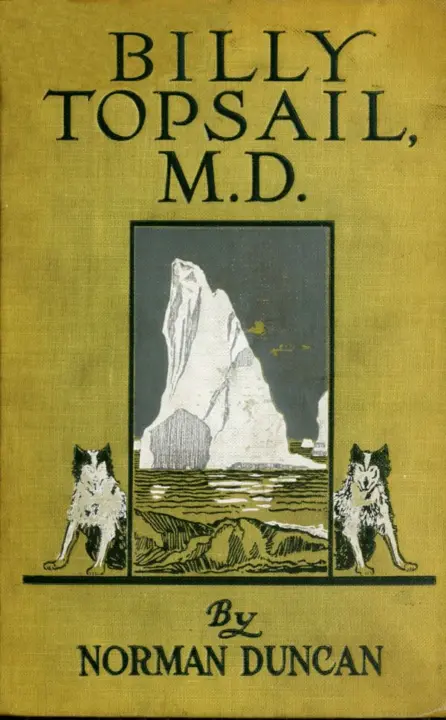
Billy Topsail, M.D.: A Tale of Adventure With Doctor Luke of the Labrador
Norman Duncan
THE CLASSIC COLLECTION · 1918
"Harbor Tales Down North" by Norman Duncan is a collection of short stories written in the early 20th century. The narratives explore life in coastal Newfoundland, focusing on the lives, struggles, and the rich, vibrant characters of the local community. The collection features themes of adventure, love, and the challenges faced by those living in a harsh yet beautiful maritime environment. The opening of the tale revolves around two young men, Tommy Lark and Sandy Rowl, who are confronted with a telegram meant for Elizabeth Luke's mother. The telegram hints at urgent news regarding Elizabeth, leading the two friends to discuss the potential significance of its contents. With a backdrop of a stormy sea and perilous ice conditions, Tommy is determined to deliver the telegram, believing Elizabeth may be in distress. As they assess the treacherous conditions of Scalawag Run, the tension escalates, revealing their fears, hopes, and complex emotions regarding their romantic feelings for Elizabeth, setting the stage for a gripping adventure.
Introduction adapted from the source catalogue; source summaries may be automatically generated.
Free to read · English · 59,649 words · No account needed
MAKE TIME FOR A GOOD BOOK
On by default. Untick to stop anonymous reading totals. Each page counts after 10 seconds in view. How this works.
Anonymous counting is on unless you have switched it off.
"Anthony," says he, "does that sort o' thing give you any real
pleasure?"
"What sort o' thing?"
"Tellin' a yarn like that to a wee lad like he?"
"'Twasn't nothin' wrong."
"Nothin' wrong!--t' bait un so?"
"Jus' a bit o' sport."
"Sorry sport!"
"Ah, well, he've growed used to it."
T' this the lad was listenin' like a caribou o' the barrens scentin'
peril.
"'Twas a naughty thing t' do, ye ol' crab!" says the skipper t'
Anthony Lot.
The lad struck in.
"Isn't it true?" says he.
Skipper Harry cotched the quiver o' doubt an' fear in his voice an' was warned jus' in time. There was jus' one thing t' say.
"True?" says the skipper. "Sure, 'tis true! Who doubts it?"
"Not me," says Anthony.
"Ye hadn't better!" says the skipper.
"You bet ye 'tis true!" says I. "I've heared that selfsame tale many a
time afore."
"Sammy, my son," says the skipper, "who is your father anyhow?"
The lad fair glowed with pride, as it seemed t' me then. Up went his head--out went his wee chest; an' his eyes went wide an' shinin', an' he smiled, an' the blood o' pride flushed his cheeks red.
"I'm John Scull's son!" says he.
Anthony Lot throwed back his head an' shot a laugh through his musty
beard.
"Now," says he, "d'ye think it comical?"
Skipper Harry shook his head.
"God, no!" says he.
"What's the matter?" says the lad. His mouth was twitchin'. 'Twas awful t' behold. 'Tis worse when I think o' the whole truth of his state. "What's--what's the m-m-matter?" says he. "Wh-wh-what's the matter?"
Skipper Harry an' me jus' sot there starin' at un. John Scull's son! Everybody in Newf'un'land knowed all about John Scull o' Hide-an'-Seek Harbor.
'Twas plain--the whole tale o' the lad's little life. In all my travels afore I had never encountered a child in a state as woeful an' helpless as that. In the beginnin', no doubt, 'twas needful t' lie t' un--a baby, no more, bewildered by a mystery that he had now forgot all about, an' plyin' folk with questions in ease o' the desolation in which his father had plunged un. The folk o' Hide-an'-Seek Harbor had lied in kindness at first--'twas all plain; an' in the drift o' the years since then, little by little, more an' more, with less conscience all the while, they had lied for their own amusement. Look you, the lad had boasted, no doubt, an' was a comical sight when he did--chest out an' face scowlin' an' flushed, as we had seed it that night, an' his wee legs spread an' his way growed loud, whilst he declared the virtues of a father whose fortune was knowed to them all, young an' old alike, an' whose fate was a by-word. In the end, I'm thinkin', 'twas a cherished sport, followed by the folk o' the harbor an' all strangers, thus t' tell wild tales t' the lad, an' the wilder the more comical, of his father's great deeds; an' 'twas a better sport still, an' far more laughable, t' gather 'round un, at times, for their own amusement an' the entertainment o' travelers, an' hear un repeat, with his own small inventions t' season them, the whoppin' yarns they had teached un t' believe.
Your reading position is saved on this browser. Take it to another device with a library code. Reading pages adapt to text, rather than matching a printed edition.
Norman Duncan
Norman Duncan
Norman Duncan
Norman Duncan
BEHIND THE BOOK
This eBook is for the use of anyone anywhere in the United States and most other parts of the world at no cost and with almost no restrictions whatsoever. You may copy it, give it away or re-use it under the terms of the Project Gutenberg License included with this eBook or online at www.gutenberg.org. If you are not located in the United States, you will have to check the laws of the country where you are located before using this eBook. Read the source licence.
The original source file, including credits and licence, is retained by this library. Request an original-format copy at no charge. Please include the book title and Project Gutenberg identifier #24520.
KEEP YOUR CURIOSITY GOING
Coulson Kernahan

Maurice Baring
Frances Wright
Cécile Tormay

Frederic Jesup Stimson

W. H. P. (William Henry Pope) Jarvis