The New Glutton or Epicure
Horace Fletcher
THE CLASSIC COLLECTION · 1898
"Happiness as Found in Forethought Minus Fearthought" by Horace Fletcher is a philosophical treatise written in the late 19th century. The work explores the concepts of happiness, fear, and the importance of cultivating a positive mindset through the elimination of negative thoughts. Fletcher argues that understanding and improving one's mental habits can lead to true happiness, which he describes as a result of conscious usefulness and personal growth. The opening of the text introduces the central idea that everyone desires to be happy, and highlights the pervasive nature of fear in human experience. Fletcher shares personal anecdotes, emphasizing that happiness can be achieved through changing one’s mindset and behaviors. He discusses the duality of forethought (positive thinking) and fearthought (negative thinking), asserting that the latter can detract from growth and well-being. As he sets the stage for presenting methods to enhance happiness and eliminate fear, he draws upon historical and personal experiences to illustrate how individuals can cultivate a more harmonious and fulfilled life.
Introduction adapted from the source catalogue; source summaries may be automatically generated.
Free to read · English · 36,999 words · No account needed
MAKE TIME FOR A GOOD BOOK
On by default. Untick to stop anonymous reading totals. Each page counts after 10 seconds in view. How this works.
Anonymous counting is on unless you have switched it off.
The birth of the soul of man is accomplished when he attains consciousness of what is good, of what his functions and duties are relative to his own best growth, and also relative to his uses and duties as a member of society.
Man is not fully born until his mind is conscious of his body and conscious of his soul, and knows the functions and duties of each relative to the best growth.
Until man is fully born, as described above, the responsibility of his perfection or imperfection rests with his teachers and their teachings.
Everything that man is conscious of is his teacher.
You are the teacher of every person who sees or is otherwise conscious of you or of your example.
It is unmanly, and especially unchristian, not to seek the greatest possible enlightenment relative to the functions and duties in growth, not only for your own sake, but as an example for others; and, being enlightened, not to do all possible to assist growth.
Whoever reads and assents to the above, takes upon himself the responsibility of his future growth, and will be respectable or not-respectable insofar as he seeks enlightenment and assists growth, or neglects to seek enlightenment and thereby retards growth.
Happiness, the evidence, fruit and reward of growth, rests in
self-respect first, and, incidentally, in the measure of respect held
by others.
No one is respectable who is not doing his best.
When a man finds fault with the material with which he has been furnished--with his form, with his face, with his mind, with his muscle, with his equipment of wealth, or other means or tools of growth, at the time of his being fully born, he puts blame upon, and thereby blasphemes, his Creator, as well as discredits his progenitors.
Whoever reads, and assents to, the foregoing is fully born, in that he has learned and now knows what is best. The question then is: "What will he do with it?"
In highly-civilized life it is not-respectable not to be fully born.
The fully-born is not doing his best, and is therefore not-respectable when he suffers himself to retain or cultivate the habit-of-fearthought.
The fully-born is not doing his best, and therefore is not-respectable, when he entertains and nurses worry.
The fully-born is doing his worst when he allows himself to be angry.
The fully-born is unmanly, especially unchristian and altogether not-respectable when he is not doing his best, and is always a subject for pity, and frequently a subject for contempt, when he is doing his worst.
Your reading position is saved on this browser. Take it to another device with a library code. Reading pages adapt to text, rather than matching a printed edition.
Horace Fletcher
Horace Fletcher
Horace Fletcher
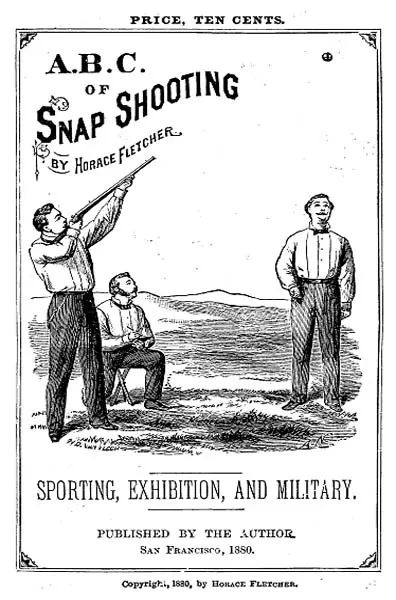
Horace Fletcher
BEHIND THE BOOK
This eBook is for the use of anyone anywhere in the United States and most other parts of the world at no cost and with almost no restrictions whatsoever. You may copy it, give it away or re-use it under the terms of the Project Gutenberg License included with this eBook or online at www.gutenberg.org. If you are not located in the United States, you will have to check the laws of the country where you are located before using this eBook. Read the source licence.
The original source file, including credits and licence, is retained by this library. Request an original-format copy at no charge. Please include the book title and Project Gutenberg identifier #46777.
KEEP YOUR CURIOSITY GOING

David Patterson (Spirit) Hatch
Coulson Kernahan

Ralph Waldo Emerson
Frances Wright

Edwin Abbott Abbott

Joseph Droz