The Olden Time Series: Vol. 2: The Days of the Spinning-Wheel in New England Gleanings Chiefly from old Newspapers of Boston and Salem, Massachusetts
Henry M. (Henry Mason) Brooks
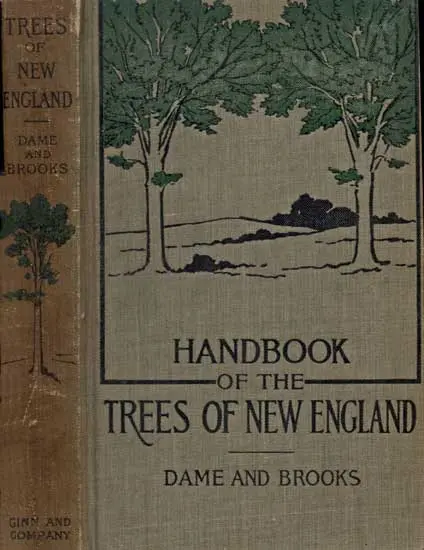
THE CLASSIC COLLECTION · 1901
"Handbook of the Trees of New England" by Lorin Low Dame and Henry M. Brooks is a scientific publication written in the early 20th century. This comprehensive guide serves as an illustrated manual for identifying trees native to New England and those established in the region, highlighting their characteristics and geographical distribution. It aims to provide a clear understanding of trees in this specific area, distinguishing between subtropical and boreal species as they coexist. The opening of the handbook establishes the need for an accessible resource on the trees of New England, emphasizing the interplay between various floras found in the region. The authors discuss the characteristics of trees as they transition between their native habitats and how these traits can vary along their geographical range. They outline the organization of the book, detailing how it will categorize trees by their leaf structure and provide information on their habitat, horticultural value, and distribution. The introduction sets the tone for a detailed examination of botanical intricacies and practical utility for both enthusiasts and professionals interested in botany and ecology.
Introduction adapted from the source catalogue; source summaries may be automatically generated.
Free to read · English · 52,631 words · No account needed
MAKE TIME FOR A GOOD BOOK
On by default. Untick to stop anonymous reading totals. Each page counts after 10 seconds in view. How this works.
Anonymous counting is on unless you have switched it off.
"Leaves elliptical or on vigorous shoots mostly semiorbicular, acute or acuminate, divided above the middle into numerous acute coarsely glandular-serrate lobes, cuneate and finely glandular-serrate below the middle and often quite entire toward the base, with slender midribs and remote primary veins arcuate and running to the points of the lobes, at the flowering time membranaceous, coated on the upper surface and along the upper surface of the midribs and veins with short soft white hairs, at maturity thick, coriaceous, dark green and lustrous on the upper surface, paler on the lower surface, glabrous or nearly so, 1-1/2-2 inches long and 1-1-1/2 inches wide, with slender glandular petioles 3/4-1 inch long, slightly grooved on the upper surface, often dark red toward the base, and like the young branchlets villous with pale soft hairs; stipules lanceolate to oblanceolate, conspicuously glandular-serrate with dark red glands, 1/2-3/4 inch long. Flowers 1/2-3/4 inch in diameter when fully expanded, in broad, many-flowered, compound tomentose cymes; bracts and bractlets linear-lanceolate, coarsely glandular-serrate, caducous; calyx tomentose, the lobes lanceolate, glandular-serrate, nearly glabrous or tomentose, persistent, wide-spreading or erect on the fruit, dark red above at the base; stamens 10; anthers yellow; styles 3 or 4. Fruit subglobose, occasionally rather longer than broad, dark crimson, marked with scattered dark dots, about 1/2 inch in diameter, with thin, sweet, dry yellow flesh; nutlets 3 or 4, about 1/4 inch long, conspicuously ridged on the back with high grooved ridges.
"A low, bushy tree, occasionally 20 feet in height with a short trunk 8-10 inches in diameter, or more frequently shrubby and forming wide dense thickets, and with stout more or less zigzag branches bright chestnut brown and lustrous during their first year, ashy-gray during their second season and armed with many stout, chestnut-brown, straight or curved spines 1-1-1/2 inches long. Flowers late in May. Fruit ripens and falls toward the end of October, usually after the leaves.
"Slopes of hills and the high banks of salt marshes usually in rich, well-drained soil, Essex county, Massachusetts, John Robinson, 1900; Gerrish island, Maine, J. G. Jack, 1899-1900; Brunswick, Maine, Miss Kate Furbish, May, 1899; Newfoundland, A. C. Waghorne, 1894."[1]
[Footnote 1: Prof. C. S. Sargent in Bot. Gaz., XXXI, 12. By permission
of the publishers.]
=Crataegus mollis, Scheele.=
Crataegus subvillosa, Schr. Crataegus coccinea, var. mollis, T. & G.
=Habitat and Range.=--Bordering on low lands and along streams.
Provinces of Quebec and Ontario.
Maine,--as far north as Mattawamkeag on the middle Penobscot, Dover on the Piscataquis, and Orono on the lower Penobscot; reported also from southern sections; Vermont,--Charlotte (Hosford); Massachusetts,--in the eastern part infrequent; no stations reported in the other New England states.
South to Pennsylvania, Louisiana, and Texas; west to Michigan and
Missouri.
Your reading position is saved on this browser. Take it to another device with a library code. Reading pages adapt to text, rather than matching a printed edition.
Henry M. (Henry Mason) Brooks
Henry M. (Henry Mason) Brooks
Henry M. (Henry Mason) Brooks
Henry M. (Henry Mason) Brooks
BEHIND THE BOOK
This eBook is for the use of anyone anywhere in the United States and most other parts of the world at no cost and with almost no restrictions whatsoever. You may copy it, give it away or re-use it under the terms of the Project Gutenberg License included with this eBook or online at www.gutenberg.org. If you are not located in the United States, you will have to check the laws of the country where you are located before using this eBook. Read the source licence.
The original source file, including credits and licence, is retained by this library. Request an original-format copy at no charge. Please include the book title and Project Gutenberg identifier #20467.
KEEP YOUR CURIOSITY GOING
Cécile Tormay

Moritz Busch
John L. Ransom
Frances Wright
Cécile Tormay

Mabel Potter Daggett