The Olden Time Series: Vol. 2: The Days of the Spinning-Wheel in New England Gleanings Chiefly from old Newspapers of Boston and Salem, Massachusetts
Henry M. (Henry Mason) Brooks
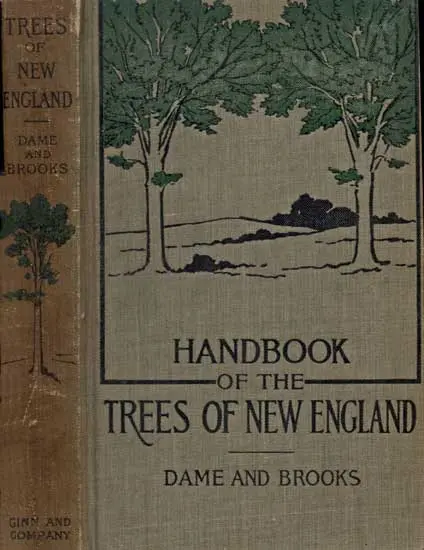
THE CLASSIC COLLECTION · 1901
"Handbook of the Trees of New England" by Lorin Low Dame and Henry M. Brooks is a scientific publication written in the early 20th century. This comprehensive guide serves as an illustrated manual for identifying trees native to New England and those established in the region, highlighting their characteristics and geographical distribution. It aims to provide a clear understanding of trees in this specific area, distinguishing between subtropical and boreal species as they coexist. The opening of the handbook establishes the need for an accessible resource on the trees of New England, emphasizing the interplay between various floras found in the region. The authors discuss the characteristics of trees as they transition between their native habitats and how these traits can vary along their geographical range. They outline the organization of the book, detailing how it will categorize trees by their leaf structure and provide information on their habitat, horticultural value, and distribution. The introduction sets the tone for a detailed examination of botanical intricacies and practical utility for both enthusiasts and professionals interested in botany and ecology.
Introduction adapted from the source catalogue; source summaries may be automatically generated.
Free to read · English · 52,631 words · No account needed
MAKE TIME FOR A GOOD BOOK
On by default. Untick to stop anonymous reading totals. Each page counts after 10 seconds in view. How this works.
Anonymous counting is on unless you have switched it off.
=Habit.=--Farther south, a tree of the first magnitude, reaching a height of 100 feet, with a trunk diameter of 4 feet; in southern New England occasionally attaining in woodlands a height of 50-60 feet; at its northern limit in Massachusetts, usually 10 to 35 feet in height, with a diameter at the ground of 6-12 inches. The trunk throws out stout, tough, and often conspicuously crooked branches, the lower horizontal or declining, forming a disproportionately large head, with dark green, dense foliage. Near the shore the limbs often grow very low, stretching along the ground as if from an underground stem.
=Bark.=--Resembling that of the white oak, but rather a darker gray, rougher and firmer; upon old trunks furrowed and cut into oblongs; small limbs brownish-gray, rough-dotted; season's shoots densely tawny-tomentose.
=Winter Buds and Leaves.=--Buds small, rounded or conical, brownish, scales minutely pubescent or scurfy. Leaves simple, alternate, 3-8 inches long, two-thirds as wide, thickish, yellowish-green and tomentose upon both sides when young, becoming a deep, somewhat glossy green above, lighter beneath, both sides still somewhat scurfy; general outline of leaf and of lobes, and number and shape of the latter, extremely variable; type-form 5-lobed, all the lobes rounded, the three upper lobes much larger, more or less subdivided, often squarish, the two lower tapering to an acute, rounded, or truncate base; sinuses deep, variable, often at right angles to the midrib; leafstalk short, tomentose; stipules linear, pubescent, occasionally persistent till midsummer. The leaves are often arranged at the tips of the branches in star-shaped clusters, giving rise to the specific name stellata.
=Inflorescence.=--May. Sterile catkins 1-3 inches long, connecting thread woolly; calyx 4-8 parted, lobes acute, densely pubescent, yellow; stamens 4-8, anthers with scattered hairs: pistillate flowers single or in clusters of 2, 3, or more, sessile or on a short stem; stigma red.
=Fruit.=--Maturing the first season, single and sessile, or nearly so, or in clusters of 2, 3, or more, on short footstalks: cup top-shaped or cup-shaped, 1/3-1/2 the length of the acorn, about 3/4 inch wide, thin; scales smooth or sometimes hairy along the top, acutish or roundish, slightly thickened at base: acorn 1/2-1 inch long, sweet.
=Horticultural Value.=--Hardy in New England; prefers a good, well-drained, open soil; quite as slow-growing as the white oak; seldom found in nurseries and difficult to transplant. Propagated from the seed.
1. Winter buds.
2. Flowering branch.
3. Sterile flower, back view.
4. Sterile flower, front view.
5. Fertile flower.
6. Fruiting branch.
=Quercus macrocarpa, Michx.=
=Habitat and Range.=--Deep, rich soil; river valleys.
Nova Scotia to Manitoba, not attaining in this region the size of the white oak, nor covering as large areas.
Your reading position is saved on this browser. Take it to another device with a library code. Reading pages adapt to text, rather than matching a printed edition.
Henry M. (Henry Mason) Brooks
Henry M. (Henry Mason) Brooks
Henry M. (Henry Mason) Brooks
Henry M. (Henry Mason) Brooks
BEHIND THE BOOK
This eBook is for the use of anyone anywhere in the United States and most other parts of the world at no cost and with almost no restrictions whatsoever. You may copy it, give it away or re-use it under the terms of the Project Gutenberg License included with this eBook or online at www.gutenberg.org. If you are not located in the United States, you will have to check the laws of the country where you are located before using this eBook. Read the source licence.
The original source file, including credits and licence, is retained by this library. Request an original-format copy at no charge. Please include the book title and Project Gutenberg identifier #20467.
KEEP YOUR CURIOSITY GOING
Cécile Tormay

Moritz Busch
John L. Ransom
Frances Wright
Cécile Tormay

Mabel Potter Daggett