The Olden Time Series: Vol. 2: The Days of the Spinning-Wheel in New England Gleanings Chiefly from old Newspapers of Boston and Salem, Massachusetts
Henry M. (Henry Mason) Brooks
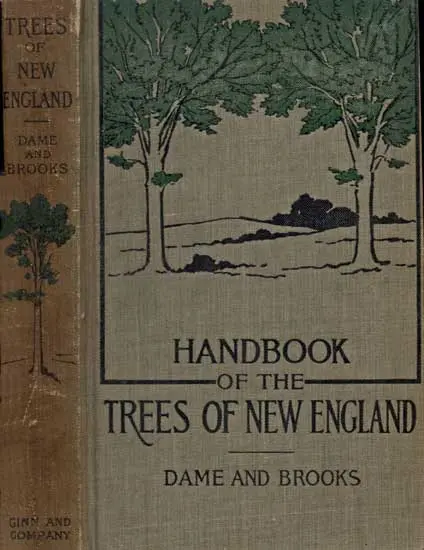
THE CLASSIC COLLECTION · 1901
"Handbook of the Trees of New England" by Lorin Low Dame and Henry M. Brooks is a scientific publication written in the early 20th century. This comprehensive guide serves as an illustrated manual for identifying trees native to New England and those established in the region, highlighting their characteristics and geographical distribution. It aims to provide a clear understanding of trees in this specific area, distinguishing between subtropical and boreal species as they coexist. The opening of the handbook establishes the need for an accessible resource on the trees of New England, emphasizing the interplay between various floras found in the region. The authors discuss the characteristics of trees as they transition between their native habitats and how these traits can vary along their geographical range. They outline the organization of the book, detailing how it will categorize trees by their leaf structure and provide information on their habitat, horticultural value, and distribution. The introduction sets the tone for a detailed examination of botanical intricacies and practical utility for both enthusiasts and professionals interested in botany and ecology.
Introduction adapted from the source catalogue; source summaries may be automatically generated.
Free to read · English · 52,631 words · No account needed
MAKE TIME FOR A GOOD BOOK
On by default. Untick to stop anonymous reading totals. Each page counts after 10 seconds in view. How this works.
Anonymous counting is on unless you have switched it off.
=Habit.=--The most beautiful of the New England pines, 50-75 feet high, with a diameter of 2-3 feet at the ground; reaching in Maine a height of 100 feet and upwards; trunk straight, scarcely tapering; branches low, stout, horizontal or scarcely declined, forming a broad-based, rounded or conical head of great beauty when young, becoming more or less irregular with age; foliage of a rich dark green, in long dense tufts at the ends of the branches.
=Bark.=--Bark of trunk reddish-brown, in old trees marked by flat ridges which separate on the surface into thin, flat, loose scales; branchlets rough with persistent bases of leaf buds; season's shoots stout, orange-brown, smooth.
=Winter Buds and Leaves.=--Leading branch-buds conical, about 3/4 inch long, tapering to a sharp point, reddish-brown, invested with rather loose scales.
Foliage leaves in twos, from close, elongated, persistent, and conspicuous sheaths, about 6 inches long, dark green, needle-shaped, straight, sharply and stiffly pointed, the outer surface round and the inner flattish, both surfaces marked by lines of minute pale dots.
=Inflorescence.=--Sterile flowers clustered at the base of the season's shoots, oblong, 1/2-3/4 inch long: fertile flowers single or few, at the ends of the season's shoots.
=Fruit.=--Cones near extremity of shoot, at right angles to the stem, maturing the second year, 1-3 inches long, ovate to oblong conical; when opened broadly oval or roundish; scales not hooked or pointed, thickened at the apex.
=Horticultural Value.=--Hardy in New England; a tall, dark-foliaged evergreen, for which there is no substitute; grows rapidly in all well-drained soils and in exposed inland or seashore situations; seldom disfigured by insects or disease; difficult to transplant and not common in nurseries. Propagated from seed.
1. Branch with sterile flowers.
2. Stamen, front view.
3. Stamen, top view.
4. Branch with fertile flowers and one-year-old cones.
5. Bract and ovuliferous scale, outer side.
6. Ovuliferous scale with ovules, inner side.
7. Fruiting branch showing cones of three different seasons.
8. Seeds with cone-scale.
9, 10. Cross-sections of leaves.
= Pinus sylvestris, L.=
SCOTCH PINE (sometimes incorrectly called the Scotch fir).
Indigenous in the northern parts of Scotland and in the Alps, and from Sweden and Norway, where it forms large forests eastward throughout northern Europe and Asia.
At Southington, Conn., many of these trees, probably originating from an introduced pine in the vicinity, were formerly scattered over a rocky pasture and in the adjoining woods, a tract of about two acres in extent. Most of these were cut down in 1898, but the survivors, if left to themselves, will doubtless multiply rapidly, as the conditions have proved very favorable (C. H. Bissell in lit., 1899).
Your reading position is saved on this browser. Take it to another device with a library code. Reading pages adapt to text, rather than matching a printed edition.
Henry M. (Henry Mason) Brooks
Henry M. (Henry Mason) Brooks
Henry M. (Henry Mason) Brooks
Henry M. (Henry Mason) Brooks
BEHIND THE BOOK
This eBook is for the use of anyone anywhere in the United States and most other parts of the world at no cost and with almost no restrictions whatsoever. You may copy it, give it away or re-use it under the terms of the Project Gutenberg License included with this eBook or online at www.gutenberg.org. If you are not located in the United States, you will have to check the laws of the country where you are located before using this eBook. Read the source licence.
The original source file, including credits and licence, is retained by this library. Request an original-format copy at no charge. Please include the book title and Project Gutenberg identifier #20467.
KEEP YOUR CURIOSITY GOING
Cécile Tormay

Moritz Busch
John L. Ransom
Frances Wright
Cécile Tormay

Mabel Potter Daggett