
The Writing of News A Handbook with Chapters on Newspaper Correspondence and Copy Reading
Charles G. (Charles Griffith) Ross
THE CLASSIC COLLECTION · 1884
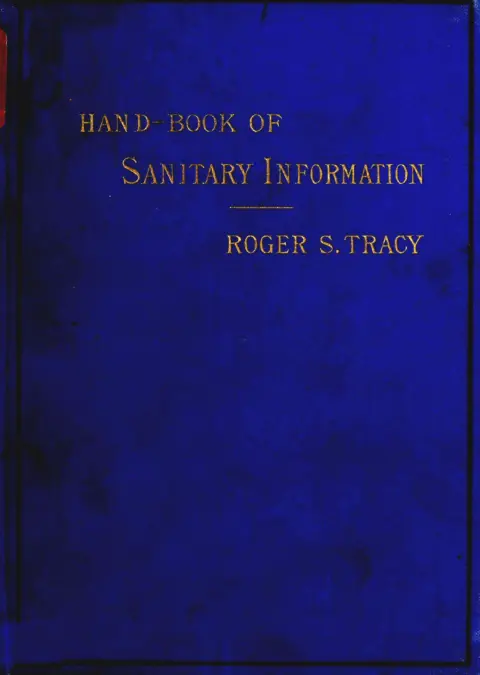
"Hand-book of Sanitary Information for Householders" by Roger Sherman Tracy is a scientific publication written in the late 19th century. The work serves as a comprehensive guide aimed at educating householders on crucial sanitary practices related to air quality, drainage, and food safety. It encompasses a range of topics including ventilation, the management of contagious diseases, and methods for ensuring safe food and water. The opening portion introduces the overall aim of the book, which is to consolidate and simplify sanitary information that has been too scattered or technical for the average householder to easily grasp. Tracy outlines the importance of good air, food, and water for health, emphasizing that the book will provide practical facts and suggestions across various chapters. Detailed contents reflect a structured approach to topics like air composition, ventilation methods, drainage systems, and food adulteration, aiming to equip readers with knowledge necessary for maintaining a healthy living environment.
Introduction adapted from the source catalogue; source summaries may be automatically generated.
Free to read · English · 21,666 words · No account needed
MAKE TIME FOR A GOOD BOOK
On by default. Untick to stop anonymous reading totals. Each page counts after 10 seconds in view. How this works.
Anonymous counting is on unless you have switched it off.
=Zinc Salts.=—The sulphate and the chloride of zinc are excellent disinfectants. They are colorless, and can therefore be used on clothing. They form, with albuminous matters, extremely insoluble compounds, and also absorb gases from putrefying material. They are the best disinfectants of their class. The sulphate is cheaper, but the chloride more efficient. Sulphate of zinc, 10 cents an ounce; chloride of zinc, 20 cents an ounce.
It is better and cheaper to buy and mix one’s own disinfectants. The many proprietary articles are no more efficient, and are very expensive. The composition of some of those most in use is here given. (Analyses by Waller, of the New York City Health Department.)
The first column gives parts in 100, and the second, ounces in a gallon in the case of liquids, and ounces in a pound in case of powders.
Bromo-chloralum (Tilden & Co.), 50 cents a pint.
Chloride of aluminum 8.152 12.71 Water, bromide of aluminum, lime salts, etc. 91.848 143.25 ———- ——— 100.000 155.96
Burnett’s Fluid is a solution of chloride of zinc (25 grains to the
drachm).
Carbolate of lime, in three-quarter pound boxes, at 25 cents.
Lime 64.245 10.28 Magnesia 0.602 0.09 Sand, oxide of iron, etc. 0.670 0.11 Carbolic acid 0.472 0.07 Carbonic acid and organic impurities 34.021 5.45 ———- ——- 100.000 16.00
Chloralum (English Chloralum Co.), 50 cents a pint.
Chloride of aluminum 13.213 20.14 Sulphate of lime 0.197 0.30 Water, chloride of calcium, etc. 86.590 131.99 ———- ——— 100.000 152.43
Chloride of lime, 20 cents a pound.
Available chlorine 31.38 5.02 Lime salts, water, etc. 68.62 10.98 ——— ——- 100.00 16.00
Condy’s Fluid is a solution of permanganate of potash (9.26 grains to a fluid ounce, about 2-1/2 drachms to the pint).
Darby’s Prophylactic Fluid, 50 cents a half-pint.
Permanganate of potash 0.055 0.08 Sulphate of potash 1.750 2.50 Chloride of potassium 1.270 1.81 Carbonate of potash 6.570 9.40 Water 90.355 129.24 ———- ——— 100.000 143.03
Egyptian Disinfectant, 25 cents a pound.
Clay 87.810 14.05 Lime 0.354 0.06 Carbolic acid 0.320 0.05 Other constituents of dead oil 5.685 0.91 Organic matter and water 5.831 0.93 ———- ——- 100.000 16.00
Excelsior Disinfectant, 15 cents a pound.
Protosulphate of iron (copperas) 31.464 5.03 Chloride of sodium (salt) 19.251 3.08 Flowers of sulphur 7.800 1.25 Water of crystallization, cassia-oil, etc. 41.485 6.64 ———- ——- 100.000 16.00
The Germicide is a patented apparatus for discharging chloride of zinc into the bowl of the water-closet, and impregnating the air at the same time with the vapor of thymol.
Girondin Disinfectant, 75 cents a quart.
Sulphate of zinc 19.692 32.64 Sulphate of copper 1.202 1.99 Sulphate of lime 0.480 0.79 Water, traces of calcium chloride, etc. 78.626 130.34 ———- ——— 100.000 165.76
Labarraque’s Solution, 50 cents a pint.
Available chlorine 1.423 1.96 Water and soda salts 98.577 135.54 ———- ——— 100.000 137.50
Metropolitan Disinfectant, 30 cents a quart.
Protosulphate of iron (copperas) 11.413 17.10 Carbolic acid (about) 3.330 4.99 Water, dead oil, and impurities 85.257 127.74 ———- ——— 100.000 149.83
Phenix Disinfectant, 35 cents a pound.
Silicate of alumina (clay) 56.876 9.10 Sesquichloride of iron 1.192 0.19 Sesquioxide of iron 7.102 1.14 Lime 2.470 0.39 Carbolic acid 0.400 0.06 Carbonic acid and organic impurities 31.960 5.12 ———- ——— 100.000 16.00
Phenol Sodique, 50 cents a half pint.
Carbolic acid 1.177 1.61 Soda salts, water, and impurities 98.823 134.29 ———- ——— 100.000 135.90
Platt’s Chlorides, 50 cents a quart.
Your reading position is saved on this browser. Take it to another device with a library code. Reading pages adapt to text, rather than matching a printed edition.
BEHIND THE BOOK
This eBook is for the use of anyone anywhere in the United States and most other parts of the world at no cost and with almost no restrictions whatsoever. You may copy it, give it away or re-use it under the terms of the Project Gutenberg License included with this eBook or online at www.gutenberg.org. If you are not located in the United States, you will have to check the laws of the country where you are located before using this eBook. Read the source licence.
The original source file, including credits and licence, is retained by this library. Request an original-format copy at no charge. Please include the book title and Project Gutenberg identifier #67768.
KEEP YOUR CURIOSITY GOING
Charles G. (Charles Griffith) Ross
Hannah Webster Foster

Emily Lawless
Edwin Hamlin Carr

Charles De Lano Hine
Andrew Ure