
The Writing of News A Handbook with Chapters on Newspaper Correspondence and Copy Reading
Charles G. (Charles Griffith) Ross
THE CLASSIC COLLECTION · 1884
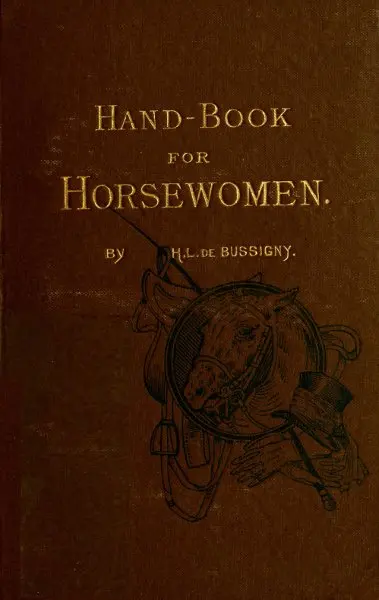
"Hand-book for Horsewomen" by H. L. de Bussigny is an instructional guide focused on equitation, written in the late 19th century. The book addresses the unique challenges that women face in horsemanship, proposing methods that combine both the English and continental riding styles. It emphasizes the importance of understanding horse management, proper riding techniques, and the specific needs of female riders to become proficient equestrians. The opening of the text establishes a framework for the discussion of riding styles, contrasting the English and continental techniques, and explaining their relevance for ladies who ride. It highlights how the common perception that women cannot ride as effectively as men is a misconception, provided they receive proper instruction tailored to their needs. De Bussigny delves into the fundamental aspects of mounting, dismounting, and maintaining a correct position on horseback, while also addressing the attire and equipment that facilitate a comfortable riding experience. Overall, this introduction sets the stage for a thorough exploration of the skills necessary to become an accomplished horsewoman.
Introduction adapted from the source catalogue; source summaries may be automatically generated.
Free to read · English · 18,948 words · No account needed
MAKE TIME FOR A GOOD BOOK
On by default. Untick to stop anonymous reading totals. Each page counts after 10 seconds in view. How this works.
Anonymous counting is on unless you have switched it off.
After the siege of Paris, in 1871, I was obliged to undertake the training of the horses of my regiment, which was then stationed at Massy. These horses were all young and unbroken; and, as a result of their youth and the fatigues they had undergone, they were in poor condition, and nearly all had sore backs. I directed all the teachers who were under me, and the men who rode the horses during their training, to rise at the trot; and, three months later, the young horses were in perfect health, while their riders, who had been exhausted by a severe campaign, had gained on an average seven pounds in weight; and it was this experiment which was submitted by me to the "Equestrian Committee."
I was tempted to make this digression, which I hope will be forgiven me, because I have heard in this country a great deal of adverse and, in my opinion, unjust criticism of the English trot, which I ascribe to the neglect of teachers, and the indifference of ladies brought up in the old school of riding to prefer horses which cantered all the time, or were broken to artificial gaits, like racking and pacing.
The rider who wishes to rise to the trot should be careful that the stirrup is not so short as to keep her left leg in constant contact with the third pommel, or leaping-horn, as, unless there is the space of three or four fingers between the pommel and the leg, the latter may be bruised, and the rider forced down too soon.
In order to explain this movement, the teacher may proceed as follows: Placing himself at the left side of the horse, he will ask the pupil to take the reins in her left hand and put her right hand on the first pommel, with the thumb inside and the palm of the hand on the pommel; he will then take her left foot in his left hand, in order to prevent her from pushing it forward, explaining that, by pressing on the stirrup, she will develop the obtuse angle formed by her leg, of which the knee is the apex; whereas, if she pushes her foot forward, the angle will cease to exist, and she can not lift herself. With his right hand placed under her left arm, he will help her to lift herself perpendicularly; while she is in the air he will count one, will let her pause there for a short space of time, and will then help her to let herself slowly down, continuing the pressure on the stirrup, and, when she has regained her saddle, he will count two; then he will recommence the movement of rising, and will count three while she is in the air, and four when she is again seated; and this may be continued until he sees that she is beginning to be tired. The foot must only be one third of its length in the stirrup; for, if it is pushed home, she will lose the play of the ankle, which will tend to stiffen the knee and hip. When the pupil begins to understand, the teacher will let her go through the movement rather more quickly, still counting one, two, three, four; then he will allow her to practice it without his help: all this preparatory work being done while the horse is standing still. It is important that she should not drop into her saddle, but let herself down by pressing on the stirrup; and on no account should the right knee cease to be in contact with the second pommel, as this is the sole case in which the lower part of this leg is motionless while the upper part moves. As soon as the pupil can rise without too much effort, and tolerably quickly, she may practice it at the walk, and then at the trot, counting for herself, one, two, three, four; and she must put a certain amount of energy into it, for all the theory in the world will not teach her to rise in time with the horse unless she also helps herself. The theory of the rhythmical cadence is easy enough to give: the rider rises when the horse takes one step, and sinks back at the second, to rise again at the third; but the cadence itself is not so easy to find; and to rise at the wrong step is like beginning on the wrong beat of a waltz. Many young persons get into the bad habit of lowering the right knee when they rise, and lifting it when they regain their seat; but this is a mistake, as the right knee should be immovable, and in constant contact with the second pommel.
Your reading position is saved on this browser. Take it to another device with a library code. Reading pages adapt to text, rather than matching a printed edition.
BEHIND THE BOOK
This eBook is for the use of anyone anywhere in the United States and most other parts of the world at no cost and with almost no restrictions whatsoever. You may copy it, give it away or re-use it under the terms of the Project Gutenberg License included with this eBook or online at www.gutenberg.org. If you are not located in the United States, you will have to check the laws of the country where you are located before using this eBook. Read the source licence.
The original source file, including credits and licence, is retained by this library. Request an original-format copy at no charge. Please include the book title and Project Gutenberg identifier #39605.
KEEP YOUR CURIOSITY GOING
Charles G. (Charles Griffith) Ross
Hannah Webster Foster

Emily Lawless
Edwin Hamlin Carr

Charles De Lano Hine
Andrew Ure