THE CLASSIC COLLECTION✦A lovers’ taleCLASSIC FREE BOOKS
A lovers’ tale
Maurice Hewlett
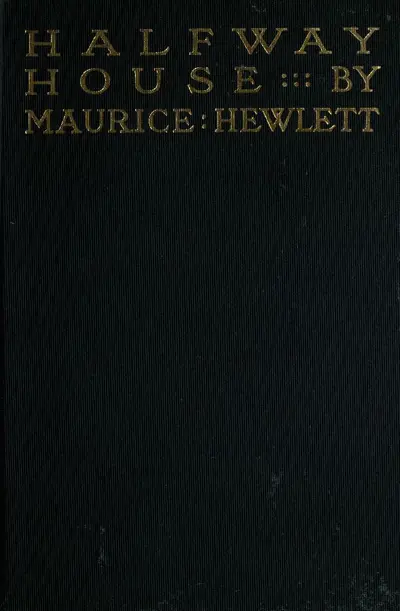
THE CLASSIC COLLECTION · 1908
"Halfway House: A Comedy of Degrees" by Maurice Hewlett is a novel written in the early 20th century. This light-hearted story centers around Mr. John Germain, a distinguished widower of fifty, who unexpectedly falls in love with a young governess named Mary Middleham, who is much younger and of modest means. The novel explores themes of class differences, romance, and the complexities of social interactions in a rural English setting. At the start of the story, Mr. Germain is attending a Sunday-school feast hosted by his sister-in-law, where he observes the children playing. His attention is captured by Mary Middleham, a radiant and charming young governess responsible for teaching the local children. The narrative captures Mr. Germain's initial fascination and burgeoning affection for her, as well as his reflections on her modest life and the implications of their age and social status disparity. The characters' interactions provide a glimpse into their personalities and relationships, setting the stage for the comedic and romantic elements that will unfold throughout the novel.
Introduction adapted from the source catalogue; source summaries may be automatically generated.
Free to read · English · 106,308 words · No account needed
MAKE TIME FOR A GOOD BOOK
On by default. Untick to stop anonymous reading totals. Each page counts after 10 seconds in view. How this works.
Anonymous counting is on unless you have switched it off.
“Molly,” said Duplessis, “why did you run away from me?”
She elbowed her brush stoutly. “Because I was afraid of you,” she said—then stopped and looked up at him. “But I’m not now—not in the least afraid.”
“You need not be. You wrote to me that you were coming on the 13th.”
“I know.”
“And this is the 20th, and you are only just here.”
“No. I have been here four or five days.”
“Where were you—when you were not here?”
“I was travelling.”
“Travelling!”
“Yes. But I decline to be questioned.”
“You mean, I suppose, that you will decline to answer.”
Her colour rose. “You always correct my language, I know. My exact meaning is that I deny your right to question me about my own affairs.”
“But if they are my affairs, too? May I not know what you are doing with
them?”
She thought. “Yes—I suppose you may do that.”
“Very well. Then I will ask you why you sent me word that you were to come here on the 13th ‘by train,’ and then did nothing of the sort?”
On her knees still, she faced him with her answer. “Yes, I will answer that. When I wrote, I intended to come—and expected that you would meet me. But when I posted the letter I had changed my mind. I did not intend to come.”
He stared, with very cold, bright eyes. “You did not intend to come when you posted the letter? Pray, did you intend me to expect you at the station?”
She answered him, “Yes, I did expect it.”
He raised his eyebrows. “Really, my dear friend, you interest me extremely. Did you think that six hours or more at Charing Cross Station would be good for my nerves, morals, or constitution?”
“I will tell you what I thought,” she said. “I thought that waiting at Charing Cross would be no worse—to say the least—for a man than an appointment in Burlington Arcade could be for a woman.”
Duplessis bit his cheek. “That was your gentle reproof, then, for my
blunder?”
“Yours was only a blunder because I saw what it really was. It had never entered your head that I could be other than honoured to meet you anywhere. You presumed that I should run there.”
“You ran very near to it, my friend,” he said. “That is, you had
yourself driven.”
She bowed her head. “I admit it. I was a fool—but I am not a fool now.”
Your reading position is saved on this browser. Take it to another device with a library code. Reading pages adapt to text, rather than matching a printed edition.
Maurice Hewlett
Maurice Hewlett
Maurice Hewlett
Maurice Hewlett
BEHIND THE BOOK
This eBook is for the use of anyone anywhere in the United States and most other parts of the world at no cost and with almost no restrictions whatsoever. You may copy it, give it away or re-use it under the terms of the Project Gutenberg License included with this eBook or online at www.gutenberg.org. If you are not located in the United States, you will have to check the laws of the country where you are located before using this eBook. Read the source licence.
The original source file, including credits and licence, is retained by this library. Request an original-format copy at no charge. Please include the book title and Project Gutenberg identifier #59963.
KEEP YOUR CURIOSITY GOING
Coulson Kernahan

Maurice Baring
Frances Wright
Cécile Tormay

Frederic Jesup Stimson

W. H. P. (William Henry Pope) Jarvis