
Letters to a Friend, Written to Mrs. Ezra S. Carr, 1866-1879
John Muir
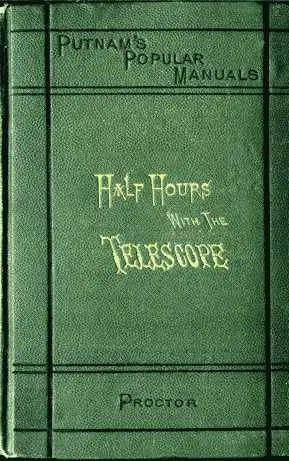
THE CLASSIC COLLECTION · 1873
"Half-Hours with the Telescope" by Richard A. Proctor is a scientific publication written in the late 19th century. The book serves as a popular guide for amateur astronomers, focusing on the use of telescopes for both educational and entertainment purposes. It discusses the construction of telescopes, the nature of star maps, and a variety of celestial phenomena that can be observed, particularly those amenable to smaller telescopes. The opening of the book provides an introduction to the telescope and its significance in astronomy, emphasizing its accessibility even for beginners. Proctor addresses common disappointments that new users face when first observing celestial bodies, explaining the importance of understanding the instrument's capabilities. He aims to empower novices with knowledge that will enhance their observational experience, thereby fostering a deeper appreciation for the wonders of the universe as seen through a telescope. The thoroughness of the text offers guidance on everything from the structure of telescopes to practical tips for object observation, making it a valuable resource for aspiring astronomers.
Introduction adapted from the source catalogue; source summaries may be automatically generated.
Free to read · English · 32,582 words · No account needed
MAKE TIME FOR A GOOD BOOK
On by default. Untick to stop anonymous reading totals. Each page counts after 10 seconds in view. How this works.
Anonymous counting is on unless you have switched it off.
h. m.
Jan. 5, 1868, 8 45 P.M.
Feb. 17, ----, 8 58 ----
Mar. 31, ----, 9 11 ----
May 13, ----, 9 24 ----
June 25, ----, 9 37 ----
Aug. 7, ----, 9 50 ----
Sept. 19, ----, 10 3 ----
Nov. 1 ----, 10 16 ----
Dec. 14, ----, 10 29 ----
Jan. 26, 1869, 10 42 ----
Mar. 10, ----, 10 25 ----
Mar. 13, ----, 7 43 ----[7]
Apr. 25, ----, 7 56 ----
June 7, ----, 8 9 ----
July 20, ----, 8 22 ----
Sept. 1, ----, 8 35 ----
Oct. 14, ----, 8 48 ----
Nov. 26, ----, 9 1 ----
Jan. 8, 1870, 9 14 ----
Feb. 20, ----, 9 27 ----
From the minimum at about 10 P.M. on October 31st, 1867, we get in like
manner the series--
h. m.
Dec. 13, 1867, 10 13 P.M.
Jan. 25, 1868, 10 26 ----
Mar. 8, ----, 10 39 ----
Apr. 20, ----, 10 52 ----
June 2, ----, 11 5 ----
June 5, ----, 7 53 ----[8]
July 18, ----, 8 6 ----
Aug. 30, ----, 8 19 ----
Oct. 12, ----, 8 32 ----
Nov. 24, ----, 8 45 ----
Jan. 6, 1869, 8 58 ----
Feb. 18, ----, 9 11 ----
Apr. 2, ----, 9 24 ----
May 15, ----, 9 37 ----
June 27, ----, 9 50 ----
Aug. 9, ----, 10 3 ----
Sept. 21, ----, 10 16 ----
Nov. 3, ----, 10 29 ----
Dec. 16, ----, 10 42 ----
Jan. 28, 1870, 10 55 ----
From one or other of these tables every observable minimum can be obtained. Thus, suppose the observer wants to look for a minimum during the last fortnight in August, 1868. The first table gives him no information, the latter gives him a minimum at 8h. 19m. P.M. on August 30; hence of course there is a minimum at 11h. 31m. P.M. on August 27; and there are no other conveniently observable minima during the fortnight in question.
The cause of the remarkable variation in this star's brilliancy has been assigned by some astronomers to the presence of an opaque secondary, which transits Algol at regular intervals; others have adopted the view that Algol is a luminous secondary, revolving around an opaque primary. Of these views the former seems the most natural and satisfactory. It points to a secondary whose mass bears a far greater proportion to that of the primary, than the mass even of Jupiter bears to the sun; the shortness of the period is also remarkable. It may be noticed that observation points to a gradual diminution in the period of Algol's variation, and the diminution seems to be proceeding more and more rapidly. Hence (assuming the existence of a dark secondary) we must suppose that either it travels in a resisting medium which is gradually destroying its motion, or that there are other dependent orbs whose attractions affect the period of this secondary. In the latter case the decrease in the period will attain a limit and be followed by an increase.
However, interesting as the subject may be, it is a digression from telescopic work, to which we now return.
Your reading position is saved on this browser. Take it to another device with a library code. Reading pages adapt to text, rather than matching a printed edition.
BEHIND THE BOOK
This eBook is for the use of anyone anywhere in the United States and most other parts of the world at no cost and with almost no restrictions whatsoever. You may copy it, give it away or re-use it under the terms of the Project Gutenberg License included with this eBook or online at www.gutenberg.org. If you are not located in the United States, you will have to check the laws of the country where you are located before using this eBook. Read the source licence.
The original source file, including credits and licence, is retained by this library. Request an original-format copy at no charge. Please include the book title and Project Gutenberg identifier #16767.
KEEP YOUR CURIOSITY GOING
John Muir

Asa Gray
Asa Gray

Florence Nightingale
Elizabeth Robins Pennell
Denison Olmsted