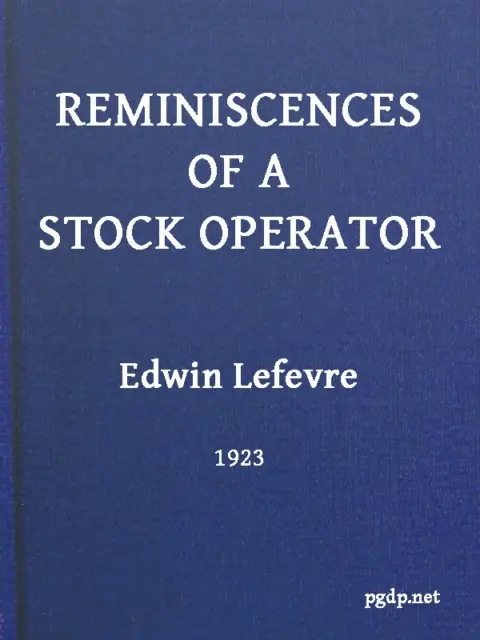
Reminiscences of a Stock Operator
Edwin Lefevre
THE CLASSIC COLLECTION · 1915
"H. R." by Edwin Lefevre is a satirical novel written in the early 20th century. The story follows Hendrik Rutgers, a dissatisfied bank clerk who aspires for more meaning in his life beyond the confines of his mundane job. Frustrated with the banking industry and the societal expectations that limit him, Hendrik's journey begins as he contemplates his quest for freedom and a better existence. At the start of the novel, we meet Hendrik Rutgers, a charismatic bank clerk who feels trapped in his role at the bank, which he believes only enriches the institution, not himself. After a confrontation with his superior over a pay raise, Hendrik becomes increasingly disillusioned with the capitalist society around him. Fueled by a mix of indignation and the fervor of spring, he decides to resign, viewing his dismissal as an act of liberation rather than loss. In a bold turn of events, he decides to organize a union of sandwich-men, whom he sees as the embodiment of societal wrongs. The opening depicts his fiery spirit and sets the stage for a larger social commentary on class struggle and personal ambition in a rapidly industrializing America.
Introduction adapted from the source catalogue; source summaries may be automatically generated.
Free to read · English · 81,545 words · No account needed
MAKE TIME FOR A GOOD BOOK
On by default. Untick to stop anonymous reading totals. Each page counts after 10 seconds in view. How this works.
Anonymous counting is on unless you have switched it off.
"You can't do it!" declared Grace, with conviction, thinking of humorous American girls. "When they are friends all you have to do is to take out the 'r' to turn them into fiends."
Mrs. Goodchild said nothing, but frowned. It had just occurred to her that here they all were, amicably talking with the man who had made their lives grievous burdens. Mr. Goodchild also was silent, but shrewdly eyed H. R.
"I'll do it!" repeated H. R., confidently.
"How can you without killing everybody?" challenged Grace, skeptically. "Everybody knows you as the leader of the sandwich men, and if you form companies--"
"My child," H. R. told her, gently, "I don't know anything about finance. That is why I want to get father's advice about my business. Every man to his trade. But I do know New York. I ought to, hang it! My grandfather owned what is now the Hotel Regina, and-- Well, look here! If by the first of June nobody even remembers that I had anything to do with sandwiches will you marry me?"
"Yes," said Mr. Goodchild.
If H. R. could do that he was fit to be anybody's son-in-law. If he couldn't, the annoyance would end.
"Grace?" asked H. R.
"I'm willing to take a chance for two weeks," said Mr. Goodchild, feeling certain he was displaying Machiavellian wisdom. But Grace shook her head.
"Everything you've done," she told H. R., "is child's play--"
"What!" interrupted H. R., indignantly. "Make New-Yorkers give money for charity that they might have spent for their own pleasure?"
"Nothing alongside of making 'em forget that you invented sandwiches. If it had been anything else, you might--I might--you--" She floundered helplessly. Her life for weeks had been so full of excitement that she could not co-ordinate her ideas quickly.
"You don't know me, dear," said H. R. "I hate to say it myself, but,
really, I'm a wonder!"
He looked so confident, so masterfully sure of himself, so little like a dreamer, and so much like a doer, that Grace was impressed.
"Can you?" she asked, more eagerly than Mr. Goodchild liked to see. But then H. R. had never kissed him.
"With your hand for the prize and your love for my reward? Can you ask
me if I can?"
"Yes, I can. Can you?"
"Yes!" he said. "But of course I'll need your help."
"My help?" Doubt came back into her eyes.
"Yes. This way." He took her in his arms and kissed her.
Mrs. Goodchild stared, open-eyed. Mr. Goodchild grew purple, and
shouted:
"Here! This is--"
Your reading position is saved on this browser. Take it to another device with a library code. Reading pages adapt to text, rather than matching a printed edition.
Edwin Lefevre
Edwin Lefevre
Edwin Lefevre
Edwin Lefevre
BEHIND THE BOOK
This eBook is for the use of anyone anywhere in the United States and most other parts of the world at no cost and with almost no restrictions whatsoever. You may copy it, give it away or re-use it under the terms of the Project Gutenberg License included with this eBook or online at www.gutenberg.org. If you are not located in the United States, you will have to check the laws of the country where you are located before using this eBook. Read the source licence.
The original source file, including credits and licence, is retained by this library. Request an original-format copy at no charge. Please include the book title and Project Gutenberg identifier #33314.
KEEP YOUR CURIOSITY GOING
Coulson Kernahan

Maurice Baring
Frances Wright
Cécile Tormay

Frederic Jesup Stimson

W. H. P. (William Henry Pope) Jarvis