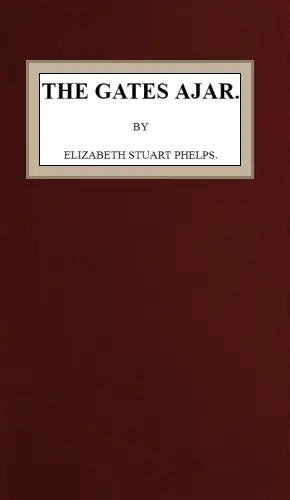
The Gates Ajar
Elizabeth Stuart Phelps
THE CLASSIC COLLECTION · 1894
"Gypsy Breynton" by Elizabeth Stuart Phelps is a novel written in the late 19th century. The story revolves around a spirited young girl named Gypsy Breynton, who embodies the lively and adventurous essence of childhood. As she navigates her world, Gypsy is characterized by her impulsiveness and mischief, contrasting with the conventional expectations of her family and societal norms. The book captures the trials and tribulations of growing up through the lens of Gypsy's carefree spirit. The opening of the novel introduces Gypsy's chaotic yet vibrant existence as she lives with her family, particularly showcasing her interactions with her older brother Tom and her playful nature, which often leads to trouble. The reader is presented with a vivid portrayal of Gypsy's bedroom, filled with disarray and personality, symbolizing her untamed character. Early scenes highlight her playful relationship with Tom, her zest for outdoor adventures, and the humorous chaos she brings into her family's life. The narration captures Gypsy's charm and her struggle to conform to the ideals of order and neatness, setting the tone for her character development throughout the story.
Introduction adapted from the source catalogue; source summaries may be automatically generated.
Free to read · English · 39,410 words · No account needed
MAKE TIME FOR A GOOD BOOK
On by default. Untick to stop anonymous reading totals. Each page counts after 10 seconds in view. How this works.
Anonymous counting is on unless you have switched it off.
It was not an easy nor a pleasant thing to apologize to a person to whom she had played the charitable lady the day before; and Mrs. Littlejohn's manner of receiving the explanation certainly made it no easier. But Gypsy, as the saying goes, "swallowed her pride," and felt that she deserved it.
"I've brought you some peas," she said, meekly.
"Oh!" said the old woman, relenting a little, "you have, have you? Well, I'm obleeged to you, and you can set 'em in the cupboard."
Gypsy emptied her peas into a yellow bowl which she found in the cupboard,
and then asked,--
"Can I do anything for you?"
"I'm terrible thirsty!" said Mrs. Littlejohn, with a long groan. "There's some water in that air pail."
Gypsy went into the corner where the pail stood, and filled the mug with water; then, not being able to think of anything more to say, she concluded to go.
"Good mornin'clock," said Mrs. Littlejohn, in a forgiving tone; "I hope
you'll come agin."
Gypsy secretly thought it was doubtful if she ever did. Her charity, like that of most young people of her age and experience, was not of the sort calculated to survive under difficulties, or to deal successfully with shrewish old women.
After inquiring in vain of the group of staring children where Peace Maythorne's room was, Gypsy resorted to her friend, the red-faced woman, who directed her to a door upon the second story.
It was closed, and Gypsy knocked.
"Come in," said a quiet voice. Gypsy went in, wondering why Peace Maythorne did not get up and open the door, and if she did not know it was more polite. She stopped short, as she entered the room, and wondered no longer.
It was a plain, bare room, but neat enough, and not unpleasant nor unhomelike, because of the great flood of morning sunlight that fell in and touched everything to golden warmth. It touched most brightly, and lingered longest, on a low bed drawn up between the windows. A girl lay there, with a pale face turned over on the pillows, and weak, thin hands, folded on the counterpane. She might, from her size, have been about sixteen years of age; but her face was like the face of a woman long grown old. The clothing of the bed partially concealed her shoulders, which were cruelly rounded and bent.
So Peace Maythorne was a cripple.
Gypsy recovered from her astonishment with a little start, and said, blushing, for fear she had been rude,--
"Good morning. I'm Gypsy Breynton. Mother sent me down with a magazine."
Your reading position is saved on this browser. Take it to another device with a library code. Reading pages adapt to text, rather than matching a printed edition.
Elizabeth Stuart Phelps
Elizabeth Stuart Phelps
Elizabeth Stuart Phelps
Elizabeth Stuart Phelps
BEHIND THE BOOK
This eBook is for the use of anyone anywhere in the United States and most other parts of the world at no cost and with almost no restrictions whatsoever. You may copy it, give it away or re-use it under the terms of the Project Gutenberg License included with this eBook or online at www.gutenberg.org. If you are not located in the United States, you will have to check the laws of the country where you are located before using this eBook. Read the source licence.
The original source file, including credits and licence, is retained by this library. Request an original-format copy at no charge. Please include the book title and Project Gutenberg identifier #18582.
KEEP YOUR CURIOSITY GOING
Coulson Kernahan

Maurice Baring
Frances Wright
Cécile Tormay

Frederic Jesup Stimson

W. H. P. (William Henry Pope) Jarvis