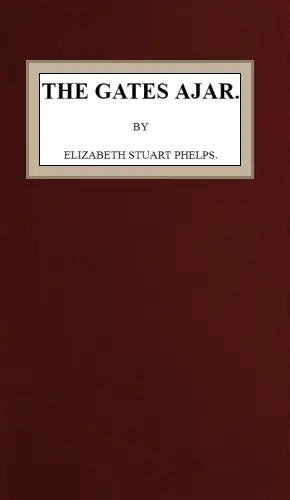
The Gates Ajar
Elizabeth Stuart Phelps
THE CLASSIC COLLECTION · 1894
"Gypsy Breynton" by Elizabeth Stuart Phelps is a novel written in the late 19th century. The story revolves around a spirited young girl named Gypsy Breynton, who embodies the lively and adventurous essence of childhood. As she navigates her world, Gypsy is characterized by her impulsiveness and mischief, contrasting with the conventional expectations of her family and societal norms. The book captures the trials and tribulations of growing up through the lens of Gypsy's carefree spirit. The opening of the novel introduces Gypsy's chaotic yet vibrant existence as she lives with her family, particularly showcasing her interactions with her older brother Tom and her playful nature, which often leads to trouble. The reader is presented with a vivid portrayal of Gypsy's bedroom, filled with disarray and personality, symbolizing her untamed character. Early scenes highlight her playful relationship with Tom, her zest for outdoor adventures, and the humorous chaos she brings into her family's life. The narration captures Gypsy's charm and her struggle to conform to the ideals of order and neatness, setting the tone for her character development throughout the story.
Introduction adapted from the source catalogue; source summaries may be automatically generated.
Free to read · English · 39,410 words · No account needed
MAKE TIME FOR A GOOD BOOK
On by default. Untick to stop anonymous reading totals. Each page counts after 10 seconds in view. How this works.
Anonymous counting is on unless you have switched it off.
"She is a good deal of a scold, and something of a sufferer," said Mrs. Breynton. Gypsy's face fell, and they walked up to the house in silence.
"Then you're not going to do anything for her?" asked Gypsy, at length, in
a disappointed tone.
"Oh, yes. She needs help. She can't be moved to the poor-house now, and, besides, is likely to get well before long, if she is properly taken care of. I gave her her supper, and have arranged with one or two of the ladies to send her meals for a few days, till we see how she is, and what had better be done. I take care of her to-morrow, and Mrs. Rowe takes her the next day."
"Good!" said Gypsy, brightening; "and I may take her down the things,
mayn't I, mother?"
"If you want to."
Gypsy went to bed as happy as a queen.
The next morning she rose early, to be sure to be in time to take Mrs. Littlejohn's breakfast; and was disappointed enough, when her mother thought it best she should wait till she had eaten her own. However, on the strength of the remembrance of her mother's tried and proved wisdom, on certain other little occasions, she submitted with a good grace.
She carried Mrs. Littlejohn a very good breakfast of griddle-cakes and fish-balls and sweet white bread, and was somewhat taken aback to find that the old woman received it rather curtly, and asked after the salmon.
It was very warm at noon. When she carried the dinner, the walk was long and wearisome, and Mrs. Littlejohn neglected to call her an angel of mercy, and it must be confessed Gypsy's enthusiasm diminished perceptibly.
That evening Mr. and Mrs. Breynton were out to tea, and Tom was off fishing. Mrs. Breynton left Mrs. Littlejohn's supper in a basket on the shelf, and told Gypsy where it was. Gypsy had been having a great frolic in the fresh hay with Sarah Rowe, and came in late. No one but Winnie was there. She ate her supper in a great hurry, and went out again. Patty saw her from the window, and concluded she had gone to Mrs. Littlejohn's.
That night, about eleven o'clock, some one knocked at Mrs. Breynton's
door, and woke her up.
"Who is it?" she called.
"Oh, mother Breynton!" said a doleful voice; "what do you suppose I've
done now?"
"I'm sure I don't know," said Mrs. Breynton, with a resigned sigh.
"I hope she hasn't been walking in her sleep again," said Mr. Breynton,
nervously.
"Forgotten Mrs. Littlejohn's supper," said the doleful voice through the
key-hole.
"Why, Gypsy!"
Your reading position is saved on this browser. Take it to another device with a library code. Reading pages adapt to text, rather than matching a printed edition.
Elizabeth Stuart Phelps
Elizabeth Stuart Phelps
Elizabeth Stuart Phelps
Elizabeth Stuart Phelps
BEHIND THE BOOK
This eBook is for the use of anyone anywhere in the United States and most other parts of the world at no cost and with almost no restrictions whatsoever. You may copy it, give it away or re-use it under the terms of the Project Gutenberg License included with this eBook or online at www.gutenberg.org. If you are not located in the United States, you will have to check the laws of the country where you are located before using this eBook. Read the source licence.
The original source file, including credits and licence, is retained by this library. Request an original-format copy at no charge. Please include the book title and Project Gutenberg identifier #18582.
KEEP YOUR CURIOSITY GOING
Coulson Kernahan

Maurice Baring
Frances Wright
Cécile Tormay

Frederic Jesup Stimson

W. H. P. (William Henry Pope) Jarvis