THE CLASSIC COLLECTION✦The House of the ArrowCLASSIC FREE BOOKS
The House of the Arrow
A. E. W. (Alfred Edward Woodley) Mason
THE CLASSIC COLLECTION · 1910
"Green Stockings: A Comedy in Three Acts" by A. E. W. Mason is a theatrical play written in the early 20th century. The narrative centers around the lives and relationships of the Faraday family, particularly focusing on their eldest daughter, Celia, and her perceived struggles with marriage and societal expectations. The play captures the themes of love, family dynamics, and societal pressures with a comedic tone, reflecting the norms and customs of its time. At the start of the play, the scene is set in the elegant drawing room of the Faraday household, where the characters engage in lively conversation about the return of Celia, who has been away for a week. The dialogue introduces the characters, revealing their personalities and relationships. Phyllis is eager to marry but feels overshadowed by her older sister Celia, whom the others view as a spinster. A sense of urgency develops as it becomes clear that Celia’s presence complicates Phyllis's romantic intentions with Bobby Tarver. As the act unfolds, Celia arrives home drenched from the rain, hinting at her resilience despite her social circumstances and the jokes made about her by the family. The lighthearted banter gradually reveals deeper tensions regarding marriage and independence, setting the stage for Celia's pivotal role in the unfolding comedy and her unconventional approach to navigating her societal constraints.
Introduction adapted from the source catalogue; source summaries may be automatically generated.
Free to read · English · 30,090 words · No account needed
MAKE TIME FOR A GOOD BOOK
On by default. Untick to stop anonymous reading totals. Each page counts after 10 seconds in view. How this works.
Anonymous counting is on unless you have switched it off.
SMITH. Ah, you see, we can't get away from him. He dominates us. Living or dead, his imperious nature will not be neglected. He sits at the table here between you and me. (Designates a spot between them on table.) To satisfy him, we've got to talk about him.
CELIA. What is there to say?
SMITH. What is there to say! And you've told me nothing about the
Smith you knew.
CELIA. (Surprised) The Smith I knew? (Recovering herself) Oh, yes,
of course.
SMITH. Yes--you see I know him only as the soldier--the man of action--the fighting man--but you----
CELIA. But there is nothing to tell.
SMITH. (Strongly) You mean there is nothing you wish to tell.
CELIA. (Defiantly) Certainly not. What is it you wish to know?
SMITH. Let us compare our pictures--mental, of course--of the man.
(With solicitude.)
CELIA. Oh, no--not at all. Not at all.
SMITH. Then you describe Smith as you saw him, and I'll tell you if I
agree with you.
CELIA. Of course, you know our descriptions won't be alike. No two people's description of anyone ever would be.
SMITH. Of course not--except in the definite facts.--His eyes, for
instance----
CELIA. His eyes--his eyes were not definite.
SMITH. Not definite?
CELIA. Their color. I mean it varied. Emotion kindled them--apathy
dulled them. Sometimes they were light and again they were very, very
dark.
SMITH. That's funny. I never saw them dark. To me they always were
light, like bottle glass.
CELIA. Really? Possibly you were not very observing.
SMITH. (Acknowledges the point with a touch of impatience) Possibly not. But his hair? Surely we can't differ as to that?
CELIA. His hair--you mean did it curl or was it straight?
SMITH. Yes--and its color.
CELIA. His hair--I hardly know how to describe his hair, because his hair was---- It was like no hair that I ever saw.
SMITH. (Laughs) That's a splendid description of a bald man. That always was a great grief to Smith, his baldness; his head was so very bald and bumpy.
CELIA. Oh, yes.
SMITH. (Puts his hand to his head) What! (Recovering himself) Oh, yes, yes. (Growing more and more determined to trip her and more and more interested in and appreciative of her attractiveness) Now his mouth----
CELIA. Well. His mouth was peculiar----
SMITH. Peculiar?
CELIA. Yes, you see it broadened when he smiled.
SMITH. (Laughing) Oh--did he smile for you?
CELIA. Oh, often, very often.
SMITH. Yes, we all do--don't we? What would you say of his voice?
CELIA. It was kind, always kind.
SMITH. (Shakes head) Gruff and commanding.
CELIA. (Insinuatingly) Naturally--not to me. (Her hand rests on
the table.)
Your reading position is saved on this browser. Take it to another device with a library code. Reading pages adapt to text, rather than matching a printed edition.
A. E. W. (Alfred Edward Woodley) Mason
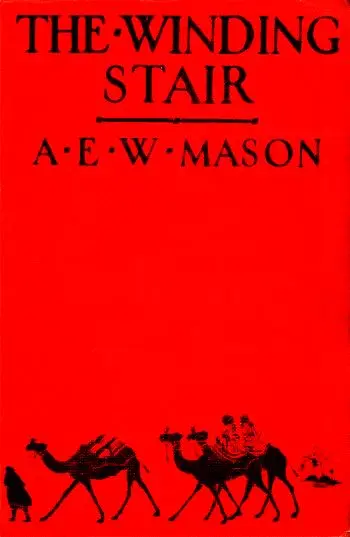
A. E. W. (Alfred Edward Woodley) Mason
A. E. W. (Alfred Edward Woodley) Mason
A. E. W. (Alfred Edward Woodley) Mason
BEHIND THE BOOK
This eBook is for the use of anyone anywhere in the United States and most other parts of the world at no cost and with almost no restrictions whatsoever. You may copy it, give it away or re-use it under the terms of the Project Gutenberg License included with this eBook or online at www.gutenberg.org. If you are not located in the United States, you will have to check the laws of the country where you are located before using this eBook. Read the source licence.
The original source file, including credits and licence, is retained by this library. Request an original-format copy at no charge. Please include the book title and Project Gutenberg identifier #38678.
KEEP YOUR CURIOSITY GOING
Maurice Baring
W. B. (William Butler) Yeats
Edward Martyn

John Brougham & Charlotte Brontë
Marguerite Merington
Leonid Andreyev