THE CLASSIC COLLECTION✦A Christmas Carol The original manuscriptCLASSIC FREE BOOKS
A Christmas Carol The original manuscript
Charles Dickens
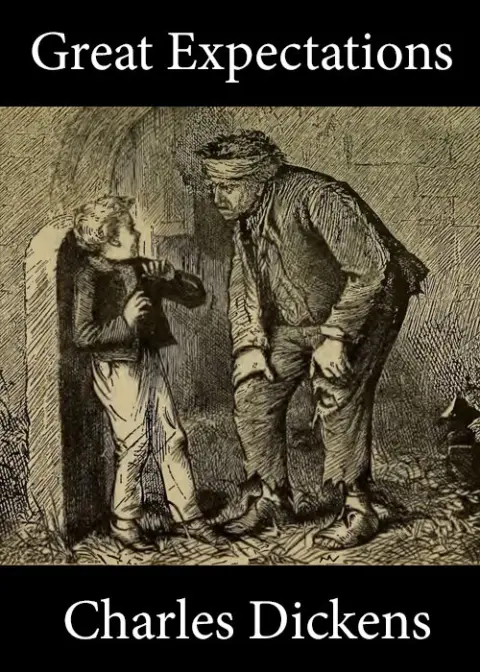
THE CLASSIC COLLECTION · 1861
"Great Expectations" by Charles Dickens is a novel first published serially from 1860 to 1861. The story follows Pip, a young orphan living with his sister and her blacksmith husband on England's coastal marshes. After a terrifying encounter with an escaped convict and strange visits to the bitter Miss Havisham and her cold adopted daughter Estella, Pip's life transforms when he mysteriously receives a fortune from an unknown benefactor. This bildungsroman explores wealth and poverty, love and rejection, through vivid characters and dramatic scenes that have captivated readers for generations.
Introduction adapted from the source catalogue; source summaries may be automatically generated.
Free to read · English · 187,831 words · No account needed
MAKE TIME FOR A GOOD BOOK
On by default. Untick to stop anonymous reading totals. Each page counts after 10 seconds in view. How this works.
Anonymous counting is on unless you have switched it off.
He looked about him in a confused way, as if he had lost his place in the book of his remembrance; and he turned his face to the fire, and spread his hands broader on his knees, and lifted them off and put them on again.
“There ain’t no need to go into it,” he said, looking round once more. “The time wi’ Compeyson was a’most as hard a time as ever I had; that said, all’s said. Did I tell you as I was tried, alone, for misdemeanor, while with Compeyson?”
I answered, No.
“Well!” he said, “I was, and got convicted. As to took up on suspicion, that was twice or three times in the four or five year that it lasted; but evidence was wanting. At last, me and Compeyson was both committed for felony,—on a charge of putting stolen notes in circulation,—and there was other charges behind. Compeyson says to me, ‘Separate defences, no communication,’ and that was all. And I was so miserable poor, that I sold all the clothes I had, except what hung on my back, afore I could get Jaggers.
“When we was put in the dock, I noticed first of all what a gentleman Compeyson looked, wi’ his curly hair and his black clothes and his white pocket-handkercher, and what a common sort of a wretch I looked. When the prosecution opened and the evidence was put short, aforehand, I noticed how heavy it all bore on me, and how light on him. When the evidence was giv in the box, I noticed how it was always me that had come for’ard, and could be swore to, how it was always me that the money had been paid to, how it was always me that had seemed to work the thing and get the profit. But when the defence come on, then I see the plan plainer; for, says the counsellor for Compeyson, ‘My lord and gentlemen, here you has afore you, side by side, two persons as your eyes can separate wide; one, the younger, well brought up, who will be spoke to as such; one, the elder, ill brought up, who will be spoke to as such; one, the younger, seldom if ever seen in these here transactions, and only suspected; t’other, the elder, always seen in ’em and always wi’ his guilt brought home. Can you doubt, if there is but one in it, which is the one, and, if there is two in it, which is much the worst one?’ And such-like. And when it come to character, warn’t it Compeyson as had been to the school, and warn’t it his schoolfellows as was in this position and in that, and warn’t it him as had been know’d by witnesses in such clubs and societies, and nowt to his disadvantage? And warn’t it me as had been tried afore, and as had been know’d up hill and down dale in Bridewells and Lock-Ups! And when it come to speech-making, warn’t it Compeyson as could speak to ’em wi’ his face dropping every now and then into his white pocket-handkercher,—ah! and wi’ verses in his speech, too,—and warn’t it me as could only say, ‘Gentlemen, this man at my side is a most precious rascal’? And when the verdict come, warn’t it Compeyson as was recommended to mercy on account of good character and bad company, and giving up all the information he could agen me, and warn’t it me as got never a word but Guilty? And when I says to Compeyson, ‘Once out of this court, I’ll smash that face of yourn!’ ain’t it Compeyson as prays the Judge to be protected, and gets two turnkeys stood betwixt us? And when we’re sentenced, ain’t it him as gets seven year, and me fourteen, and ain’t it him as the Judge is sorry for, because he might a done so well, and ain’t it me as the Judge perceives to be a old offender of wiolent passion, likely to come to worse?”
Your reading position is saved on this browser. Take it to another device with a library code. Reading pages adapt to text, rather than matching a printed edition.
Charles Dickens
Samuel McChord Crothers & Charles Dickens
Rebecca Harding Davis & Thomas De Quincey & Charles Dickens & Nathaniel Hawthorne & Edward Bulwer Lytton, Baron Lytton & Edgar Allan Poe & Harriet Elizabeth Prescott Spofford
Charles Dickens
BEHIND THE BOOK
This eBook is for the use of anyone anywhere in the United States and most other parts of the world at no cost and with almost no restrictions whatsoever. You may copy it, give it away or re-use it under the terms of the Project Gutenberg License included with this eBook or online at www.gutenberg.org. If you are not located in the United States, you will have to check the laws of the country where you are located before using this eBook. Read the source licence.
The original source file, including credits and licence, is retained by this library. Request an original-format copy at no charge. Please include the book title and Project Gutenberg identifier #1400.
KEEP YOUR CURIOSITY GOING
Coulson Kernahan

Maurice Baring
Frances Wright
Cécile Tormay

Frederic Jesup Stimson

W. H. P. (William Henry Pope) Jarvis