THE CLASSIC COLLECTION✦A Christmas Carol The original manuscriptCLASSIC FREE BOOKS
A Christmas Carol The original manuscript
Charles Dickens
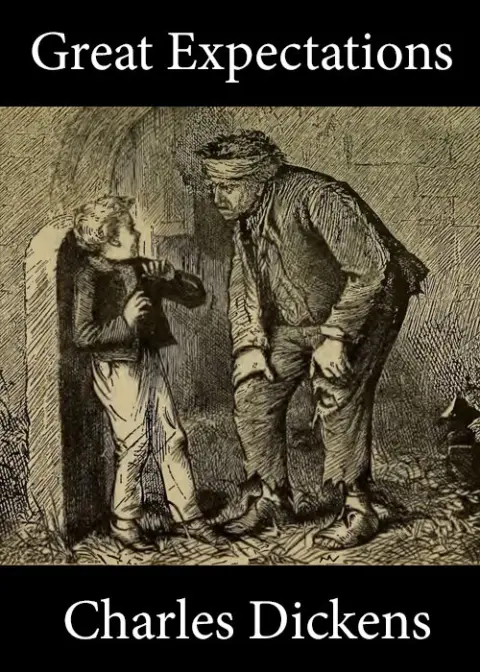
THE CLASSIC COLLECTION · 1861
"Great Expectations" by Charles Dickens is a novel first published serially from 1860 to 1861. The story follows Pip, a young orphan living with his sister and her blacksmith husband on England's coastal marshes. After a terrifying encounter with an escaped convict and strange visits to the bitter Miss Havisham and her cold adopted daughter Estella, Pip's life transforms when he mysteriously receives a fortune from an unknown benefactor. This bildungsroman explores wealth and poverty, love and rejection, through vivid characters and dramatic scenes that have captivated readers for generations.
Introduction adapted from the source catalogue; source summaries may be automatically generated.
Free to read · English · 187,831 words · No account needed
MAKE TIME FOR A GOOD BOOK
On by default. Untick to stop anonymous reading totals. Each page counts after 10 seconds in view. How this works.
Anonymous counting is on unless you have switched it off.
“Gentlemen,” said Mr. Wopsle, “I am proud to see you. I hope, Mr. Pip, you will excuse my sending round. I had the happiness to know you in former times, and the Drama has ever had a claim which has ever been acknowledged, on the noble and the affluent.”
Meanwhile, Mr. Waldengarver, in a frightful perspiration, was trying to get himself out of his princely sables.
“Skin the stockings off Mr. Waldengarver,” said the owner of that property, “or you’ll bust ’em. Bust ’em, and you’ll bust five-and-thirty shillings. Shakspeare never was complimented with a finer pair. Keep quiet in your chair now, and leave ’em to me.”
With that, he went upon his knees, and began to flay his victim; who, on the first stocking coming off, would certainly have fallen over backward with his chair, but for there being no room to fall anyhow.
I had been afraid until then to say a word about the play. But then, Mr. Waldengarver looked up at us complacently, and said,—
“Gentlemen, how did it seem to you, to go, in front?”
Herbert said from behind (at the same time poking me), “Capitally.” So I said “Capitally.”
“How did you like my reading of the character, gentlemen?” said Mr. Waldengarver, almost, if not quite, with patronage.
Herbert said from behind (again poking me), “Massive and concrete.” So I said boldly, as if I had originated it, and must beg to insist upon it, “Massive and concrete.”
“I am glad to have your approbation, gentlemen,” said Mr. Waldengarver, with an air of dignity, in spite of his being ground against the wall at the time, and holding on by the seat of the chair.
“But I’ll tell you one thing, Mr. Waldengarver,” said the man who was on his knees, “in which you’re out in your reading. Now mind! I don’t care who says contrairy; I tell you so. You’re out in your reading of Hamlet when you get your legs in profile. The last Hamlet as I dressed, made the same mistakes in his reading at rehearsal, till I got him to put a large red wafer on each of his shins, and then at that rehearsal (which was the last) I went in front, sir, to the back of the pit, and whenever his reading brought him into profile, I called out “I don’t see no wafers!” And at night his reading was lovely.”
Mr. Waldengarver smiled at me, as much as to say “a faithful Dependent—I overlook his folly;” and then said aloud, “My view is a little classic and thoughtful for them here; but they will improve, they will improve.”
Your reading position is saved on this browser. Take it to another device with a library code. Reading pages adapt to text, rather than matching a printed edition.
Charles Dickens
Samuel McChord Crothers & Charles Dickens
Rebecca Harding Davis & Thomas De Quincey & Charles Dickens & Nathaniel Hawthorne & Edward Bulwer Lytton, Baron Lytton & Edgar Allan Poe & Harriet Elizabeth Prescott Spofford
Charles Dickens
BEHIND THE BOOK
This eBook is for the use of anyone anywhere in the United States and most other parts of the world at no cost and with almost no restrictions whatsoever. You may copy it, give it away or re-use it under the terms of the Project Gutenberg License included with this eBook or online at www.gutenberg.org. If you are not located in the United States, you will have to check the laws of the country where you are located before using this eBook. Read the source licence.
The original source file, including credits and licence, is retained by this library. Request an original-format copy at no charge. Please include the book title and Project Gutenberg identifier #1400.
KEEP YOUR CURIOSITY GOING
Coulson Kernahan

Maurice Baring
Frances Wright
Cécile Tormay

Frederic Jesup Stimson

W. H. P. (William Henry Pope) Jarvis