THE CLASSIC COLLECTION✦An outlaw’s diary: the CommuneCLASSIC FREE BOOKS
An outlaw’s diary: the Commune
Cécile Tormay
THE CLASSIC COLLECTION · 1890
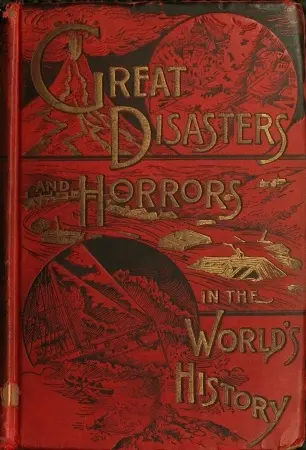
"Great Disasters and Horrors in the World's History" by Allen Howard Godbey is a historical account written in the late 19th century. The work compiles significant calamities that have afflicted humanity across different eras, both on land and at sea, presenting a vivid portrayal of disasters such as tornadoes, floods, earthquakes, and volcanic eruptions. This book aims to explore not only the events themselves but also the principles governing these natural calamities, emphasizing human responses and heroism in the face of adversity. The opening of this account sets the tone for the exploration of natural disasters, beginning with a deep dive into the myths and personifications associated with winds in ancient cultures. Godbey reflects on how human understanding has transformed from mystical interpretations to a more scientific grasp of atmospheric phenomena. The author aims to illustrate the laws of nature that govern storms and earthquakes while intertwining thrilling narratives of previous calamities. Through this introduction, readers are prepared for a robust examination of not only the horrors wrought by nature but also the indomitable spirit of humanity that shines through in the aftermath of such events.
Introduction adapted from the source catalogue; source summaries may be automatically generated.
Free to read · English · 145,118 words · No account needed
MAKE TIME FOR A GOOD BOOK
On by default. Untick to stop anonymous reading totals. Each page counts after 10 seconds in view. How this works.
Anonymous counting is on unless you have switched it off.
upper stories; the wave, even more than it did, would have crushed as with the single blow of a mighty hammer, and the number of survivors who could tell a tale of wonderful deliverance would have been correspondingly diminished. The lesson of these facts is for those who dwell below dams or reservoirs. If there be nothing in the nature of the channel to distribute the water, and the rupture be instantaneous, the destruction of life and property will be awful to contemplate.
At the Gautier Works, the flood, while extending over all the valley, was yet parted into three principal divisions. One of these, following the course of the Conemaugh, rushed down against the foot of the hill, just above the Stone Bridge, and would have instantly swept away that magnificently solid structure, had it not stood parallel to, rather than at right angles with the torrent; another turning to the left, swept across Conemaugh Borough and the upper wards of Johnstown, destroying hundreds of stone buildings, the German Lutheran church, and the Hulbert House; while the third swept straight down through the middle of the city, demolishing the Y. M. C. A. Hall, the Municipal buildings, and scores of the finest residences. This last, turned into a reverse current by the damming of the water at the bridge, was presently rolled back, to ensure the destruction of whatever had escaped in its downward course.
Thousands of people, drifted from the towns above, were dead already, or still struggling in the water; and to these were now quickly added many thousands more. Of the people of Johnstown, it may be said that not a soul had time to fly. We hear nothing at all about escapes to the hills. At the scream of the warning whistle, some were startled, and looked up the river. According to their place in the town, they saw, at the distance of a mile, half a mile, or only a hundred yards away, an ominous and inexplicable dark cloud, which might be smoke or spray, hanging upon the surface of the water. They felt that something unusual had taken place, but of its nature they were not well aware. Those who saw it at the greatest distance had hardly time to scramble to the upper stories of their dwellings, before, even there, they found themselves struggling in the water; while the vast majority, on looking forth, saw buildings, not a half block above them, already leaping from their foundations. Simultaneous with the roar and rush of the torrent, came the crash of houses, the shrieks and cries of men, women and children, the revolution of everything as in a kaleidoscope, and then, driven with the speed of a race-horse, houses, furniture, cars, locomotives, railroad tracks, the Gautier plant, animals alive and dead, trees, lumber and infinite wreckage were rushed onward to be jammed and piled at the railroad bridge in a maze of ruin fifty feet high and covering forty acres of ground. Here the laboring waters finding no ready exit, were in part turned to the left up Stony Creek, and in part rolled swiftly backward across the center of the city, bearing the drift on their bosom, and in some instances dropping shattered houses within a square or two of their former places. The wreckage above the bridge, entangling and holding fast, hundreds, if not thousands, as well of the living as the dead, presently caught fire, thus adding, through all the long awful night, to the horrors of flood, the fiercer horrors of flame. From the roaring conflagration, a sickly, baleful gleam was thrown through a mile radius of surrounding gloom; but like the Miltonic fires of perdition, from those flames
Your reading position is saved on this browser. Take it to another device with a library code. Reading pages adapt to text, rather than matching a printed edition.
BEHIND THE BOOK
This eBook is for the use of anyone anywhere in the United States and most other parts of the world at no cost and with almost no restrictions whatsoever. You may copy it, give it away or re-use it under the terms of the Project Gutenberg License included with this eBook or online at www.gutenberg.org. If you are not located in the United States, you will have to check the laws of the country where you are located before using this eBook. Read the source licence.
The original source file, including credits and licence, is retained by this library. Request an original-format copy at no charge. Please include the book title and Project Gutenberg identifier #51246.
KEEP YOUR CURIOSITY GOING
Cécile Tormay

Moritz Busch
John L. Ransom
Frances Wright
Cécile Tormay

Mabel Potter Daggett