THE CLASSIC COLLECTION✦Some Diversions of a Man of LettersCLASSIC FREE BOOKS
Some Diversions of a Man of Letters
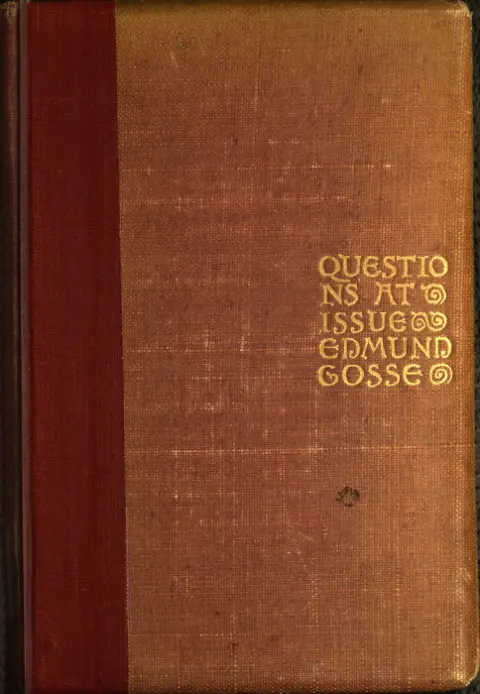
Edmund Gosse
THE CLASSIC COLLECTION · 1891
"Gossip in a Library" by Edmund Gosse is a collection of reflections and essays written in the early 20th century. In this work, the author explores the intimate relationship between bibliophiles and their collections of books, providing a nostalgic and personal account of his own library and the literary treasures within it. The writing delves into themes of literature, the history of libraries, and the joy and complications of book collecting as a hobby. The opening of "Gossip in a Library" presents a contemplative piece on the nature of libraries, both public and private. Gosse reflects on the evolution of libraries as institutions and the deep personal significance of books for collectors. He introduces the idea that even small, private libraries can be treasure troves of history and emotion, filled with the remnants of past lives and aspirations contained within each volume. The author expresses a longing for an idealized personal library, one that harmonizes beauty and knowledge, while acknowledging the quirks and eccentricities of his own collection. This opening serves as an invitation to readers to join him in a literary journey that evokes both affection and reverence for the written word.
Introduction adapted from the source catalogue; source summaries may be automatically generated.
Free to read · English · 53,748 words · No account needed
MAKE TIME FOR A GOOD BOOK
On by default. Untick to stop anonymous reading totals. Each page counts after 10 seconds in view. How this works.
Anonymous counting is on unless you have switched it off.
The best master in a bad class of lumbering and tiresome fiction was the author of the book which is the text of this chapter. La Calprenède, whose full name was nothing less than Gautier de Costes de la Calprenède, was a Gascon gentleman of the Guards, of whose personal history the most notorious fact is that he had the temerity to marry a woman who had already buried five husbands. Some historians relate that she proceeded to poison number six, but this does not appear to be certain, while it does appear that Calprenède lived in the married state for fifteen years, a longer respite than the antecedents of madame gave him any right to anticipate. He made a great fame with his two huge Roman novels, Cassandra and Cleopatra, and then, some years later, he produced a third, Pharamond which was taken out of early French history. The translator, in the version before us, says of this book that it "is not a romance, but a history adorned with some excellent flourishes of language and loves, in which you may delightfully trace the author's learned pen through all those historians who wrote of the times he treats of." In other words, while Gombreville--with his King of the Canaries, and his Vanishing Islands, and his necromancers, and his dragons--canters through pure fairyland, and while Mlle. de Scudéry elaborately builds up a romantic picture of her own times (in Clélie, for instance, where the three hundred and seventy several characters introduced are said to be all acquaintances of the author), Calprenède attempted to produce something like a proper historical novel, introducing invention, but embroidering it upon some sort of genuine framework of fact.
To describe the plot of Pharamond, or of any other heroic novel, would be a desperate task. The great number of personages introduced in pairs, the intrigues of each couple forming a separate thread wound into the complex web of the plot, is alone enough to make any following of the story a great difficulty. On the fly-leaf of a copy of Cleopatra which lies before me, some dear lady of the seventeenth century has very conscientiously written out "a list of the Pairs of Lovers," and there are thirteen pairs. Pharamond begins almost in the same manner as a novel by the late Mr. G.P.R. James might. When the book opens we discover the amorous Marcomine and the valiant Genebaud sallying forth along the bank of a river on two beautiful horses of the best jennet-race. Throughout the book all the men are valiant, all the ladies are passionate and chaste. The heroes enter the lists covered with rubies, loosely embroidered over surcoats of gold and silk tissue; their heads "shine with gold, enamel and precious stones, with the hinder part covered with an hundred plumes of different colours." They are mounted upon horses "whose whiteness might outvie the purest snow upon the frozen Alps." They pierce into woodland dells, where they by chance discover renowned princesses, nonpareils of beauty, in imminent danger, and release them. They attack hordes of deadly pirates, and scatter their bodies along the shore; and yet, for all their warlike fire and force, they are as gentle as marmozets in a lady's boudoir. They are especially admirable in the putting forth of sentiments, in glozing over a subtle difficulty in love, in tying a knot of silk or fastening a lock of hair to their bonnet. They will steal into a cabinet so softly that a lady who is seated there, in a reverie, will not perceive them; they are so adroit that they will seize a paper on which she has sketched a couplet, will complete it, pass away, and she not know whence the poetical miracle has come. In valour, in courtesy, in magnificence they have no rival, just as the ladies whom they court are unique in beauty, in purity, in passion, and in self-denial. Sometimes they correspond at immense length; in Pharamond the letters which pass between the Princess Hunnimonde and Prince Balamir would form a small volume by themselves, an easy introduction to the art of polite letter-writing. Mlle. de Scudéry actually perceived this, and published a collection of model correspondence which was culled bodily from the huge store-house of her own romances, from Le Grand Cyrus and Clélie. These interchanges of letters were kept up by the severity of the heroines. It was not thought proper that the lady should yield her hand until the gentleman had exhausted the resources of language, and had spent years of amorous labour on her conquest. When Roger Boyle, in 1654, published his novel of Parthenissa, in four volumes, Dorothy Osborne objected to the ease with which the hero succeeded; she complains "the ladies are all so kind they make no sport."
Your reading position is saved on this browser. Take it to another device with a library code. Reading pages adapt to text, rather than matching a printed edition.
Edmund Gosse
Edmund Gosse
Edmund Gosse
Edmund Gosse
BEHIND THE BOOK
This eBook is for the use of anyone anywhere in the United States and most other parts of the world at no cost and with almost no restrictions whatsoever. You may copy it, give it away or re-use it under the terms of the Project Gutenberg License included with this eBook or online at www.gutenberg.org. If you are not located in the United States, you will have to check the laws of the country where you are located before using this eBook. Read the source licence.
The original source file, including credits and licence, is retained by this library. Request an original-format copy at no charge. Please include the book title and Project Gutenberg identifier #11628.
KEEP YOUR CURIOSITY GOING

David Patterson (Spirit) Hatch

David Patterson (Spirit) Hatch

David Patterson (Spirit) Hatch
Cécile Tormay

Moritz Busch
John L. Ransom