THE CLASSIC COLLECTION✦Some Diversions of a Man of LettersCLASSIC FREE BOOKS
Some Diversions of a Man of Letters
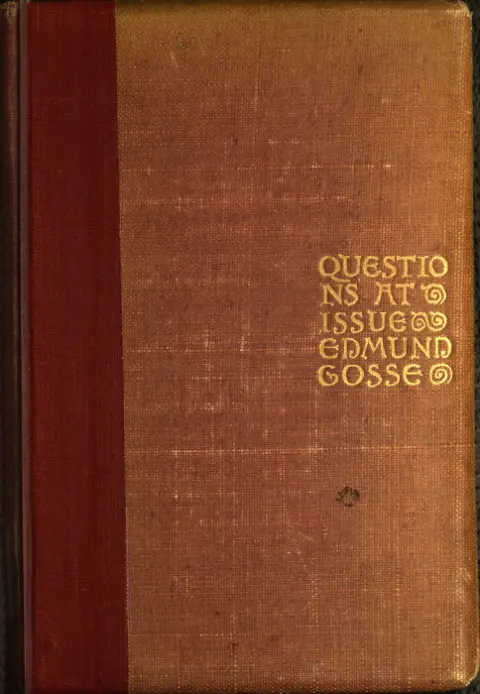
Edmund Gosse
THE CLASSIC COLLECTION · 1891
"Gossip in a Library" by Edmund Gosse is a collection of reflections and essays written in the early 20th century. In this work, the author explores the intimate relationship between bibliophiles and their collections of books, providing a nostalgic and personal account of his own library and the literary treasures within it. The writing delves into themes of literature, the history of libraries, and the joy and complications of book collecting as a hobby. The opening of "Gossip in a Library" presents a contemplative piece on the nature of libraries, both public and private. Gosse reflects on the evolution of libraries as institutions and the deep personal significance of books for collectors. He introduces the idea that even small, private libraries can be treasure troves of history and emotion, filled with the remnants of past lives and aspirations contained within each volume. The author expresses a longing for an idealized personal library, one that harmonizes beauty and knowledge, while acknowledging the quirks and eccentricities of his own collection. This opening serves as an invitation to readers to join him in a literary journey that evokes both affection and reverence for the written word.
Introduction adapted from the source catalogue; source summaries may be automatically generated.
Free to read · English · 53,748 words · No account needed
MAKE TIME FOR A GOOD BOOK
On by default. Untick to stop anonymous reading totals. Each page counts after 10 seconds in view. How this works.
Anonymous counting is on unless you have switched it off.
I hear some one say "Murrain take him, the ape!" And so Murrain shall, in a bookseller's shape; An evil-eyed elf, in a down-looking flurry, Who'd fain be a coxcomb, and calls himself Murray. Adorn thou his door, like the sign of the Shoe, For court-understrappers to congregate to; For Southey to come, in his dearth of invention, And eat his own words for mock-praise and a pension; For Croker to lurk with his spider-like limb in, And stock his lean bag with waylaying the women; And Jove only knows for what creatures beside To shelter their envy and dust-liking pride, And feed on corruption, like bats, who at nights, In the dark take their shuffles, which they call then flights; Be these the court-critics and vamp a Review. And by a poor figure, and therefore a true, For it suits with thy nature, both shoe-like and slaughterly Be its hue leathern, and title the Quarterly, Much misconduct, and see that the others Misdeem, and misconstrue, like miscreant brothers; Misquote, and misplace, and mislead, and misstate, Misapply, misinterpret, misreckon, misdate, Misinform, misconjecture, misargue; in short, Miss all that is good, that ye miss not the Court.
And finally, thou, my old soul of the tritical, Noting, translating, high slavish, hot critical, Quarterly-scutcheon'd, great heir to each dunce, Be Tibbald, Cook, Arnall, and Dennis at once
At the end, Mercury dooms the ugly boot to take the semblance of a man, and the satire closes with its painful metamorphosis into Gifford. The poem is not without cleverness, but it is chiefly remarkable for a savage tone which is not, we think, repeated elsewhere throughout the writings of Hunt. The allusions to Gifford's relations, nearly half a century earlier, to that Earl Grosvenor who first rescued him from poverty, the well-deserved scorn of his intolerable sneers at Perdita Robinson's crutches:
Hate Woman, thou block in the path of fair feet; If Fate want a hand to distress them, thine be it; When the Great, and their flourishing vices, are mention'd Say people "impute" 'em, and show thou art pension'd; But meet with a Prince's old mistress discarded, And then let the world see how vice is rewarded--
the indications of the satirist's acquaintance with the private life of his victim, all these must have stung the editor of the Quarterly to the quick, and are very little in Hunt's usual manner, though he had examples for them in Peter Pindar and others. There is a very early allusion to "Mr. Keats and Mr. Shelley," where, "calm, up above thee, they soar and they shine." This was written immediately after the review of Endymion in the Quarterly.
Your reading position is saved on this browser. Take it to another device with a library code. Reading pages adapt to text, rather than matching a printed edition.
Edmund Gosse
Edmund Gosse
Edmund Gosse
Edmund Gosse
BEHIND THE BOOK
This eBook is for the use of anyone anywhere in the United States and most other parts of the world at no cost and with almost no restrictions whatsoever. You may copy it, give it away or re-use it under the terms of the Project Gutenberg License included with this eBook or online at www.gutenberg.org. If you are not located in the United States, you will have to check the laws of the country where you are located before using this eBook. Read the source licence.
The original source file, including credits and licence, is retained by this library. Request an original-format copy at no charge. Please include the book title and Project Gutenberg identifier #11628.
KEEP YOUR CURIOSITY GOING

David Patterson (Spirit) Hatch

David Patterson (Spirit) Hatch

David Patterson (Spirit) Hatch
Cécile Tormay

Moritz Busch
John L. Ransom