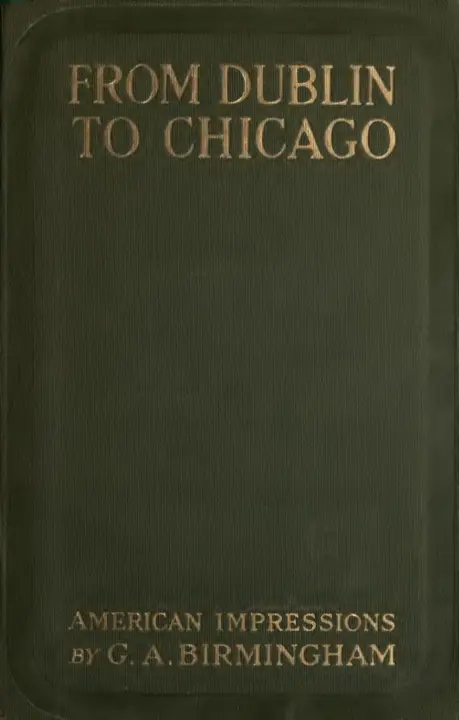
From Dublin to Chicago: Some Notes on a Tour in America
George A. Birmingham
THE CLASSIC COLLECTION · 1915
"Gossamer" by George A. Birmingham is a novel written in the early 20th century. The story revolves around Sir James Digby, an Irish disinherited gentleman, and his meeting with Michael Gorman, a passionate Irish patriot and journalist. The narrative explores themes of identity, national sentiment, and the complexities of human relationships against the backdrop of a transatlantic voyage. The opening portion of the book introduces us to Sir James and Gorman's discussions, where they delve into the emotional turmoil of a fellow Irishman, Carl Ascher, a banker. As the narrative unfolds, we learn about their backgrounds—Gorman’s fervent Irish nationalism contrasts with Sir James’s feelings of disconnection from his own heritage. Their voyage to America brings them into contact with Ascher, who is initially seasick but later expresses interest in the dynamics of their interactions. The opening chapters also set the stage for Gorman's ambition to engage with the wealthy Ascher, hinting at a business proposal that holds the potential for conflict and moral questioning within the context of financial dealings.
Introduction adapted from the source catalogue; source summaries may be automatically generated.
Free to read · English · 74,694 words · No account needed
MAKE TIME FOR A GOOD BOOK
On by default. Untick to stop anonymous reading totals. Each page counts after 10 seconds in view. How this works.
Anonymous counting is on unless you have switched it off.
Gorman did as he promised. He took Ascher in hand next day. He made the poor man walk up and down the deck with him. There is nothing on shipboard more detestable than that tramp along the deck. Only the strongest minded man can avoid counting his steps, making an estimate of yards, and falling into the bondage of trying to walk a fixed number of miles. Conversation and even coherent thought become impossible when the mind is set on the effort to keep count of the turns made at the end of the deck. I am sure that Ascher did not enjoy himself; but Gorman kept him at it for more than an hour. I watched them from the deck chair in which I sat, rolled up very comfortably in my rug. At one o’clock, when we ought to have gone down to lunch, Gorman stopped opposite my chair. He proclaimed his success jubilantly.
“We’ve been talking about finance,” he said, “high finance. Pity you wouldn’t join us.”
Ascher bowed towards me. Gorman described Ascher’s manners as foreign. I daresay they are. There is a certain flavour of formal courtesy about them which Englishmen rarely practise, of which Irishmen of my generation, partly anglicised by their education, have lost the trick.
“Sir James would only have been bored,” said Ascher.
“Not he,” said Gorman, “he’s just as keen as I am to know what bankers
do with money.”
“It’s a dull trade,” said Ascher, “very dull. Some day I shall give it up and devote the rest of my time to----”
“Don’t say art,” said Gorman.
Ascher opened his eyes and looked at Gorman with a mild kind of wonder.
“Of course,” he said, “I can never be an artist. I haven’t got the temperament, the soul, the capacity for abandon. But I might find enjoyment, the highest pleasure, in understanding, in appreciating, perhaps even in encouraging----”
“Sort of Mecenas,” said Gorman. “I wonder if Mecenas was a banker. He seems to have been a rich man.”
“He was a descendant of kings,” I said, “but that’s no reason why he shouldn’t have made money.”
“Anyhow,” said Gorman, “you’d find art just as dull as banking if you went in for it systematically.”
“But artists----!” said Ascher, “genuine artists! Men with inspiration!”
“Selfish conceited swine,” said Gorman.
“Well,” I said, “you ought to know. You’re an artist yourself. Ascher told me so yesterday.”
“I remember your two novels,” said Ascher, “and I recognised in them the touch, the unmistakable touch.”
“Let’s go down to lunch,” said Gorman.
Your reading position is saved on this browser. Take it to another device with a library code. Reading pages adapt to text, rather than matching a printed edition.
George A. Birmingham
George A. Birmingham
George A. Birmingham
George A. Birmingham
BEHIND THE BOOK
This eBook is for the use of anyone anywhere in the United States and most other parts of the world at no cost and with almost no restrictions whatsoever. You may copy it, give it away or re-use it under the terms of the Project Gutenberg License included with this eBook or online at www.gutenberg.org. If you are not located in the United States, you will have to check the laws of the country where you are located before using this eBook. Read the source licence.
The original source file, including credits and licence, is retained by this library. Request an original-format copy at no charge. Please include the book title and Project Gutenberg identifier #24394.
KEEP YOUR CURIOSITY GOING
Coulson Kernahan

Maurice Baring
Frances Wright
Cécile Tormay

Frederic Jesup Stimson

W. H. P. (William Henry Pope) Jarvis