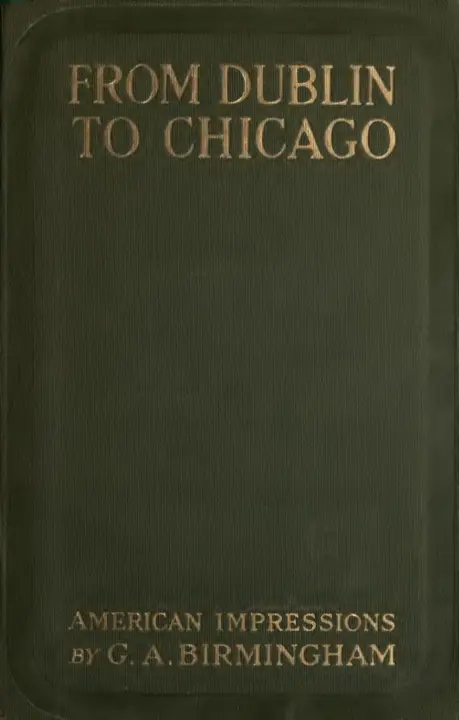
From Dublin to Chicago: Some Notes on a Tour in America
George A. Birmingham
THE CLASSIC COLLECTION · 1915
"Gossamer" by George A. Birmingham is a novel written in the early 20th century. The story revolves around Sir James Digby, an Irish disinherited gentleman, and his meeting with Michael Gorman, a passionate Irish patriot and journalist. The narrative explores themes of identity, national sentiment, and the complexities of human relationships against the backdrop of a transatlantic voyage. The opening portion of the book introduces us to Sir James and Gorman's discussions, where they delve into the emotional turmoil of a fellow Irishman, Carl Ascher, a banker. As the narrative unfolds, we learn about their backgrounds—Gorman’s fervent Irish nationalism contrasts with Sir James’s feelings of disconnection from his own heritage. Their voyage to America brings them into contact with Ascher, who is initially seasick but later expresses interest in the dynamics of their interactions. The opening chapters also set the stage for Gorman's ambition to engage with the wealthy Ascher, hinting at a business proposal that holds the potential for conflict and moral questioning within the context of financial dealings.
Introduction adapted from the source catalogue; source summaries may be automatically generated.
Free to read · English · 74,694 words · No account needed
MAKE TIME FOR A GOOD BOOK
On by default. Untick to stop anonymous reading totals. Each page counts after 10 seconds in view. How this works.
Anonymous counting is on unless you have switched it off.
I did not mean that. I am, indeed, pretty sure that if there were no Aschers, if Gorman succeeded in abolishing the class, neither the city clerk, nor his pretty wife, nor any one else in England would eat hothouse peaches. There would not be any. I am inclined to think that if Ascher were done away with there would not even be any tinned peaches. Tinned peaches come from California. Somebody grows them there. That man must be kept going, fed, clothed sufficiently, housed, while the peach trees grow. He must be financed. Somebody else collects the peaches, puts them into tins, solders air-tight lids on them, pastes labels round them. He works with borrowed money. Somebody packs the tins in huge cases, puts them in trains, piles them into ships, despatches them to London, getting his power to do these things in some mysterious way from Ascher.
“While she washes up the cups and saucers,” said Gorman, “he brings round that motor cycle.”
“Paid for,” I said, “in monthly instalments.”
“Probably,” said Gorman, “with a deposit of £25 to start with.”
“It’s Ascher,” I said, “who makes that possible.”
“It’s Ascher,” said Gorman, “who makes that necessary. If it were not for Ascher’s rake-off, the tax he levies on every industry, the machine could be bought right out for the original £25 and there would be no instalments to be paid.”
Possibly. But the tires of the machine were made of rubber. I remembered my visit to Para, the broad, steaming Amazon, the great ships crawling slowly past walls of forest trees, the pallid white men, the melancholy Indians. It may be possible to devise some other means of getting the precious gum from the Brazilian forest; but at present the whole business is dependent on Ascher.
We left that motor cycle behind us at last and sped faster along a stretch of road where the traffic was less dense.
“You notice,” said Gorman, “the way London is swallowing up the country. That was once a rural inn.”
I had observed what Gorman pointed out to me. Here and there along the road, a mile or so apart from each other, we came on old buildings, a group of cottages, a farm house, an inn. These were solidly built after the good old fashion. It had seemed wasteful to pull them down. The waves of the advancing tide of London reached them, passed them, swept beyond them, left them standing.
“Quite a few years ago,” said Gorman, “those houses stood in the middle of fields, and the people who lived in them ate the food that grew at their doors.”
“No tinned peaches,” I said, “no bicycles.”
Your reading position is saved on this browser. Take it to another device with a library code. Reading pages adapt to text, rather than matching a printed edition.
George A. Birmingham
George A. Birmingham
George A. Birmingham
George A. Birmingham
BEHIND THE BOOK
This eBook is for the use of anyone anywhere in the United States and most other parts of the world at no cost and with almost no restrictions whatsoever. You may copy it, give it away or re-use it under the terms of the Project Gutenberg License included with this eBook or online at www.gutenberg.org. If you are not located in the United States, you will have to check the laws of the country where you are located before using this eBook. Read the source licence.
The original source file, including credits and licence, is retained by this library. Request an original-format copy at no charge. Please include the book title and Project Gutenberg identifier #24394.
KEEP YOUR CURIOSITY GOING
Coulson Kernahan

Maurice Baring
Frances Wright
Cécile Tormay

Frederic Jesup Stimson

W. H. P. (William Henry Pope) Jarvis