THE CLASSIC COLLECTION✦My diaries, being a personal narrative of events 1888-1914, Part 2 (1900-1914)CLASSIC FREE BOOKS
My diaries, being a personal narrative of events 1888-1914, Part 2 (1900-1914)
Wilfrid Scawen Blunt

THE CLASSIC COLLECTION · 1911
Gordon at Khartoum by Wilfrid Scawen Blunt. Explore this classic work in a free online edition. Subjects include Gordon, Charles George, 1833-1885; Generals -- Great Britain -- Biography; Sudan -- History -- 1821-1881; Egypt -- History -- British occupation, 1882-1936; Egypt -- Politics and government -- 1882-1952; Colonial administrators -- Sudan -- Biography. Read the locally hosted text below, adjust the reading display, and continue where you left off.
Introduction adapted from the source catalogue; source summaries may be automatically generated.
Free to read · English · 224,989 words · No account needed
MAKE TIME FOR A GOOD BOOK
On by default. Untick to stop anonymous reading totals. Each page counts after 10 seconds in view. How this works.
Anonymous counting is on unless you have switched it off.
This is interesting as a record of the incompatibility of temper and ideas existing between Gordon and Cromer six years before 1884. It explains indeed what would otherwise be inexplicable, the quarrel that broke out at once between them when Gordon returned to Cairo on his final mission.
It is not necessary to continue Gordon’s story of how he was played with on the earlier occasion by our Cairo diplomatists, but one scene which gives us an amusing glimpse of Lesseps, and at the same time of Gordon’s character, I will add: “The next morning,” he continues, “the 8th March at 9 I went to Lesseps en route to His Highness. Lesseps said, ‘See what Cherif Pasha has written to me.’ ‘Mon cher Vicomte, son Altesse le Khedive m’a chargé de vous présenter ses grands remerciments pour avoir accepté d’être sur la Commission d’Enquête et elle me prie d’ajouter que c’est ce qu’elle a toujours attendu d’un si ancien ami de Mehemet Ali et ses fils.’ This letter had been written before I saw Lesseps, and of course His Highness thanked him for being upon the Enquête without the four Commissioners of the Dette, which Lesseps declined to do except under certain conditions, so the letter was written to Lesseps thanking him for services which the Khedive was furious about. Lesseps said, looking at his pretty young wife of twenty-two, ‘I am off to Halowan and shall not be back until night. I have telegraphed to my Government to ask permission to be on the Enquête with you. Here is a copy of the telegram, will you give it to His Highness?’ He gave it over to me to read. I read it, it was thus: ‘Son Altesse le Khedive m’a prié de me joindre avec M. Gordon et les Commissionaires de la Caisse pour faire une Enquête sur les finances d’Egypte, je demande permission.’ I said, ‘Oh! my dear old fellow M. Lesseps, this will never do.’ He said, ‘Well, anyway it is off, and I am off to Halowan and shall not be back to- night.’ Well, off I had to go with this telegram to Abdin. Cherif and Riaz Pasha were in the antechamber, drowsy and happily smoking. As I went in I saw a bald-headed ‘coot,’ the Consul-General of the Pays Bas, going in to His Highness. Cherif drowsily said, ‘Well, any news?’ I said, ‘No, only I have a telegram for His Highness from Lesseps.’ So Riaz and Cherif chatted away in Turkish till I saw the ‘coot’ go out and Cherif was called in. Suddenly Cherif came flying out, all drowsiness gone, and said, ‘Where is the telegram of Lesseps?’ I gave it him and then in came flying Pharaoh (the Khedive) with Cherif. Pharaoh threw himself on the sofa and said, ‘Je suis tout à fait bouleversé avec ce télégramme de Lesseps. C’est tout à fait contre mes désirs. Barrat! (l’esclave écrivain de son altesse) venez ici, dites à quelqu’un d’aller à Halowan et de dire à Lesseps de ne pas télégraphier à Paris,’ and then turning to me His Highness said, ‘I put the whole affair into your hands.’ Then, calling Barrat, he said, ‘Telegraph to Goschen, Gordon is charged with the whole affair, arrange with him.’ Consequently I telegraphed to Goschen, ‘I have recommended His Highness to suspend the payment of the next Coupon in order to pay the employés and meet pressing claims. I will arrange with you for the Commission of Inquiry into the finances.’ Goschen answered, ‘I will not look at you, the matter is in the hands of Her Majesty’s Government.’ I then wrote to His Highness and proposed that he should suspend the payment of the Coupon and pay the employés and pressing claims, that he should do it by decree and quote me. Throw all the blame upon me, saying if he did not like to do this I would myself write to Lord Derby, to say I had recommended His Highness to do so-and-so; that I did not ask Her Majesty’s Government to give any acquiescence to it, but merely to tell them if the Khedive did this, it was my fault. The Khedive hesitated and did not answer me, and shut himself up in his harem for two days and the game was lost. (There would have been no risk in this.) Vivian (English Consul-General), of course, was on the qui vive; he knew that some strong measure was in prospect, and telegraphed to Her Majesty’s Government, begging the same to authorize him to join the French Consul-General, to stop His Highness taking any sharp measures. Of course Vivian pointed out the Red Republican nature of your humble servant. Lord Derby, against anything abrupt, telegraphed to Vivian, who came to me and said, ‘I have a telegram; I will read it to you; but you are not to say anything about it until I have communicated it to His Highness, for it would not be proper.’ The telegram ran thus: ‘You are authorized in conjunction with your French colleague, to inform His Highness that Her Majesty’s Government trusts His Highness will do nothing without accordance with his creditors, and that Her Majesty’s Government are willing to send Rivers Wilson out to help him, and that Her Majesty’s Government think that Baring ought to be on the Inquiry.’ Vivian then said, ‘What will you recommend His Highness to do?’ I said, ‘I would recommend him to bow to Her Majesty’s Government.’ Vivian said, ‘What will he do?’ I said, ‘He might say I am sovereign and will do as I will.’ Vivian (who was a pretty black-eyed boy, and was put by General Fox under my care at the Royal Military Academy, and whom Ruck Keene kicked on the ankle when he was removed from that rough school) went home, and on the morrow went in great pomp to His Highness with the French Consul-General, saying on leaving, ‘C’est tout ce que nous avons à dire à votre altesse pour le moment.’ Of course my tongue was tied; but before they (the two Consuls- General) went to His Highness I wrote to Cherif Pasha, and said, hoping to take the wind out of their sails, ‘Tell His Highness if he is troubled, to ask Her Majesty’s Government for Rivers Wilson to come out and help me’; and I added (for I had begun to see, with Pharaoh wavering, it was necessary for me to look to my retreat), ‘I will not act with any of the four Commissioners of the Dette.’ This also gave His Highness a reason for refusing Her Majesty’s Government’s recommendation, that Baring should be on the Commission of Inquiry, because he could quote my objections.
Your reading position is saved on this browser. Take it to another device with a library code. Reading pages adapt to text, rather than matching a printed edition.
Wilfrid Scawen Blunt
Wilfrid Scawen Blunt
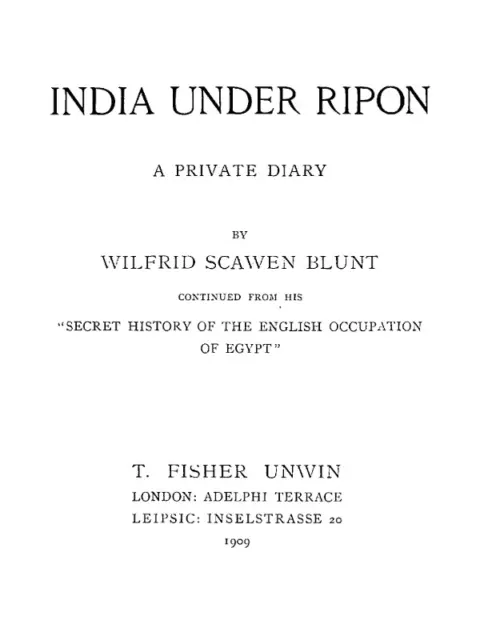
Wilfrid Scawen Blunt
Wilfrid Scawen Blunt
BEHIND THE BOOK
This eBook is for the use of anyone anywhere in the United States and most other parts of the world at no cost and with almost no restrictions whatsoever. You may copy it, give it away or re-use it under the terms of the Project Gutenberg License included with this eBook or online at www.gutenberg.org. If you are not located in the United States, you will have to check the laws of the country where you are located before using this eBook. Read the source licence.
The original source file, including credits and licence, is retained by this library. Request an original-format copy at no charge. Please include the book title and Project Gutenberg identifier #78995.
KEEP YOUR CURIOSITY GOING
Cécile Tormay

Moritz Busch
John L. Ransom
Frances Wright
Cécile Tormay

Mabel Potter Daggett