THE CLASSIC COLLECTION✦My diaries, being a personal narrative of events 1888-1914, Part 2 (1900-1914)CLASSIC FREE BOOKS
My diaries, being a personal narrative of events 1888-1914, Part 2 (1900-1914)
Wilfrid Scawen Blunt

THE CLASSIC COLLECTION · 1911
Gordon at Khartoum by Wilfrid Scawen Blunt. Explore this classic work in a free online edition. Subjects include Gordon, Charles George, 1833-1885; Generals -- Great Britain -- Biography; Sudan -- History -- 1821-1881; Egypt -- History -- British occupation, 1882-1936; Egypt -- Politics and government -- 1882-1952; Colonial administrators -- Sudan -- Biography. Read the locally hosted text below, adjust the reading display, and continue where you left off.
Introduction adapted from the source catalogue; source summaries may be automatically generated.
Free to read · English · 224,989 words · No account needed
MAKE TIME FOR A GOOD BOOK
On by default. Untick to stop anonymous reading totals. Each page counts after 10 seconds in view. How this works.
Anonymous counting is on unless you have switched it off.
“Then I showed him Pollen’s letter, communicating Lord Ripon’s message about agricultural banks in India and the Oxford examinations. He said that I might tell Lord Ripon that he was favourable about both matters, and especially about the agricultural banks, and that if he would draw him up a scheme on paper he would support it. But he had not the necessary knowledge on either subject to push it without assistance, nor the time to get the questions up. He seemed pleased at Lord Ripon’s having communicated with him. I also mentioned the case of Suchait Singh and the Pundit of Vizianagram, and he told me to send the details to Moore, his secretary. About Lepel Griffin he said he could not quarrel with him, but he was writing to him by this mail, and would suggest to him that he should make me some apology.
“Then we sent for Jemal-ed-Din, whom Randolph received with great politeness and made him sit by him on the sofa. They talked in French, but I soon perceived that Randolph knew very little of the language, and I had to translate for them. Randolph first asked about the Mahdi’s death, whether it was true, and Jemal-ed-Din said he thought not, but even if true it would make little difference, as the Soudanese would choose a successor. Randolph asked who that would be. Jemal-ed-Din: ‘It would not be Osman Digna, but one of the Mahdi’s companions, a man of religion; Osman Digna would be the General but not the Khalifa. All would be done as on the occasion of Mohammed’s death, when the most religious man was chosen.’ Randolph then asked about Afghanistan, what the Amir’s position was. And Jemal-ed-Din’s account was briefly this: Abd-el-Rahman, he said, was a good general but he was not a great politician, though neither was he a fool. He had the majority of the Afghans with him, but nothing would be easier than to get up revolts against him. The Afghans were simple-minded people—peuple naïf—ignorant of politics and always ready to fight. The Russians might make a revolt through Ishak Khan or a dozen others of the sons of Shere Ali and the princely house. Nothing would be easier. The Russians had no intention of fighting the Afghans this year, but would make friends with some of these princes and raise disturbances. They would represent themselves as allies against the English and would promise the provinces of Cashmere and Peshawar if India revolted. The Afghans would believe them. Randolph: ‘Do the Afghans hate us more than the Russians?’ Jemal-ed-Din: ‘The Russians have done no harm to the Afghans. The English have made three wars on them.’ Randolph: ‘But do not you consider that the Russians have done more harm to Islam than we have done?’ Jemal-ed-Din: ‘The Russians have swallowed up a few principalities, the Crimea, Circassia, and among the Turcomans, but England has destroyed the great empire at Delhi, it has invaded Egypt, the Soudan.’ Randolph: ‘It was the Mahrattas that destroyed the Mogul Empire.’ Jemal-ed-Din: ‘The Mahrattas came and went. Nadir Shah invaded India, but he was a Moslem. You remained and you destroyed the Empire. There are three reasons why the Mohammedans of India have hated you more than the Russians: Firstly, because you destroyed the Empire of Delhi; secondly, because you give no salaries to the imams and muezzins and keepers of the mosques, which the Russians are careful to do; and you have resigned the Wakaf property and do not repair the sacred buildings.’ Randolph: ‘We repair some of the mosques.’ Jemal- ed-Din: ‘Only when they are works of art, not for the sake of religion. And, thirdly, because you give no high offices of rank in the army to Mohammedans. The Russians do this.’ Randolph: ‘There are many Mohammedans in the highest offices in the Native States of India.’ Jemal-ed-Din: ‘The Native States are not British India. What the belly has not swallowed it does not digest.’ (Here we laughed.) Randolph: ‘Then you think England a greater danger to Mohammedans than Russia?’ Jemal-ed-Din: ‘I do not say so; I have spoken of the past. England has done more harm to us than Russia, but Russia is now more dangerous. If the Russians remain, I do not say at Penjdeh or Tulfikar or Merushak, but at Merv still five years, there will be no more Afghanistan and no more Persia and no more Anatolia and no more India. All will have been swallowed. They will leave Penjdeh and the rest, but it will matter nothing; they will remain in Merv.’ Randolph: ‘This is true. But what would you have us do?’ Jemal-ed-Din: ‘You must make an alliance with Islam, with the Afghans, the Persians, the Turks, the Egyptians, the Arabs; you must drive the Russians back out of Merv to the Caspian Sea. To make friends with the Mohammedans you must leave Egypt. There is no danger for Egypt from foreign nations. You hold Cyprus, you hold Aden, what do you fear? Nor from the Mahdi. With a Mohammedan government in Egypt the Mahdi is not a danger. Then you must make alliance with the Mohammedans, who would believe you their friend.’ Randolph: ‘Could we send troops or officers to Afghanistan to help the Afghans against Russia?’ Jemal-ed-Din: ‘If you send troops, as for instance to Candahar, even with the Amir’s consent, it will be the right of any Moslem to go to the top of a hill and raise a revolt against you. He would say you were come under pretence of a friendship to take possession; and all would believe him. You might, however, send officers, a few officers, for these could not take possession. They would be servants of the Amir. But remember, if the Russians stay five years at Merv it will be too late; you should attack them not through Afghanistan but by the other side; then the Mollahs would preach a jehad to join you against the Russians.’
Your reading position is saved on this browser. Take it to another device with a library code. Reading pages adapt to text, rather than matching a printed edition.
Wilfrid Scawen Blunt
Wilfrid Scawen Blunt
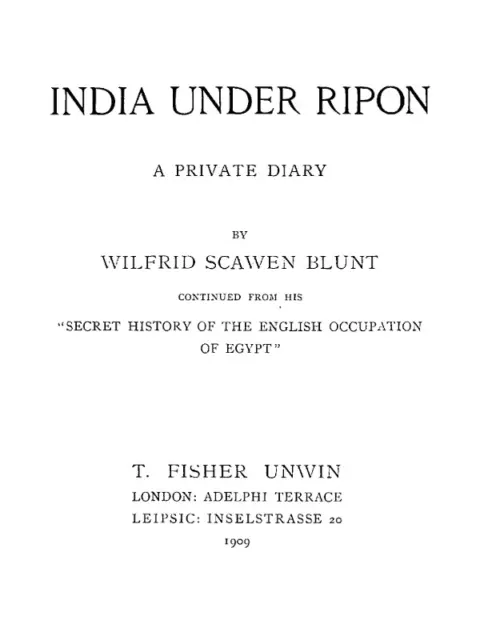
Wilfrid Scawen Blunt
Wilfrid Scawen Blunt
BEHIND THE BOOK
This eBook is for the use of anyone anywhere in the United States and most other parts of the world at no cost and with almost no restrictions whatsoever. You may copy it, give it away or re-use it under the terms of the Project Gutenberg License included with this eBook or online at www.gutenberg.org. If you are not located in the United States, you will have to check the laws of the country where you are located before using this eBook. Read the source licence.
The original source file, including credits and licence, is retained by this library. Request an original-format copy at no charge. Please include the book title and Project Gutenberg identifier #78995.
KEEP YOUR CURIOSITY GOING
Cécile Tormay

Moritz Busch
John L. Ransom
Frances Wright
Cécile Tormay

Mabel Potter Daggett