Pioneers of the Old Southwest: a chronicle of the dark and bloody ground
Constance Lindsay Skinner
THE CLASSIC COLLECTION · 1917
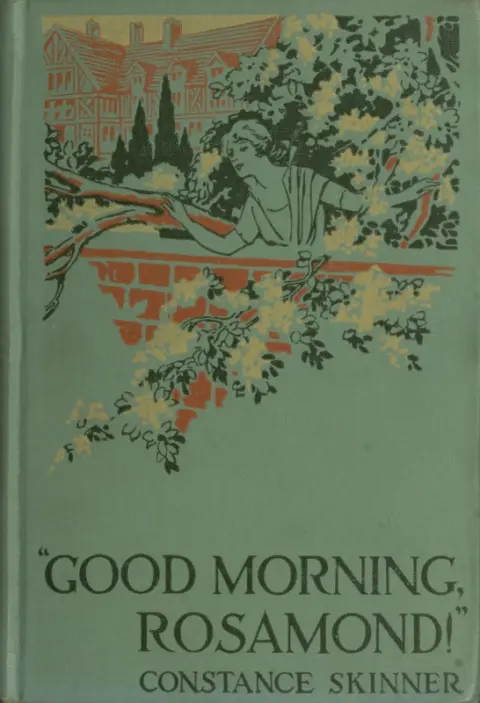
"Good-Morning, Rosamond!" by Constance Lindsay Skinner is a novel written in the early 20th century. The story centers around Rosamond Mearely, a young widow and the wealthiest woman in the small hamlet of Roseborough, as she navigates the complexities of her new life after the passing of her husband, Hibbert Mearely. The book explores themes of societal expectations, personal identity, and the quest for freedom and happiness. At the start of the novel, readers are introduced to Rosamond's daily life, characterized by strict domestic routines managed by her two long-serving housemaids, Amanda and Jemima Frigget. As Rosamond prepares for her morning routine, tensions arise with her staff regarding her lateness, which uncovers social dynamics and expectations related to her late husband's status. The opening scenes reveal Rosamond's inner thoughts about her past marriage, as well as her determination to embrace her youth and beauty on what she deems her one "Wonderful Day." Amidst her reflections, she eagerly anticipates a future filled with love and adventure, hinting at her desire for liberation from the constraints of her high-society life.
Introduction adapted from the source catalogue; source summaries may be automatically generated.
Free to read · English · 82,509 words · No account needed
MAKE TIME FOR A GOOD BOOK
On by default. Untick to stop anonymous reading totals. Each page counts after 10 seconds in view. How this works.
Anonymous counting is on unless you have switched it off.
“Whereas, with us, the matter is not so simple. Conceive of a half battalion in livery to find the boots--under the regulations of the Secret Service Department. Two detectives to unravel the laces. Two gentlemen, from the Interstate Commission of Harmony-Producers, to bring the royal feet and royal boots into juxtaposition. Four to incase the feet in the boots. And, say, half a dozen more to attend to lacing and polishing. So with everything. An army of chemists to test one’s toilet waters and perfumes every time one desires a sniff--for fear some anarchist spy may have dropped poison into them. It becomes irksome. And, at times, we steal forth secretly, climb the palace palings, leap across the orchard, open the front gate of our kingdom and stroll forth, incognito--as you see.”
Corinne gasped “Isn’t it thrilling?”
“Oh, yes,” Rosamond breathed.
Mrs. Witherby was anxious to retrieve herself, feeling that her first essay had not resulted greatly to her honour. She smiled respectfully and began again.
“I hope Your Highness will not think me impertinent--but is Your Highness not related to most of the crowned heads of Europe?”
“You perceive resemblances?”
“Oh, strong ones!” She tossed her head, delighted with herself for this show of intelligence. “Particularly to the Czar of Russia--and the King of Spain. Also Emperor William--about the eyes. Those are the royalties who are most often photographed in the papers. But I daresay Your Highness resembles all the others, too. I believe you are all related? One hears that said.”
“We sprang from a common parent, madam.”
Mr. Marks looked about, proudly, and said:
“Hi think ’e looks like the King of Hengland.” After a brief pause, he added patronizingly, “though the hothers is well enough in their way.”
“I trust Your Highness does not find us deficient in etiquette,” said Mrs. Witherby. “My late husband’s mother once knew a London lady who had been to Court.”
“Oh mamma, I’m sure His Highness doesn’t care about etiquette, or he wouldn’t run away incog,” Corinne expostulated.
“Every Court has its rules of etiquette, my dear, and even royalty must
conform to them.”
Corinne looked disappointed.
“Oh, does Your Highness have to do just so--as we do?”
He gave her an affectionate, whimsical glance, and said:
“Yes; but when I put on my crown and climb upon my throne, I write my own rules of Just So. And, what is more, I make everyone conform to them. It is not difficult. Because, when they once understand, they wish to conform; and no other rules will do for them at all.”
“They must be wonderful laws that people want to keep,” Mabel thought.
Your reading position is saved on this browser. Take it to another device with a library code. Reading pages adapt to text, rather than matching a printed edition.
Constance Lindsay Skinner
BEHIND THE BOOK
This eBook is for the use of anyone anywhere in the United States and most other parts of the world at no cost and with almost no restrictions whatsoever. You may copy it, give it away or re-use it under the terms of the Project Gutenberg License included with this eBook or online at www.gutenberg.org. If you are not located in the United States, you will have to check the laws of the country where you are located before using this eBook. Read the source licence.
The original source file, including credits and licence, is retained by this library. Request an original-format copy at no charge. Please include the book title and Project Gutenberg identifier #57254.
KEEP YOUR CURIOSITY GOING
Coulson Kernahan

Maurice Baring
Frances Wright
Cécile Tormay

Frederic Jesup Stimson

W. H. P. (William Henry Pope) Jarvis