Pioneers of the Old Southwest: a chronicle of the dark and bloody ground
Constance Lindsay Skinner
THE CLASSIC COLLECTION · 1917
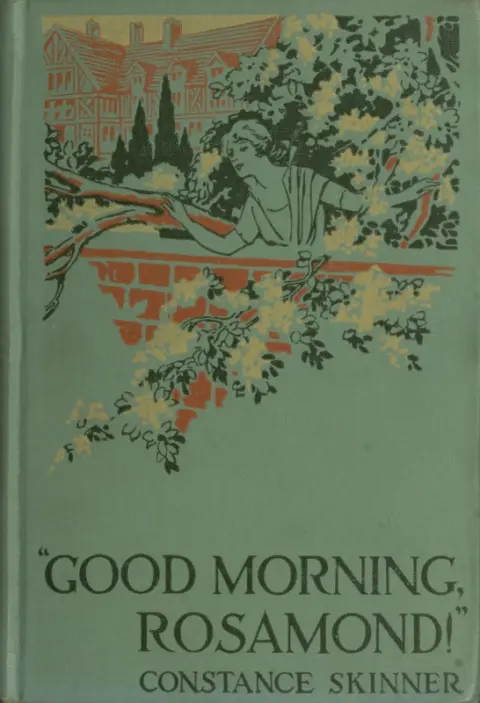
"Good-Morning, Rosamond!" by Constance Lindsay Skinner is a novel written in the early 20th century. The story centers around Rosamond Mearely, a young widow and the wealthiest woman in the small hamlet of Roseborough, as she navigates the complexities of her new life after the passing of her husband, Hibbert Mearely. The book explores themes of societal expectations, personal identity, and the quest for freedom and happiness. At the start of the novel, readers are introduced to Rosamond's daily life, characterized by strict domestic routines managed by her two long-serving housemaids, Amanda and Jemima Frigget. As Rosamond prepares for her morning routine, tensions arise with her staff regarding her lateness, which uncovers social dynamics and expectations related to her late husband's status. The opening scenes reveal Rosamond's inner thoughts about her past marriage, as well as her determination to embrace her youth and beauty on what she deems her one "Wonderful Day." Amidst her reflections, she eagerly anticipates a future filled with love and adventure, hinting at her desire for liberation from the constraints of her high-society life.
Introduction adapted from the source catalogue; source summaries may be automatically generated.
Free to read · English · 82,509 words · No account needed
MAKE TIME FOR A GOOD BOOK
On by default. Untick to stop anonymous reading totals. Each page counts after 10 seconds in view. How this works.
Anonymous counting is on unless you have switched it off.
“Hif it was my juty Hi’d ’ave ’ad ter kill ’im.” He put the straw hat on his head with an air.
“Duty! How dare you shoot a man just because you see him alone on the
road at night!”
“Yes, ma’am. But, you see, ma’am, constable Gardner and me, we was sent out to-night to look for a tramp. That’s hon account of some busybody thinkin’ they seen ’im ’ereabouts this very hevenin’. So they tells the chief, and ’e sends us, me an’ Gardner,--my nyme bein’ Marks, Halfred Marks, Halfred Marks” (he touched his hat-brim to each in turn). “An’ so we comes beatin’ hit along hup the valley. An’ w’en Hi seen ’im on the porch....”
Rosamond made an exclamation of alarm.
“You--you saw...?”
“Be careful,” her patient whispered.
“Yes, ma’am. I seen ’im standin’ on the railin’ as I come up the road. And, considerin’ the time o’ night, hit looked queer--to me.” His expression defied them to criticise his angle of vision.
“Why--why ...” Mrs. Mearely began, feeling for words that eluded her. The vagabond came to her aid.
“Naturally--naturally--sergeant....”
The Law’s regard became more affable.
“Hi hain’t the sergeant, sir--thankin’ you kindly jest the same. Seein’ a man on the railin’ at that time o’ night....”
She interrupted, nervously:
“It couldn’t have been so very late....”
“Sh!” came the warning from behind her.
Slowly and laboriously, Mr. Marks took from his pocket a large, open-faced silver watch, attached to a short loop and bow of bright, cherry-coloured ribbon.
“Three-twelve; nigh on three-fifteen,” he said, after a prolonged
examination.
“But it was not three, then!”
“Hi didn’t say three, ma’am. Hi said three-twelve. Three-thirteen it is now, bein’ as time an’ tide waits for no man. Must a’ben two-thirty, any’ow--nearer two forty-five.” Preparing to return the watch to his pocket, he noticed the other man gazing at its cherry bow. “Hi see you’re hadmirin’ of this. It’s one of Mrs. Marks’s ’appy touches. She ‘as a good bit of sentiment, Mrs. Marks ’as--on haccount of marryin’ late in life. Hi recommends Mrs. Marks as a wife; or hany spinster that’s standin’, so to speak, hon the doorsill of the lonesome forties, for, w’en they gets took up by a man, they’re very grateful an’ supine. So as Hi was sayin’, seein’ ’im on the railin’ at that time of night, Hi thought Hi’d see wot was hup!”
“Naturally, officer: of course.”
Your reading position is saved on this browser. Take it to another device with a library code. Reading pages adapt to text, rather than matching a printed edition.
Constance Lindsay Skinner
BEHIND THE BOOK
This eBook is for the use of anyone anywhere in the United States and most other parts of the world at no cost and with almost no restrictions whatsoever. You may copy it, give it away or re-use it under the terms of the Project Gutenberg License included with this eBook or online at www.gutenberg.org. If you are not located in the United States, you will have to check the laws of the country where you are located before using this eBook. Read the source licence.
The original source file, including credits and licence, is retained by this library. Request an original-format copy at no charge. Please include the book title and Project Gutenberg identifier #57254.
KEEP YOUR CURIOSITY GOING
Coulson Kernahan

Maurice Baring
Frances Wright
Cécile Tormay

Frederic Jesup Stimson

W. H. P. (William Henry Pope) Jarvis