Pioneers of the Old Southwest: a chronicle of the dark and bloody ground
Constance Lindsay Skinner
THE CLASSIC COLLECTION · 1917
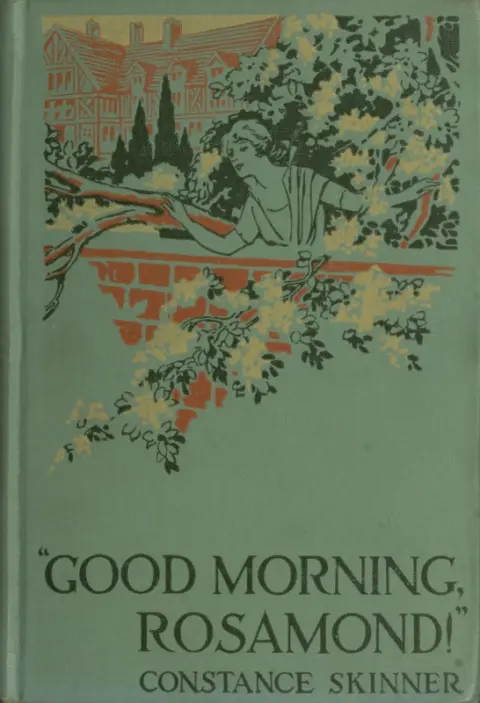
"Good-Morning, Rosamond!" by Constance Lindsay Skinner is a novel written in the early 20th century. The story centers around Rosamond Mearely, a young widow and the wealthiest woman in the small hamlet of Roseborough, as she navigates the complexities of her new life after the passing of her husband, Hibbert Mearely. The book explores themes of societal expectations, personal identity, and the quest for freedom and happiness. At the start of the novel, readers are introduced to Rosamond's daily life, characterized by strict domestic routines managed by her two long-serving housemaids, Amanda and Jemima Frigget. As Rosamond prepares for her morning routine, tensions arise with her staff regarding her lateness, which uncovers social dynamics and expectations related to her late husband's status. The opening scenes reveal Rosamond's inner thoughts about her past marriage, as well as her determination to embrace her youth and beauty on what she deems her one "Wonderful Day." Amidst her reflections, she eagerly anticipates a future filled with love and adventure, hinting at her desire for liberation from the constraints of her high-society life.
Introduction adapted from the source catalogue; source summaries may be automatically generated.
Free to read · English · 82,509 words · No account needed
MAKE TIME FOR A GOOD BOOK
On by default. Untick to stop anonymous reading totals. Each page counts after 10 seconds in view. How this works.
Anonymous counting is on unless you have switched it off.
“I think,” he said, “that on the whole it might be as well to play in turn. Of course, I make no rule”--a deprecating gesture toward his bristling partner forbade her to think he would presume to make rules for her--“but it is generally done, I believe.” He rose, beamed benignly. “Your card.” He passed it to her.
Corinne tossed her head at her mother and led the round.
When her turn came, Mrs. Witherby threw down the knave of hearts and
gathered up the cards.
“Trumps! Our trick, doctor,” she cried victoriously. Her success was greeted with a profound silence, broken at last by Dr. Wells; he coughed. Andrews, seeing that Corinne was about to express herself with her customary frankness, flung himself into the breach.
“Er--you overlooked--oh, quite by accident, of course--er--you have the three of clubs in your hand.”
“I refuse to play with any one--any one--who is capable of looking at
my hand.”
The sensitive Mr. Andrews turned the peony-red which is specially inflicted upon sandy, blond men.
“I did not look at your hand,” he protested, with mild heat. “You played the three of clubs when you led off, just now, in your daughter’s place--oh, by mistake, of course. It is still in your hand.”
“Your card,” the doctor murmured, politely handing it to her. Corinne
gathered up the trick.
“Another round finishes the game. Come on, Mrs. Witherby. You must put your best foot forward and cast these young people into the shade,” Dr. Wells urged in his cheeriest tones, obviously endeavouring to banish the sour gloom that had settled on his partner’s spirit. A darting, knifelike glance of her eyes told that he had failed.
“My foot is not of such dimensions as to cast a shade over two persons,” sourly. “I don’t understand your allusion.”
Again the peace-loving Andrews flew like the dove upon the storm.
“Of course, Mrs. Witherby, you will be one of Mrs. Lee’s breakfast party to-morrow?” he said, and thus gave Mrs. Lee the opportunity she needed. She had begun to wonder how she was to introduce her topic sympathetically in the discordant atmosphere of one of Mrs. Witherby’s “card-game humours.”
“Did I hear my name?” she asked, turning to them.
“I mentioned your breakfast party,” Andrews replied quickly. “It is to be at eleven o’clock, is it not?”
“Yes. But everyone is to be there by a quarter to eleven, so that we can be prompt in beginning.”
“To be sure. Ah. The breakfast party.” The Judge looked over his paper.
“Do tell us about it,” Mrs. Witherby interjected. “I am simply bored
with these cards.”
Your reading position is saved on this browser. Take it to another device with a library code. Reading pages adapt to text, rather than matching a printed edition.
Constance Lindsay Skinner
BEHIND THE BOOK
This eBook is for the use of anyone anywhere in the United States and most other parts of the world at no cost and with almost no restrictions whatsoever. You may copy it, give it away or re-use it under the terms of the Project Gutenberg License included with this eBook or online at www.gutenberg.org. If you are not located in the United States, you will have to check the laws of the country where you are located before using this eBook. Read the source licence.
The original source file, including credits and licence, is retained by this library. Request an original-format copy at no charge. Please include the book title and Project Gutenberg identifier #57254.
KEEP YOUR CURIOSITY GOING
Coulson Kernahan

Maurice Baring
Frances Wright
Cécile Tormay

Frederic Jesup Stimson

W. H. P. (William Henry Pope) Jarvis