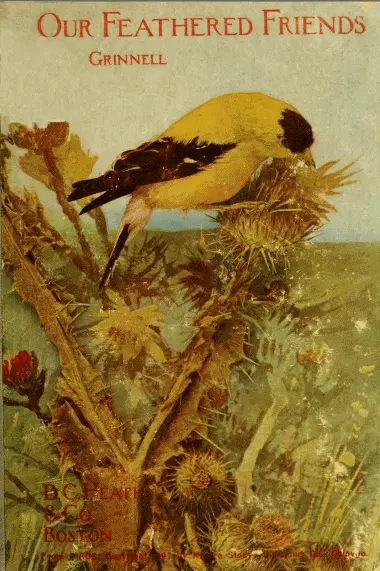
Our Feathered Friends
Elizabeth Grinnell & Joseph Grinnell

THE CLASSIC COLLECTION · 1901
"Gold Hunting in Alaska" by Joseph Grinnell is a narrative nonfiction work written in the late 19th century. The book recounts the true experiences of a group of gold-hunters who embark on a journey to Alaska during the gold rush of the late 1800s. The narrative provides insight into the lives of the men in the expedition, their hopes for gold, and the challenges they face in the harsh Arctic wilderness. The opening of the book introduces us to a party of twenty men, all driven by the allure of gold as they set sail for Kotzebue Sound in Alaska. Among the crew are colorful characters, including an undertaker-turned-miner and a doctor, who add depth to the group dynamic. The captain's humorous disposition contrasts with the serious nature of their quest, as they journey on the ship "Penelope," facing storms and sea sickness while sharing meals and camaraderie. The diary-like entries reveal both the hardships and the lighter moments of their travels, setting the stage for their adventures in search of fortune in an unforgiving territory.
Introduction adapted from the source catalogue; source summaries may be automatically generated.
Free to read · English · 70,169 words · No account needed
MAKE TIME FOR A GOOD BOOK
On by default. Untick to stop anonymous reading totals. Each page counts after 10 seconds in view. How this works.
Anonymous counting is on unless you have switched it off.
The hot weather is upon us at last and the last four days have been "sweaters." It is like an oven in the tent where I am writing. Dr. Coffin got us each a box of lemons and oranges on the "Alaska," just in, before he left. Jesse just brought in a big stew kettle full of ice-cold lemonade. Two bowls full just serve to make one want more. It tastes so good. We have had one mess of fresh potatoes and onions. We ate the latter raw with vinegar. It does a fellow good to be without such things a while, if not too long. He knows better how to appreciate them.
And now I record a fact that ought to make every face blush that turns an upward glance at Old Glory. The United States has passed "a law," permitting; saloons in Cape Nome. The natives get all they want and are killing each other when drunk. The native girl who mends some of our shoes, came in drunk, and when sober she was asked where she obtained the liquor. She gave the name of the man. Our foreman told him that he would report him to the captain of our squad, and was offered $50 by the criminal to "keep mum."
Aug. 5.--It is nothing now but "work" from 7 a. m. to 6 p. m. After ten hours of it one is more ready to rest than to write. I do not get a minute to so much as look at a bird except Sunday, which we have voted to observe. And then there is plenty to till in every minute when one comes along, including mending and washing. But I can scarcely help seeing the birds that fly past along the beach just as if to taunt me. Bands of Pacific kittiwakes pass up and down the surf on the lookout for herrings, and an occasional glaucus, or rather the Port Barrow gull, comes sailing along. A pair of Arctic terns feeding their full-grown young, afford almost the only bird notes of any kind. The young have a pleading, and yet harshly strong, succession of calls, and hover along the beach ever ready for the fish caught in the surf by the parent birds. The precision with which the terns can drop on a tiny fish or crustacean in the boiling surf is remarkable. And yet they seem so light on the wing and rise from the water with so little apparent exertion. Long-tailed jagers are common, coursing back and forth over the tundra or poising against the wind with fluttering wings much like a sparrow-hawk. Their long, pointed, streamer-like, central tail feathers distinguish them at almost any distance from the other jagers. They feed on meadow mice and caterpillars mostly, but their habit of forcing gulls to disgorge is of frequent notice. As there are no mud flats or marshes here the waders are scarce. I saw a godwit, probably the Pacific, flying back toward the interior. Several golden plover, which I have no doubt are rearing their young, are always on the back part of our claims. Their melodious, warbling call reminds me strongly of the robin. These plover show decided preference for the dryest tundra and uplands, and at Cape Blossom I found them on the hillsides in the interior of the peninsula. One day last week while I was at work in a prospect hole back of the bluff, three turnstones lit in the mossy hummocks within a few yards of me. They were very tame and remained an hour or more near me, feeding on insects or their larvæ. I have never taken this species (the common turnstone), although I saw it at Cape Prince of Wales and Cape Blossom, and tried hard to get some specimens. I took several of the black turnstones in Sitka in 1896, and also in San Clemente Island last year. Black-throated loons are numerous and are constantly seen and heard overhead as they fly back and forth from the lakes on the tundra to their feeding grounds out at sea. This is the only loon I have seen here, although I saw the red-throated at Kotzebue. I have kept special watch for the yellow-billed loon which is ascribed to this region, but have never identified it. The Eskimos make clothing of loon skins, and I have particularly examined such evidences, but have never found a scrap of yellow-billed loon skin. This species cannot therefore be very numerous. Land birds are very scarce here, probably on account of the awful barrenness of the region. I flushed one snowy owl back of camp one day, and the boys say they saw a hawk of some kind yesterday, I think from their description a gyrfalcon. I saw two juvenile Lapland longspurs yesterday feeding about the bluff, and also heard a yellow wagtail. I have noted a pair of juvenile redpolls several times along the bluff.
Your reading position is saved on this browser. Take it to another device with a library code. Reading pages adapt to text, rather than matching a printed edition.
Elizabeth Grinnell & Joseph Grinnell
Elizabeth Grinnell & Joseph Grinnell
Joseph Grinnell
BEHIND THE BOOK
This eBook is for the use of anyone anywhere in the United States and most other parts of the world at no cost and with almost no restrictions whatsoever. You may copy it, give it away or re-use it under the terms of the Project Gutenberg License included with this eBook or online at www.gutenberg.org. If you are not located in the United States, you will have to check the laws of the country where you are located before using this eBook. Read the source licence.
The original source file, including credits and licence, is retained by this library. Request an original-format copy at no charge. Please include the book title and Project Gutenberg identifier #65123.
KEEP YOUR CURIOSITY GOING
Wilfrid Scawen Blunt
Wilfrid Scawen Blunt

E. W. (Edgar Watson) Howe
Cécile Tormay

Moritz Busch
John L. Ransom