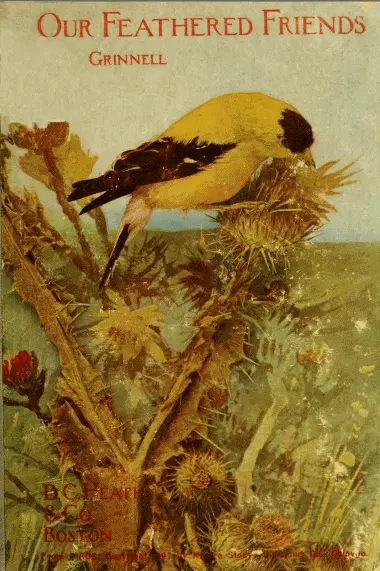
Our Feathered Friends
Elizabeth Grinnell & Joseph Grinnell

THE CLASSIC COLLECTION · 1901
"Gold Hunting in Alaska" by Joseph Grinnell is a narrative nonfiction work written in the late 19th century. The book recounts the true experiences of a group of gold-hunters who embark on a journey to Alaska during the gold rush of the late 1800s. The narrative provides insight into the lives of the men in the expedition, their hopes for gold, and the challenges they face in the harsh Arctic wilderness. The opening of the book introduces us to a party of twenty men, all driven by the allure of gold as they set sail for Kotzebue Sound in Alaska. Among the crew are colorful characters, including an undertaker-turned-miner and a doctor, who add depth to the group dynamic. The captain's humorous disposition contrasts with the serious nature of their quest, as they journey on the ship "Penelope," facing storms and sea sickness while sharing meals and camaraderie. The diary-like entries reveal both the hardships and the lighter moments of their travels, setting the stage for their adventures in search of fortune in an unforgiving territory.
Introduction adapted from the source catalogue; source summaries may be automatically generated.
Free to read · English · 70,169 words · No account needed
MAKE TIME FOR A GOOD BOOK
On by default. Untick to stop anonymous reading totals. Each page counts after 10 seconds in view. How this works.
Anonymous counting is on unless you have switched it off.
We are a jolly crowd and no one would believe us to be disappointed gold-hunters. The main occupation of this branch of the L. B. A. M. & T. Co. at present is bird-nesting. I hope we have to stay here two weeks Day and night are all the same to us nowadays. I seldom get to bed before one a. m., and am up for breakfast at eight. The snow is beginning to stay this evening and the landscape is whitening. This is such weather as the old Arctic explorers met with all summer when they suffered so much from exposure, but a warm, dry tent like ours, with plenty of wood, keeps us comfortable and very far from martyrs to the "cause." The winds are very chilly, and I really suffered more from cold last night as we were sailing up the river to camp than I did all last winter. It is hard to keep one's feet dry. If I wear hip boots I am sure to step into some hole in a swamp and get them full. One time I went in to my waist by surprise when I was wading in the edge of a pond after a grebe's nest. For an instant I was deprived of speech, which was a great hardship. The ice is getting "rotten" rapidly, with the heavy winds breaking it up.
Kowak Delta, Sunday. June 25.--I am sitting on a heap of spruce boughs before an open fire in the woods. There is a heavy wind blowing and the tents and steamer at the river bank are altogether too airy. This is a much more sheltered and comfortable spot. We have been at this camp two weeks, but will probably pull out to-morrow and go down to the mouth of the river, and, as soon as the weather is favorable, go across the dreaded Holtham Inlet and on to the Mission. The launch "Iowa" reports the ice breaking up at the river mouth and moving out. For a while there was quite a large community of tents along the river each side of ours, but they have all started down now. The "Agnes Boyd" passed us, having been laid up on a bar several days. She brought the sad news of the death of Jack Messing, one of the San Jose crew of the Hanson Camp. He was found dead in his bed on the steamer. Five other men were sleeping with him, but noticed nothing unnatural until they attempted to arouse him for breakfast. Jack was a sociable, good-hearted fellow, and many were the pleasant visits exchanged between him and members of our camp last winter. It is reported that an Indian shot two white men over on the Selawik this spring. As the natives tell the story, the Indian was entirely justified. They forced him to mend a sled at the muzzle of a revolver, and scared him so that he finally tried to run away. They picked up rifles and started after him. But he got behind a tree with his own rifle and anticipated them to the number of one man. Many men are still crippled with the scurvy. On the Pick River fifty-two men out of sixty were down with black-leg. The schooner "Life" wintered near Selawik Lake with nine men aboard. Missionary Samms received word by the Eskimos that these men were sick with the scurvy and were helpless. So he set out to their aid. He returned a few days ago, reporting that five out of the nine had died and the other four were recovering. It is an awful disease, and many more have perished from that cause than from disaster or accident. It is strange that our company has escaped so far all such mishaps, but we are not out of danger yet. As we see them, the general run of people are impatient to get home, are cross and quarrelsome. Many are the "scraps" and differences among companies. It is a common thing to hear men cursing each other bitterly over such trivialities as loading a boat or setting up a tent. Sometimes partners will divide their supplies, even breaking a spoon or knife in two to "make it even." I am glad to say that our crowd is remarkably free from such things. The usual sounds are of singing and joviality. The doctor and I have frequent friendly word fights over such topics as, "Which way the wind blows to bring rain." whether a "light object floats down stream as fast as a heavy one;" or, "how close to the wind we can sail the boat." But if there Is one of us assailed on any point by anyone else we both agree at once, and bring consternation to the ranks of the enemy. Someone made the statement the other day that a razor becomes sharper if left for a while unused, and every man except the doctor and myself was of the same mind. Think of such a tradition in this enlightened age! Several maintained that for that reason they kept two razors, using them alternate weeks. When we especially feel the need of mental exercise, the doctor and I argue on physical and mental evolution, and on this subject the other boys let us alone for good reasons.
Your reading position is saved on this browser. Take it to another device with a library code. Reading pages adapt to text, rather than matching a printed edition.
Elizabeth Grinnell & Joseph Grinnell
Elizabeth Grinnell & Joseph Grinnell
Joseph Grinnell
BEHIND THE BOOK
This eBook is for the use of anyone anywhere in the United States and most other parts of the world at no cost and with almost no restrictions whatsoever. You may copy it, give it away or re-use it under the terms of the Project Gutenberg License included with this eBook or online at www.gutenberg.org. If you are not located in the United States, you will have to check the laws of the country where you are located before using this eBook. Read the source licence.
The original source file, including credits and licence, is retained by this library. Request an original-format copy at no charge. Please include the book title and Project Gutenberg identifier #65123.
KEEP YOUR CURIOSITY GOING
Wilfrid Scawen Blunt
Wilfrid Scawen Blunt

E. W. (Edgar Watson) Howe
Cécile Tormay

Moritz Busch
John L. Ransom